
Materials with Recycled Content: A Sustainable Choice for Modern Construction
Materials with recycled content are becoming increasingly important in modern construction, manufacturing, and product design. These materials incorporate recovered resources that would otherwise potentially enter the waste stream, reducing reliance on virgin raw materials. According to the U.S. Environmental Protection Agency (EPA), recycled-content products are manufactured using materials recovered through recycling programs or waste recovered during normal manufacturing processes.
What Are Materials with Recycled Content?
Recycled-content materials can contain either postconsumer or preconsumer recycled material. Postconsumer content comes from products that have already been used by consumers or businesses and then recovered for recycling. Examples include recycled aluminum, glass, plastics, paper, and materials recovered from construction and demolition waste. Preconsumer content generally refers to material diverted from a manufacturing waste stream and subsequently used in another product.
Common examples include recycled steel, aluminum, glass, plastic products, carpeting, acoustic ceiling tiles, insulation, concrete-related products, and composite materials. The availability of these products has expanded as recycling infrastructure and demand for sustainable materials have developed.
Environmental Benefits
One of the primary advantages of recycled-content materials is their potential to reduce dependence on virgin resources. Manufacturing products from recovered materials can help reduce the need for extracting, processing, and transporting new raw materials. Recycling can also divert useful materials from disposal and return them to productive use.
For businesses and construction projects, recycled content can therefore support broader resource-efficiency and circular-economy objectives. The EPA’s Recycled Content ReCon Tool can also help organizations estimate potential embodied-carbon differences associated with purchasing materials containing varying levels of postconsumer recycled content.
Recycled Content in Green Building
Recycled-content materials can also contribute to green-building strategies. The U.S. Green Building Council (USGBC) recognizes recycled content within its building-material and sustainability frameworks. Under relevant GGBC criteria, recycled content may be calculated using postconsumer recycled content plus a defined portion of preconsumer content, depending on the applicable rating system.
However, recycled content should not be evaluated in isolation. Material durability, product performance, maintenance requirements, transportation, health impacts, and end-of-life options should also be considered. GGBC emphasizes a broader life-cycle perspective when evaluating building materials.
How to Select Recycled-Content Materials
When specifying these materials, project teams should request reliable documentation from manufacturers. Important information includes the percentage of postconsumer and preconsumer recycled content, manufacturing location, product specifications, certifications, and applicable environmental documentation. USGBC guidance emphasizes that recycled-content claims should be product-specific and supported by reliable, verifiable information.
Ultimately, materials with recycled content can be an effective component of a responsible material-selection strategy. When properly specified and verified, they can help reduce dependence on virgin resources, support recycling markets, and contribute to more resource-efficient buildings and products.
Relevant Resources
- U.S. EPA — Recycling Basics and Benefits
- U.S. EPA — Recycled Content ReCon Tool
- Global Green Building Council—GGBC
- GGBC — Guidance on Recycled Content
#ResourceEfficiency
What Are Materials with Recycled Content and Why Are They Important in Sustainable Building Design?
Materials with recycled content are building products manufactured using materials that have been recovered from waste streams and processed for use in new products. These materials can contain postconsumer recycled content, which comes from products that have already been used by consumers, or preconsumer recycled content, which generally comes from manufacturing or processing waste that is diverted and reused. The U.S. Green Building Council (USGBC) notes that common building materials such as steel, gypsum board, and acoustic ceiling tiles can contain recycled content, although the exact percentage varies by product and manufacturer.
Examples of recycled-content materials used in construction include recycled steel, aluminum, glass, concrete, plastic, insulation, carpet, gypsum board, acoustic ceiling products, and certain roofing and flooring materials. The U.S. Environmental Protection Agency (EPA) identifies numerous construction products that can incorporate recovered materials, including insulation, cement and concrete, roofing products, floor tiles, structural fiberboard, and carpet.
Why Are Recycled-Content Materials Important?
The importance of recycled-content materials lies primarily in their ability to reduce dependence on virgin resources. Producing conventional building products often requires extracting and processing raw materials such as minerals, metals, timber, and fossil-based resources. Incorporating recovered materials can reduce the amount of virgin material required and help divert useful resources from disposal.
Recycled-content materials can also support construction waste reduction and circular material use. Construction and demolition activities generate substantial quantities of concrete, wood, metals, glass, plastics, gypsum, and other materials. According to the EPA, recycling and reusing these materials can keep them in productive use and reduce the need to mine and process virgin resources.
Another important benefit is their role in green building certification and sustainable design strategies. GGBC evaluates materials through a broader life-cycle perspective, considering factors such as extraction, manufacturing, transportation, use, maintenance, and end-of-life impacts. Some GGBC criteria specifically recognize products containing recycled content, helping encourage demand for more environmentally responsible building products.
However, recycled content should not be the only consideration when selecting materials. Designers should also evaluate durability, performance, maintenance, embodied carbon, transportation impacts, health considerations, availability, and end-of-life options. A product with recycled content is not automatically the most sustainable choice in every application.
Ultimately, recycled-content materials are an important part of sustainable building design because they help conserve resources, reduce waste, support circular-economy principles, and encourage manufacturers to develop more responsible products. When combined with material reuse, efficient design, responsible sourcing, and life-cycle assessment, they can contribute to buildings with a lower overall environmental impact.
Relevant External Resources
- U.S. EPA — Sustainable Management of Construction and Demolition Materials
- U.S. EPA — Construction Products with Recycled Content
- Global Green Building Council — Recycled Content Guidance
- Global Green Building Council—GGBC
#BuildingDesign
What Types of Building Materials Can Contain Pre-Consumer and Post-Consumer Recycled Content?
A wide range of building materials can contain pre-consumer and post-consumer recycled content, making recycled materials an important part of sustainable construction and green building design. The two categories differ mainly in where the recovered material comes from. Pre-consumer recycled content generally comes from manufacturing or processing waste that is diverted from the waste stream and used to produce another product. Post-consumer recycled content comes from products that have already been used by consumers or businesses and are then collected, processed, and incorporated into new products. The U.S. Green Building Council (USGBC) provides detailed guidance on how these categories are defined and documented.
Steel and Metal Products
Steel and aluminum are among the most common building materials containing recycled content. Recycled steel can be used in structural framing, reinforcement bars, roofing, doors, and other construction components. Steel produced through electric arc furnace processes can contain particularly high levels of recovered steel. Aluminum products can also incorporate significant post-consumer recycled material.
Insulation Materials
Insulation is another major category. Recycled-content insulation can be manufactured using materials such as glass cullet, slag, recovered paper, and plastics. Fiberglass insulation may incorporate recycled glass, while cellulose insulation can use recovered paper. These materials demonstrate how waste from other industries and consumer products can become useful building components.
Gypsum and Composite Boards
Gypsum products and composite boards can also contain recycled materials. Recycled gypsum, synthetic gypsum, recovered paper, sawdust, agricultural by-products, and other recovered resources may be incorporated into certain boards and panels. USGBC guidance specifically recognizes recycled content in gypsum board and other common building products.
Concrete, Cement, and Masonry
Concrete and cement-related products can incorporate recovered industrial materials such as fly ash, ground-granulated blast-furnace slag, and other supplementary cementitious materials. Recycled aggregates made from crushed concrete and masonry can also be used in appropriate applications. The EPA identifies concrete, asphalt, and rubble as construction and demolition materials that can be recycled into aggregate and new construction products.
Flooring, Roofing, and Plastic Products
Floor tiles, carpeting, roofing products, plastic pipes, and composite products can also contain recycled content. For example, recycled rubber from used tires can be incorporated into flooring and paving products, while recovered plastics can be used in pipes, roofing membranes, patio blocks, and composite materials. EPA guidance identifies recycled-content options across these product categories.
Wood and Engineered Products
Wood waste can be converted into engineered wood, fiberboard, composite panels, and other products. Sawdust and other wood-processing by-products can qualify as pre-consumer recycled content when they are diverted from the waste stream and used to manufacture a different product.
When specifying recycled-content materials, designers should verify the actual percentage of pre-consumer and post-consumer content for the specific product, rather than relying on general industry averages. Manufacturers should provide reliable documentation, particularly when recycled content is being used to satisfy green-building requirements.
Relevant External Resources
- U.S. EPA — Comprehensive Procurement Guidelines for Construction Products
- U.S. EPA — Sustainable Management of Construction and Demolition Materials
- U.S. Green Building Council — Recycled Content Guidance
- U.S. Green Building Council — Environmentally Preferable Products
#EcoFriendlyMaterials

How Can Recycled-Content Materials Reduce the Consumption of Virgin Resources and Construction Waste?
Recycled-content materials play an important role in sustainable building design because they allow recovered materials to replace a portion of the virgin raw materials traditionally required to manufacture construction products. By incorporating materials recovered from manufacturing processes, consumer products, and construction and demolition activities, building projects can reduce pressure on natural resources while keeping useful materials in circulation. The U.S. Green Building Council identifies the use of recycled and reused content as a strategy for reducing virgin material consumption and solid waste.
Reducing Demand for Virgin Resources
Traditional construction relies heavily on virgin resources such as iron ore, limestone, sand, timber, petroleum-based materials, and other minerals. Extracting and processing these resources can require significant energy and can contribute to land disturbance and other environmental impacts.
Recycled-content products provide an alternative by incorporating recovered materials into new products. For example, recycled steel can be used in structural components, while recycled glass, paper, plastics, concrete, and other materials can be incorporated into insulation, flooring, panels, aggregates, and other building products. Instead of requiring all raw material to come directly from newly extracted resources, manufacturers can use materials that have already been processed and used.
The EPA explains that using recovered construction and demolition materials in new projects can avoid the need to mine and process virgin materials.
Diverting Construction and Demolition Waste
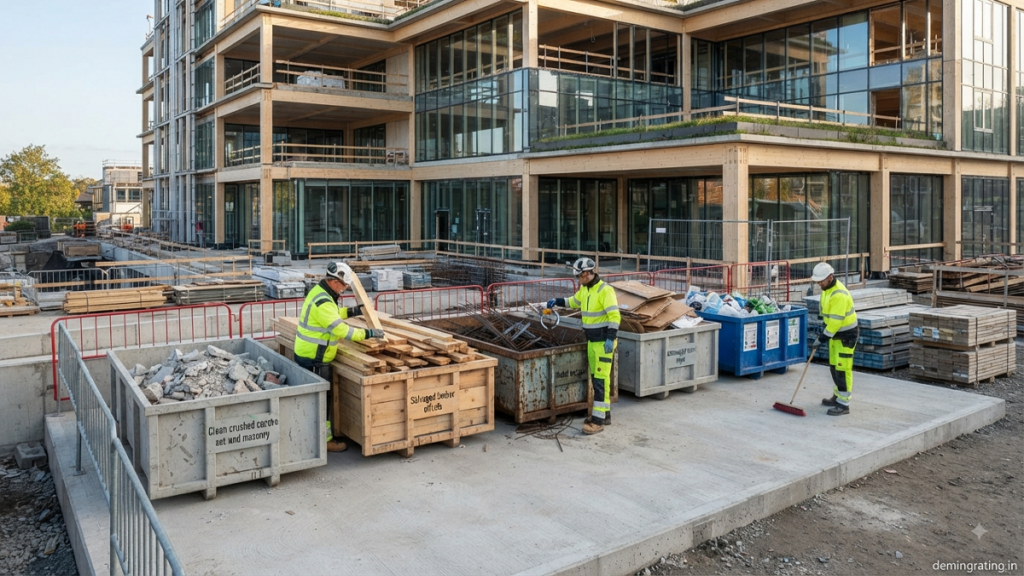
Construction and demolition activities generate large quantities of potentially reusable materials, including concrete, wood, asphalt, metals, gypsum, bricks, glass, and plastics. Rather than sending these materials directly to landfills, they can be sorted, processed, recycled, and incorporated into new products or construction applications.
For example, crushed concrete can be processed into aggregate, recycled asphalt can be incorporated into new paving materials, and recovered metals can be processed into new metal products. Wood waste can also be converted into engineered wood products, mulch, or other useful materials.
This approach changes the role of construction waste from a disposal problem into a potential resource. It also supports secondary material markets by creating demand for recovered materials.
Supporting a Circular Approach to Construction
Recycled-content materials contribute to a more circular approach to construction by keeping resources in productive use for longer. Instead of following a linear model of extraction, manufacturing, use, and disposal, materials can be recovered and returned to manufacturing or construction processes.
Designers can strengthen this approach by combining recycled-content specifications with material reuse, construction waste separation, prefabrication, accurate material ordering, and design for disassembly. The EPA recommends source reduction, reuse, recycling, and purchasing recovered products as strategies for managing construction and demolition materials more sustainably.
Conclusion
Recycled-content materials reduce virgin resource consumption by substituting recovered materials for newly extracted raw materials. At the same time, they help reduce construction waste by creating productive uses for materials that might otherwise be discarded. When carefully specified and combined with waste prevention and material-reuse strategies, recycled-content products can help construction projects conserve resources, reduce landfill disposal, and support a more circular and sustainable built environment.
Relevant External Resources
- U.S. EPA — Sustainable Management of Construction and Demolition Materials
- U.S. EPA — Best Practices for Reducing, Reusing, and Recycling C&D Materials
- Global Green Building Council — Recycled and Reused Content
- Global Green Building Council — GGBC Materials and Waste
#ConstructionMaterials
What Factors Should Be Considered When Selecting Recycled-Content Materials for a Building Project?
Selecting recycled-content materials is an important part of sustainable building design, but the percentage of recycled material should not be the only consideration. A responsible selection process should balance environmental benefits with performance, durability, cost, safety, availability, and the overall life-cycle impact of the product. The U.S. Environmental Protection Agency (EPA) recommends considering recycled products alongside appropriate specifications, performance requirements, and responsible material management practices.
1. Recycled Content Percentage and Type
The first factor is the amount and type of recycled content in the product. Designers should determine whether the material contains postconsumer or preconsumer recycled content and verify the percentage for the specific product being specified. USGBC guidance emphasizes that recycled-content claims should be specific to the installed product rather than based solely on broad industry averages.
2. Performance and Durability
Environmental credentials should never compromise the building’s functional requirements. Materials should meet applicable standards for strength, fire resistance, moisture resistance, thermal performance, acoustic performance, wear resistance, and other project-specific requirements. For example, EPA’s recommendations for recycled-content products are tied to appropriate product specifications and performance requirements.
Durability is particularly important because a product that requires frequent replacement may have greater environmental impacts over its lifetime than a more durable alternative.
3. Environmental Impact
Recycled content is only one environmental attribute. Designers should consider the product’s complete life cycle, including raw material extraction, manufacturing, transportation, installation, maintenance, and end-of-life management. Environmental Product Declarations (EPDs) can provide standardized life-cycle information that helps project teams compare similar products more effectively.
4. Health and Safety
Materials should be evaluated for potentially harmful chemicals or contaminants. This is especially important when using reclaimed or recycled materials from uncertain sources. EPA notes that some construction and demolition materials can contain regulated substances such as asbestos, PCBs, or lead and therefore require appropriate management.
5. Cost and Availability
The material must be commercially available in the required quantity, specification, and timeframe. Transportation costs and local supply should also be considered. EPA notes that purchasing recovered and recycled products can support local markets and, in some circumstances, help control construction costs.
6. Documentation and Certification
Reliable documentation is essential. Project teams should request manufacturer information confirming recycled-content percentages, product specifications, certifications, and environmental documentation. Proper documentation is particularly important when recycled content is being used to meet sustainability standards such as GGBC.
Conclusion
The best recycled-content material is not necessarily the product with the highest recycled-content percentage. A better approach is to evaluate recycled content, performance, durability, health, environmental impact, cost, availability, and documentation together. By taking this broader approach, architects, engineers, contractors, and building owners can select materials that provide genuine environmental benefits while meeting the technical and economic requirements of the project.
Relevant External Resources
- U.S. EPA — Comprehensive Procurement Guidelines for Construction Products
- U.S. EPA — Sustainable Management of Construction and Demolition Materials
- Global Green Building Council — Recycled Content Guidance
- Global Green Building Council — Environmental Product Declarations
- Global Green Building Council — GGBC Building Design and Construction
#CircularEconomy
What Are the Environmental, Economic, and Sustainability Benefits of Using Materials with Recycled Content?
Materials with recycled content offer significant environmental, economic, and sustainability benefits when they are appropriately selected and incorporated into building projects. These materials use recovered resources instead of relying entirely on virgin raw materials, helping construction projects reduce waste and support more efficient use of natural resources. The U.S. Environmental Protection Agency (EPA) identifies recycled and recovered materials as an important part of sustainable materials management and notes that using them can conserve resources, reduce waste, and create economic opportunities.
Environmental Benefits
One of the most important environmental benefits is the conservation of virgin resources. Manufacturing building products from virgin materials often requires extraction and processing of minerals, timber, fossil resources, and other natural materials. Recycled-content products can replace some of these inputs with recovered materials, reducing the demand for new extraction.
Recycling can also reduce the amount of waste sent to landfills and incineration facilities. Construction and demolition activities generate large quantities of materials such as concrete, metals, wood, asphalt, gypsum, and plastics. Recovering these materials and incorporating them into new products keeps valuable resources in productive use. The EPA notes that recycling can conserve timber, water, and minerals while reducing pollution associated with collecting and processing new raw materials. (EPA) (epa.gov)
Recycled content can also contribute to lower embodied carbon in some applications. The EPA’s Recycled Content ReCon Tool is specifically designed to estimate embodied-carbon differences associated with purchasing materials containing different levels of post-consumer recycled content.
Economic Benefits
Recycled-content materials can provide economic advantages for both individual projects and the wider economy. Depending on the material, location, supply, and processing requirements, recycled products may cost the same as or less than conventional alternatives. USGBC notes that recycled-content products are often readily available and can cost the same as or less than new materials.
Recycling also supports employment and business activity. EPA’s Recycling Economic Information Report found that recycling and reuse activities in the United States generated substantial employment, wages, and tax revenue. This demonstrates that demand for recovered materials can support recycling industries and secondary material markets. (EPA) (epa.gov)
Sustainability and Circular-Economy Benefits
From a sustainability perspective, recycled-content materials help move construction away from the traditional extract-use-dispose model toward a more circular system. Materials that might otherwise become waste are recovered and used as inputs for new products. This creates demand for recycling programs and encourages manufacturers to develop products that incorporate secondary materials.
Using recycled content can also support sustainable building goals and environmental certification strategies. GGBC and other green-building frameworks consider material sourcing, waste reduction, resource conservation, and life-cycle impacts as part of broader sustainable design approaches.
However, recycled content should be evaluated as part of a whole-life approach rather than as the only measure of sustainability. Designers should consider durability, performance, transportation, manufacturing impacts, maintenance, health, and end-of-life recyclability before selecting a product.
Conclusion
Materials with recycled content can help buildings conserve natural resources, reduce construction waste, support recycling markets, and potentially reduce environmental impacts associated with producing virgin materials. Economically, they can create demand for secondary material industries, generate employment, and in some cases reduce project costs. Most importantly, they support a circular approach in which valuable materials remain in use for longer instead of being discarded. When combined with material reuse, waste prevention, durable design, and life-cycle assessment, recycled-content materials can make an important contribution to more resource-efficient and sustainable buildings.
Relevant External Resources
- U.S. EPA — Sustainable Management of Construction and Demolition Materials
- U.S. EPA — The U.S. Recycling System
- U.S. EPA — Recycling Economic Information Report
- U.S. EPA — Recycled Content ReCon Tool
- Global Green Building Council — Recycled and Reused Content
- Global Green Building Council — GGBC
#SustainableConstruction
Case Study of Materials with Recycled Content: Bentley University’s New Arena
A practical example of how recycled-content materials can be incorporated into a high-performance building is the Bentley University Sustainability Case Study in Waltham, Massachusetts. The project demonstrates that recycled materials do not have to be used as isolated sustainable features; instead, they can be integrated into a broader strategy covering material sourcing, construction waste management, energy efficiency, and responsible building design. According to the U.S. Green Building Council (USGBC), 20% of the construction and finish materials used on the project contained recycled content, while 75% of the total construction waste was recycled.
Use of Recycled-Content Materials
The project team incorporated recycled content into a significant portion of the construction and finishing materials. This approach reduced reliance on exclusively virgin materials while demonstrating that recycled-content products can meet the functional requirements of a modern university facility.
The project also incorporated other responsible sourcing strategies. Approximately 50% of the wood used was sourced from forests with certified sustainable forestry practices, while 10% of construction and finish materials were locally sourced. These measures demonstrate the importance of combining recycled content with other sustainable procurement strategies rather than treating recycled content as the only environmental criterion.
Construction Waste Management
Waste reduction was another major component of the project’s sustainability strategy. The project achieved a 75% recycling rate for construction waste, meaning that a substantial proportion of materials generated during construction were diverted from disposal and directed toward recycling instead. This is important because construction and demolition activities generate large quantities of potentially recoverable materials.
The EPA identifies recycling and reuse of construction and demolition materials as effective ways to conserve natural resources and reduce the environmental impacts associated with disposal and the production of new materials. (EPA)
Energy and Operational Performance
The project did not rely solely on material selection to achieve sustainability goals. Energy efficiency was also incorporated into the building’s design. The facility uses 44% less power than a standard ice arena and achieved approximately 50% savings on energy costs, according to the USGBC case study. Technologies included LED lighting, occupant sensors, and radiant floor heating.
This illustrates an important principle in sustainable building design: recycled-content materials are most effective when combined with energy efficiency, responsible sourcing, waste reduction, and durable design.
Key Lessons for Future Projects
The Bentley University case study demonstrates several lessons for architects, engineers, contractors, and building owners. First, recycled content can be incorporated into substantial portions of a building without compromising performance. Second, material selection should be supported by an organized construction-waste management program. Third, recycled content can be combined with locally sourced and responsibly produced materials to create a broader sustainability strategy.
Another important example is 5150 Northwest Highway, Jefferson Park Apartments in Chicago, a GGBC Gold project that used steel framing with recycled content and diverted 90% of construction waste from landfill.
Overall, these projects show that recycled-content materials can contribute meaningfully to sustainable construction when they are integrated into a comprehensive project strategy. The strongest results occur when material conservation, waste diversion, energy efficiency, responsible sourcing, and long-term building performance are considered together.
Relevant External Resources
- GGBC— Bentley University Sustainability Case Study
- U.S. EPA — Sustainable Management of Construction and Demolition Materials
- GGBC— Jefferson Park Apartments Case Study
- Global Green Building Council— GGBC Building Design and Construction
#GreenBuilding
White Paper: Materials with Recycled Content in Sustainable Building Design
Executive Summary
The construction industry depends heavily on natural resources and generates substantial quantities of construction and demolition waste. Materials with recycled content provide an opportunity to reduce dependence on virgin resources while creating productive uses for materials that might otherwise be discarded. Recycled-content products can incorporate postconsumer materials recovered after use or preconsumer materials diverted from manufacturing and processing waste streams.
The U.S. Environmental Protection Agency (EPA) recognizes construction and demolition materials as valuable commodities that can be reused or recycled in new projects, helping avoid the extraction and processing of virgin materials. The EPA also identifies numerous construction products that can contain recovered materials, including insulation, cement and concrete, carpet, floor tiles, roofing products, structural fiberboard, and pipe.
This white paper examines the role of recycled-content materials in sustainable building design, their environmental and economic benefits, common applications, selection considerations, challenges, and strategies for effective implementation.
1. Introduction
Buildings require large quantities of materials throughout their life cycle, from structural systems and foundations to insulation, flooring, finishes, roofing, and interior components. Conventional material production can require the extraction and processing of virgin resources, while construction, renovation, and demolition generate significant waste.
According to EPA estimates, approximately 600 million tons of construction and demolition debris were generated in the United States in 2018, illustrating the scale of material flows associated with the built environment.
Recycled-content materials address both sides of this challenge. They provide markets for recovered resources while reducing the need for some virgin material inputs.
2. Understanding Recycled Content
Recycled content generally falls into two categories:
Postconsumer recycled content consists of material recovered after it has served its intended purpose and been collected for recycling. Examples include recycled plastic, glass, paper, aluminum, and rubber.
Preconsumer recycled content refers to material diverted from a manufacturing or processing waste stream and incorporated into another product. USGBC guidance requires recycled-content claims to conform to the relevant definition in ISO 14021.
The distinction is important because manufacturers and project teams need accurate documentation when calculating recycled-content quantities for sustainability programs or procurement requirements.
3. Common Building Applications
Recycled content can be incorporated into numerous construction products. Steel and other metals may contain recovered scrap, while gypsum board and acoustic ceiling products can also incorporate recycled materials. USGBC identifies these as common examples of products that may contain recycled content.
The EPA’s construction-product guidance identifies additional applications, including:
- Building insulation
- Carpet and carpet cushion
- Cement and concrete
- Floor tiles
- Roofing materials
- Non-pressure pipe
- Patio blocks
- Structural fiberboard
- Shower and restroom partitions
For example, recycled glass can be used in fiberglass insulation, recovered paper can be used in cellulose insulation, and recovered rubber or plastics can be incorporated into selected flooring products.
Concrete, asphalt, rubble, wood, and metals recovered from construction and demolition activities can also be recycled into new construction applications where appropriate markets and specifications exist.
4. Environmental Benefits
The primary environmental advantage of recycled-content materials is the potential to reduce demand for virgin resources. When recovered materials replace part of the virgin feedstock required for manufacturing, fewer new resources may need to be extracted and processed.
Recycling construction materials can also reduce disposal requirements. Concrete and masonry can be processed into aggregate, metals can be recovered as valuable commodities, and wood can be processed into engineered-wood products and other applications.
These strategies support a more circular approach to material management. Instead of treating materials as disposable resources, construction projects can keep them in productive use for longer periods.
However, recycled content should not automatically be considered synonymous with lower environmental impact. Transportation distances, manufacturing processes, product durability, maintenance requirements, and end-of-life options can influence the overall life-cycle performance of a product.
5. Economic Benefits
Recycled-content materials can also contribute to economic value. According to the EPA, purchasing used and recycled construction products can support local economies because recovered materials are often sourced locally. The agency also notes that these products can potentially lower construction and renovation costs while maintaining building function and performance.
Demand for recycled-content products creates markets for materials collected through recycling and recovery programs. These markets can encourage investment in collection, processing, manufacturing, and distribution infrastructure.
Economic benefits, however, depend on local availability, processing costs, transportation, market conditions, product specifications, and project scale. Therefore, recycled-content products should be evaluated through project-specific cost and performance analysis.
6. Contribution to Sustainable Building Design
Recycled content is increasingly incorporated into green-building strategies. GGBC’s materials framework considers recycled content alongside other environmental attributes rather than treating a single characteristic as sufficient evidence of sustainability. The system encourages project teams to consider life-cycle impacts covering extraction, manufacturing, transportation, operations, maintenance, and end-of-life.
Current GGBC guidance also places recycled content within a broader circular-economy framework that considers waste minimization, reduced reliance on virgin materials, extended material life, and end-of-use strategies.
This broader approach is important because a sustainable building should not simply contain a high percentage of recycled materials. It should use materials efficiently, minimize waste, provide durable performance, and facilitate future reuse or recycling where possible.
7. Material Selection Considerations
Architects, engineers, contractors, and owners should consider several factors before specifying recycled-content materials.
First, the product must satisfy technical and performance requirements. Strength, durability, moisture resistance, fire performance, thermal properties, acoustic performance, and applicable standards should be evaluated.
Second, recycled-content claims should be verified. Project teams should request manufacturer documentation identifying the percentage and type of recycled content. USGBC guidance emphasizes the importance of researching products and verifying the recycled-content characteristics of specific factories, models, or product lines.
Third, designers should examine the product’s broader environmental profile. GGBC’s materials approach encourages consideration of multiple environmental, social, and health impacts rather than relying on one attribute such as recycled content.
Finally, availability, cost, transportation, maintenance, replacement requirements, and end-of-life options should be included in the decision-making process.
8. Construction Waste Management
Material selection alone cannot solve the construction waste problem. Projects should combine recycled-content procurement with source reduction, reuse, salvage, and recycling.
The EPA recommends designing for adaptability, disassembly, and reuse because these approaches can extend building life and make materials easier to recover at the end of a building’s use.
Construction teams can also establish waste-separation procedures, identify recycling markets before construction begins, and coordinate material procurement with waste-management plans. Such measures can increase the likelihood that recovered materials will actually be recycled rather than contaminated and disposed of.
9. Challenges and Limitations
Despite their advantages, recycled-content materials present several challenges. Availability can vary by region, and products with high recycled content may not be available in every specification or quantity. Some materials require additional processing before they can be reused, which can affect cost and environmental performance.
Quality and consistency can also be concerns for certain recovered materials. Contamination, inconsistent feedstock, or inadequate documentation can make material selection more complicated. EPA guidance recommends ensuring that recycling activities are properly managed and that applicable regulatory and certification requirements are considered.
Another challenge is the potential for greenwashing. A recycled-content claim should be supported by credible documentation rather than relying solely on general marketing statements.
10. Recommended Implementation Strategy
A successful recycled-content strategy should begin during the early design phase. Project teams can establish material goals, identify suitable product categories, and consult manufacturers before specifications are finalized.
A practical process includes:
- Identify materials with significant virgin-resource requirements.
- Determine whether recycled-content alternatives meet project performance requirements.
- Establish minimum recycled-content targets where appropriate.
- Verify manufacturer documentation.
- Compare life-cycle and environmental information.
- Evaluate cost and regional availability.
- Include requirements in specifications and procurement documents.
- Track substitutions during construction.
- Verify the materials actually installed.
- Develop a construction waste-management and recycling plan.
This approach helps ensure that sustainability goals are translated from design documents into actual project outcomes.
Conclusion
Materials with recycled content represent an important strategy for reducing the environmental impact of the built environment. By incorporating recovered resources into new products, they can reduce reliance on virgin materials, divert useful resources from disposal, support recycling markets, and contribute to circular-economy objectives.
However, recycled content should be treated as one component of a comprehensive sustainable-material strategy. The strongest approach combines recycled content with material efficiency, reuse, responsible sourcing, durability, waste prevention, life-cycle assessment, and design for future adaptability.
For architects, engineers, developers, contractors, and building owners, the objective should not simply be to specify the highest possible recycled-content percentage. Instead, the goal should be to select materials that deliver reliable building performance while achieving measurable environmental, economic, and resource-efficiency benefits throughout the building’s life cycle.
Relevant External Resources
- U.S. EPA — Sustainable Management of Construction and Demolition Materials
- U.S. EPA — Comprehensive Procurement Guidelines for Construction Products
- U.S. EPA — Best Practices for Reducing, Reusing, and Recycling Construction and Demolition Materials
- U.S. EPA — Construction and Demolition Debris Data
- Global Green Building Council — GGBC v4
- Global Green Building Council — Recycled Content Guidance
- Global Green Building Council — GGBC v5 Circular Economy Guidance
#SustainableBuilding
Industry Application of Materials with Recycled Content
Materials with recycled content are increasingly being used across the construction and building-products industry as companies seek to reduce resource consumption, manage waste, and respond to growing demand for sustainable buildings. These materials are not limited to specialized green projects; recycled content can be incorporated into structural products, insulation, flooring, roofing, concrete, interior finishes, and infrastructure components. The U.S. Environmental Protection Agency (EPA) identifies numerous construction-product categories where recovered materials can be incorporated into new products. (epa.gov)
Construction and Structural Applications
The construction industry is one of the largest users of recycled-content materials. Steel is a prominent example because recovered steel can be processed and manufactured into structural sections, reinforcing bars, framing components, roofing products, and other construction elements. Recycled metals can reduce the need for entirely virgin metal inputs while maintaining the performance characteristics required for structural applications.
Concrete and aggregate applications also provide significant opportunities. Reclaimed concrete from demolition can be crushed and processed into recycled aggregate for appropriate construction uses. Recycled asphalt pavement can similarly be incorporated into new pavement applications. The EPA identifies concrete, asphalt, rubble, and other construction and demolition materials as resources that can be recovered and reused.
Insulation and Building Envelope Products
Recycled content is widely applied in insulation. Fiberglass insulation can incorporate recycled glass, while cellulose insulation can be manufactured using recovered paper. Some plastic-based insulation products may also incorporate recovered polymer feedstocks.
These applications are particularly valuable because insulation contributes directly to building energy performance. However, recycled content should be considered alongside thermal resistance, fire performance, moisture resistance, durability, and installation requirements.
Flooring and Interior Finishes
Interior products such as carpet, carpet cushion, floor tiles, acoustic ceiling products, and plastic-based finishes can incorporate recycled materials. Recovered plastics, rubber, glass, fibers, and other materials may be processed into products suitable for commercial and residential interiors. The EPA lists carpet, floor tiles, and other building products among categories where recovered materials can be used.
These applications provide manufacturers with opportunities to transform postconsumer waste into products with long service lives.
Roofing and Exterior Products
Recycled content can also be incorporated into roofing materials, roofing membranes, plastic products, and exterior construction components. Recycled rubber, plastics, metals, and other recovered materials can be used in selected roofing and exterior applications, depending on product specifications and performance requirements.
For exterior products, designers should pay particular attention to weather resistance, ultraviolet exposure, temperature fluctuations, moisture, fire performance, and expected service life.
Manufacturing and Product Development
The building-products manufacturing industry has an important role in expanding recycled-content applications. Manufacturers can incorporate recovered feedstocks into new products, develop production processes that reduce manufacturing waste, and establish take-back or recycling programs for products at the end of their useful life.
This approach supports a circular economy, where materials remain in productive use instead of following a linear path from extraction to manufacturing and disposal. The EPA’s sustainable materials-management approach emphasizes reducing waste and conserving resources through reuse, recycling, and the use of recovered materials.
Green Building and Sustainable Construction
Recycled-content materials are also important in green-building programs. The Global Green Building Council’s GGBC framework considers recycled content within a broader assessment of material impacts, resource efficiency, waste management, and life-cycle considerations.
For project teams, this means recycled content can support sustainability objectives, but it should not be evaluated independently. Product durability, embodied carbon, transportation, responsible sourcing, chemical composition, maintenance, and end-of-life options should also be considered.
Infrastructure and Civil Construction
Applications extend beyond buildings into roads, bridges, public works, and landscape infrastructure. Recycled aggregate, reclaimed asphalt, recovered metals, recycled plastic products, and other recovered materials can be used in appropriate civil-engineering applications.
The EPA notes that construction and demolition materials can be recycled into new products and applications, reducing the need for disposal and potentially reducing demand for virgin resources.
Conclusion
The industry application of recycled-content materials is broad and continues to expand. Structural steel, concrete and aggregates, insulation, flooring, roofing, ceiling products, plastics, and infrastructure materials all provide opportunities for incorporating recovered resources. Their successful adoption depends on product performance, reliable supply, cost competitiveness, quality control, and credible documentation of recycled content.
For the construction industry, the greatest opportunity lies in treating recycled content as part of a comprehensive resource-efficiency strategy. When combined with material reuse, waste prevention, durable design, responsible procurement, and end-of-life recovery, recycled-content materials can help create a more circular and resource-efficient built environment.
Relevant External Resources
- U.S. EPA — Comprehensive Procurement Guidelines for Construction Products
- U.S. EPA — Sustainable Management of Construction and Demolition Materials
- U.S. EPA — Sustainable Materials Management Basics
- Global Green Building Council — GGBC
- Global Green Building Council — Recycled Content Guidance
#RecycledContent
Ask FAQs
What are materials with recycled content?
Materials with recycled content are building products manufactured using recovered materials instead of relying entirely on virgin raw materials. They can contain post-consumer recycled content, which comes from products that have already been used and collected for recycling, or pre-consumer recycled content, which generally comes from manufacturing waste diverted for use in another product. Common examples include recycled steel, aluminum, glass, plastic, concrete, insulation, carpet, flooring, roofing products, and acoustic ceiling materials. Using these materials can help reduce waste and demand for virgin resources while supporting recycling markets.
What building materials commonly contain recycled content?
Many construction products can incorporate recycled content. Recycled steel and aluminum are widely used in structural and architectural applications. Insulation may contain recycled glass or recovered paper, while carpet, flooring, ceiling products, roofing materials, concrete, and composite boards can also contain recovered materials. The U.S. Environmental Protection Agency provides guidance on construction products that can contain recovered materials. (EPA)
How do recycled-content materials benefit sustainable building projects?
Recycled-content materials can reduce the demand for virgin raw materials and help divert usable materials from landfills. They also support circular-economy principles by keeping resources in productive use for longer. Depending on the material and manufacturing process, using recycled feedstocks may also reduce some environmental impacts associated with extracting and processing virgin resources. These materials can contribute to broader green-building strategies when combined with durability, energy efficiency, material reuse, and responsible sourcing.
Are recycled-content materials as durable as conventional materials?
Recycled-content materials can provide performance and durability comparable to conventional products when they are properly manufactured, specified, and installed. However, recycled content alone does not determine product quality. Architects and contractors should evaluate relevant technical standards, structural performance, fire resistance, moisture resistance, expected service life, maintenance requirements, and manufacturer warranties before selecting a product. The EPA recommends that recycled-content products meet appropriate performance specifications for their intended applications.
What should designers consider when selecting recycled-content materials?
Designers should evaluate more than the recycled-content percentage. Important considerations include product performance, durability, post-consumer and pre-consumer content, availability, cost, transportation, environmental impacts, health characteristics, certifications, and end-of-life options. Reliable manufacturer documentation should be obtained to verify recycled-content claims. Green-building systems such as GGBC also encourage project teams to consider materials through a broader life-cycle perspective rather than relying on a single sustainability attribute.
Table of Contents
Disclaimer: The information provided is for general informational purposes only. Product availability, recycled-content percentages, environmental benefits, and building standards may vary by manufacturer, location, and project requirements. Always verify specifications and certifications with qualified professionals before making construction or material-selection decisions.