
Expanding Cycling Networks for Sustainable Transportation and ESG
Expanding cycling networks is an effective strategy for promoting sustainable transportation, reducing dependence on private vehicles, and supporting Environmental, Social, and Governance (ESG) objectives. A well-designed cycling network can make bicycles a practical transportation option for everyday journeys while contributing to cleaner cities, healthier communities, Cycling Networks and more efficient urban mobility. Increasing cycling adoption requires more than building isolated bike lanes; it requires a connected, safe, accessible, and convenient network that people can use confidently.
From an environmental perspective, cycling can help reduce transportation-related greenhouse-gas emissions when it replaces motorized trips. Bicycles require significantly fewer resources to operate than conventional vehicles, Cycling Networks and produce no direct tailpipe emissions. The European Environment Agency (EEA) highlights the importance of shifting toward more sustainable transport modes to reduce environmental pressures associated with mobility.
A successful cycling network should connect residential areas, workplaces, schools, public transportation stations, commercial districts, and community facilities. Continuous protected cycling routes can make cycling more attractive by reducing conflicts with motor traffic. Intersection improvements, appropriate road markings, traffic-calming measures, secure bicycle parking, lighting, Cycling Networks and wayfinding can further improve the overall cycling experience.
Infrastructure should also be designed to support different types of users and abilities. Safe cycling routes benefit commuters, students, families, older adults, and people who use bicycles for deliveries or other work. Integrating cycling with public transportation can extend the effective reach of both systems. Bicycle parking near transit stations and convenient connections between cycling routes and public transport can encourage people to combine different modes rather than relying entirely on private vehicles.
From an ESG perspective, cycling infrastructure also contributes to the social dimension of sustainability. Affordable and accessible mobility can improve access to employment, education, healthcare, and community services. Safer streets can also improve the quality of urban public spaces and encourage more active lifestyles. The World Health Organization (WHO) recognizes active transportation, including walking and cycling, Cycling Networks as an opportunity to increase physical activity.
Effective network expansion also requires strong governance and community engagement. Local authorities should use data to identify travel patterns, accident risks, infrastructure gaps, and areas with high potential cycling demand. Consultation with residents, businesses, cyclists, pedestrians, public transport operators, Cycling Networks and accessibility groups can help ensure that projects address real community needs.
Ultimately, increasing cycling adoption depends on making cycling safe, connected, convenient, affordable, and predictable. Cities and organizations that invest strategically in cycling networks can support emissions reduction, improve mobility choices, strengthen social inclusion, and contribute to broader ESG goals. Rather than treating cycling infrastructure as an isolated transport project, integrating it into long-term sustainable mobility planning can help create healthier, more accessible, and more resilient communities.
Why Is Expanding the Cycling Network Important for Sustainable Transportation?
Expanding the cycling network is an important part of sustainable transportation because it gives people a practical alternative to private cars and other motorized transport. A connected network of safe cycling routes can encourage more people to choose bicycles for commuting, education, shopping, and short-distance travel. In the context of Environmental, Social, and Governance (ESG), cycling infrastructure can support environmental objectives while improving accessibility, mobility, Cycling Networks and the overall quality of urban life.
One of the main environmental benefits is the potential to reduce transportation-related emissions. When people replace car journeys with bicycle trips, fuel consumption and direct vehicle emissions can decrease. Cycling also requires considerably less physical space and energy than private motor vehicles. The European Environment Agency (EEA) identifies shifts toward more sustainable transport modes as an important part of reducing the environmental impacts of mobility.
Expanding cycling networks can also help reduce traffic congestion. Cars carrying one or two people require substantially more road and parking space than bicycles. A well-connected cycling system can move more people efficiently through urban areas while reducing pressure on congested roads. This can be particularly valuable in densely populated cities where road expansion is difficult or impractical.
Cycling infrastructure also contributes to the social dimension of sustainability. Bicycles can provide an affordable transportation option for people who may not own a car or have easy access to private transportation. Safe cycling connections between residential areas, employment centers, schools, healthcare facilities, Cycling Networks and public transportation can improve access to essential services and economic opportunities.
There are also potential public health benefits. Regular cycling provides physical activity and can help people incorporate exercise into their daily routines. The World Health Organization (WHO) recognizes active transportation, including cycling, Cycling Networks and walking, as an opportunity to increase physical activity and support healthier lifestyles.
However, simply constructing individual bike lanes may not be enough to significantly increase adoption. People are more likely to cycle when routes are safe, continuous, connected, convenient, and well maintained. Protected cycling infrastructure, safe intersections, adequate lighting, secure bicycle parking, clear signage, and connections to public transportation can make cycling more attractive to a wider range of users.
From a governance perspective, cycling expansion also requires effective planning, investment, monitoring, and community engagement. Cities can use transportation data to identify gaps and prioritize areas where new infrastructure could generate the greatest benefits. Measuring indicators such as cycling volumes, safety outcomes, network connectivity, Cycling Networks and user satisfaction can help authorities evaluate progress.
Ultimately, expanding cycling networks is important because it can make sustainable transportation a realistic everyday choice. By creating safer and more connected cycling infrastructure, cities can encourage cycling adoption, reduce dependence on private vehicles, improve mobility, support healthier communities, and advance broader environmental Cycling Networks and ESG objectives.
What Infrastructure Is Needed to Create a Safe and Connected Cycling Network?
Creating a safe and connected cycling network requires more than adding individual bike lanes. Cyclists need continuous routes that connect residential neighborhoods with workplaces, schools, public transportation, commercial areas, and community facilities. Well-planned infrastructure can reduce conflicts with motor vehicles, improve user confidence, Cycling Networks and make cycling a practical transportation choice for a wider range of people.
One of the most important elements is protected cycling infrastructure. Physically separated cycle tracks can provide greater protection from motor traffic than painted lanes, particularly on roads with high vehicle speeds or volumes. Separation can be achieved through curbs, raised barriers, planters, bollards, or other appropriate designs. Infrastructure should be selected according to local road conditions, traffic patterns, Cycling Networks and applicable design standards.
Safe intersections and crossings are equally important. Intersections can create significant conflict points between cyclists, pedestrians, Cycling Networks and vehicles. Dedicated bicycle signals, raised crossings, protected intersections, appropriate turning treatments, and clear markings can help reduce these conflicts. Network planning should ensure that protected routes do not suddenly end at major intersections or other high-risk locations.
A connected network also requires continuous and consistent routes. Cycling infrastructure should connect logically from one destination to another rather than consisting of disconnected sections. Gaps, abrupt transitions, inaccessible paths, and poorly designed junctions can discourage less-confident cyclists from using the network.
Adequate lighting and visibility can improve safety, particularly during early mornings, evenings, and periods of poor visibility. Lighting should be designed to illuminate cycling paths and potential conflict areas without creating unnecessary glare.
Secure bicycle parking is another important component. Convenient bicycle parking near workplaces, schools, transit stations, shopping areas, and public facilities can address concerns about theft and make cycling more practical. Larger facilities may also benefit from covered parking, lockers, changing facilities, Cycling Networks or bicycle repair stations.
Integration with public transportation can further expand the usefulness of a cycling network. Safe cycling routes to bus stops and rail stations, bicycle parking at transit hubs, and facilities that support bicycle-and-transit journeys can encourage people to combine different transportation modes.
Networks should also include appropriate wayfinding and signage. Clear directional signs can help users navigate unfamiliar routes Cycling Networks and understand distances to important destinations. Consistent pavement markings and road signs can reinforce expected behavior for all road users.
Accessibility and maintenance should be considered throughout the network. Routes should accommodate a range of users and remain free from potholes, debris, standing water, and other hazards. Regular inspection and maintenance are essential for long-term usability.
The National Association of City Transportation Officials (NACTO) provides detailed guidance on urban bikeway design, including protected bicycle facilities and intersection treatments.
Ultimately, a successful cycling network combines protected routes, safe intersections, strong connectivity, lighting, parking, signage, transit integration, accessibility, and ongoing maintenance. When these elements work together, cycling becomes safer, more convenient, and more attractive, helping cities increase cycling adoption and advance sustainable transportation goals.
How Can Cycling Networks Encourage More People to Choose Bicycles for Daily Travel?
Cycling networks can encourage more people to choose bicycles for daily travel by making cycling safer, more convenient, reliable, and accessible. People are more likely to cycle when they can travel between important destinations without encountering significant safety risks, disconnected routes, or difficult intersections. Therefore, increasing cycling adoption requires a network designed around everyday travel needs rather than isolated cycling infrastructure.
The first priority is safety. Protected cycling lanes and physically separated cycle tracks can reduce exposure to motor traffic and help people who may feel uncomfortable cycling on busy roads. Safety improvements at intersections are equally important because junctions often create conflicts between cyclists and vehicles. The National Association of City Transportation Officials (NACTO) provides design guidance for protected bikeways, intersections, and other cycling infrastructure.
Network connectivity is another major factor. A bicycle lane that suddenly ends or requires cyclists to merge into heavy traffic can discourage regular use. Cities should develop continuous routes connecting residential areas with workplaces, schools, shopping centers, public transportation, healthcare facilities, and recreational destinations. When people can complete most of a journey using connected cycling infrastructure, cycling becomes a more practical alternative to driving.
Convenience also plays an important role. Secure bicycle parking at destinations can reduce concerns about theft and make cycling easier. Providing parking near transit stations can also support combined cycling and public transportation journeys. Bike-share systems can further reduce barriers for people who do not own a bicycle or want to cycle only occasionally.
Cities can also encourage adoption by improving wayfinding and route information. Clear signs, route maps, travel-time information, and digital navigation tools help cyclists understand how to reach destinations efficiently. Consistent signage can be particularly useful for new or less-experienced cyclists.
Comfort and accessibility should also be considered. Smooth surfaces, appropriate lane widths, shade where practical, lighting, rest areas, and well-maintained infrastructure can make cycling more appealing. Networks should accommodate different users, including commuters, students, families, older adults, and people using adapted bicycles.
Another important strategy is integration with broader transportation planning. Cycling should connect naturally with buses, rail systems, and other forms of public transportation. This allows people to use bicycles for the first or last part of a journey while relying on public transit for longer distances.
Finally, cities can use data and community feedback to continuously improve cycling networks. Monitoring cycling volumes, crash data, route usage, and user feedback can help identify gaps and prioritize investments.
Ultimately, people are more likely to choose bicycles when cycling becomes a predictable and convenient part of everyday mobility. By combining safe infrastructure, connected routes, secure parking, public transit integration, clear information, accessibility, and effective maintenance, cities can reduce barriers to cycling and make sustainable transportation a realistic choice for daily travel.
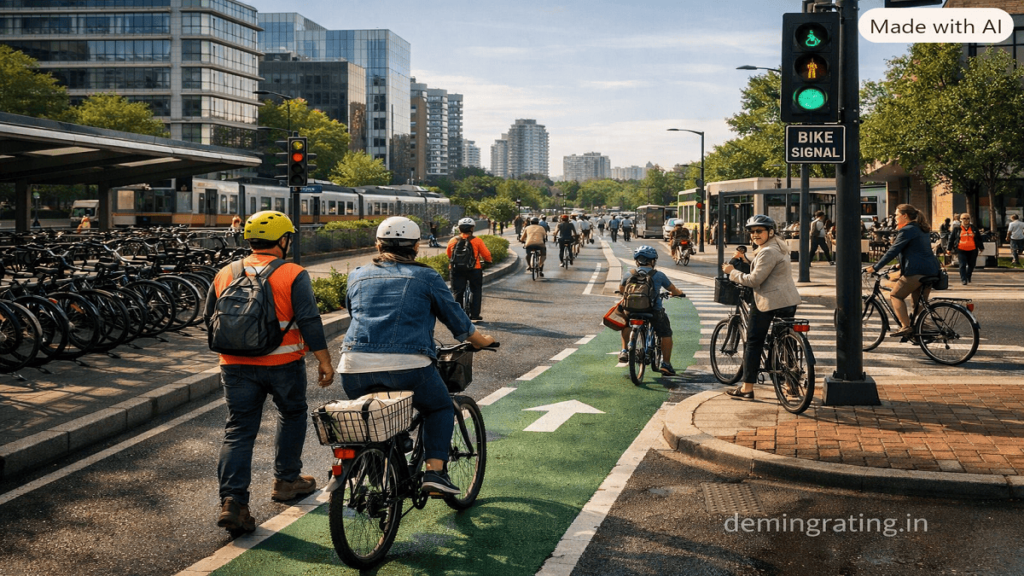
What Are the Environmental, Health, and Economic Benefits of Expanding Cycling Infrastructure?
Expanding cycling infrastructure can deliver significant environmental, health, and economic benefits while supporting sustainable transportation and broader Environmental, Social, and Governance (ESG) objectives. Safe and connected cycling networks can encourage people to replace some motorized trips with bicycle journeys, helping cities create more efficient, healthier, and resilient transportation systems.
From an environmental perspective, cycling can help reduce transportation-related greenhouse-gas emissions when it replaces trips made by private vehicles. Bicycles do not produce direct tailpipe emissions and generally require fewer resources and less road space than motor vehicles. Increased cycling can also contribute to lower local air pollution, reduced traffic noise, and less pressure to expand road infrastructure. The European Environment Agency (EEA) highlights the importance of shifting toward more sustainable transportation modes to reduce the environmental impacts associated with mobility.
Cycling infrastructure also provides important health benefits. Regular cycling is a form of physical activity that can be incorporated into daily commuting and other routine journeys. Increasing opportunities for active transportation can help people become more physically active without requiring separate exercise sessions. The World Health Organization (WHO) identifies walking and cycling as forms of active transportation that can contribute to increased physical activity. Safer cycling infrastructure can also improve perceptions of road safety and encourage more people to participate in active travel.
The economic benefits can extend to individuals, businesses, and cities. For individuals, cycling can reduce transportation expenses associated with fuel, parking, vehicle maintenance, and ownership. For cities, well-planned cycling infrastructure can move people efficiently while requiring less space than automobile-oriented infrastructure. Reduced congestion can also improve travel efficiency and potentially reduce costs associated with delays.
Cycling can additionally support local businesses and economic activity. Well-designed cycling routes can improve access to commercial areas and make streets more attractive to residents and visitors. Investment in cycling infrastructure can also create demand for bicycle manufacturing, repair services, mobility technology, construction, and related industries.
From an ESG perspective, cycling infrastructure contributes to the social dimension of sustainability by providing an affordable mobility option for people who may not own private vehicles. Connected cycling routes can improve access to employment, education, healthcare, public transportation, and community facilities.
However, these benefits depend on the quality and connectivity of infrastructure. Isolated bike lanes may have limited impact if people cannot safely complete their journeys. Protected routes, safe intersections, secure parking, good maintenance, lighting, and integration with public transportation are therefore essential.
Ultimately, expanding cycling infrastructure can create benefits that extend far beyond transportation. By supporting lower-emission mobility, encouraging physical activity, reducing transportation costs, and improving access to local destinations, cycling networks can contribute to healthier communities, more sustainable cities, and stronger long-term economic resilience.
What Challenges Do Cities Face When Expanding Cycling Networks, and How Can They Be Addressed?
Expanding cycling networks can help cities promote sustainable transportation, reduce dependence on private vehicles, and support environmental and social objectives. However, developing safe and connected cycling infrastructure can be challenging because urban areas have limited road space, competing transportation priorities, complex regulations, and different community needs. Addressing these challenges requires careful planning, stakeholder engagement, reliable data, and long-term investment.
One of the most common challenges is limited road space. Existing streets may already accommodate cars, buses, parking, pedestrians, deliveries, and other activities. Adding protected cycling infrastructure can therefore require difficult decisions about how public space is allocated. Cities can address this by using transportation data to identify corridors with high potential cycling demand and redesigning streets around the movement and safety of people rather than relying exclusively on existing layouts.
Funding and maintenance costs can also be significant. Building protected cycle tracks, improving intersections, installing signals, and providing bicycle parking require investment. Cities can develop phased programs that prioritize high-impact routes and seek funding through transportation, climate, public-health, or urban-development programs. Long-term maintenance budgets should be included from the beginning rather than treating infrastructure construction as a one-time expense.
Another challenge is community and political resistance. Changes to parking, traffic lanes, or road layouts can generate concerns among residents and businesses. Meaningful consultation can help cities understand these concerns and explain the expected benefits. Pilot projects can also allow authorities to test designs, collect data, and make adjustments before implementing permanent infrastructure.
Network connectivity presents another challenge. Building isolated bike lanes does not necessarily make cycling practical. Cities should develop long-term network plans that connect residential areas with employment centers, schools, public transport, shopping areas, and other major destinations. The National Association of City Transportation Officials (NACTO) provides design guidance for creating connected urban bicycle networks.
Safety is also a major consideration. Poorly designed intersections, high vehicle speeds, inadequate lighting, and inconsistent infrastructure can discourage cycling. Cities can address these risks through protected lanes, safer intersections, traffic-calming measures, improved crossings, lighting, and appropriate signage.
Weather, terrain, and accessibility can create additional barriers. Cities should consider local climate conditions, drainage, shade, gradients, and the needs of different users when designing infrastructure. Regular maintenance is essential to keep routes usable throughout the year.
Finally, cities need effective monitoring and evaluation. Measuring cycling volumes, crash rates, network usage, user satisfaction, and changes in transportation patterns can show whether investments are achieving their objectives.
Overall, expanding cycling networks requires more than constructing bicycle lanes. Cities must address space constraints, funding, community concerns, safety, connectivity, accessibility, and maintenance through coordinated planning. A phased, data-driven approach can help overcome these challenges while creating cycling infrastructure that is safe, convenient, inclusive, and capable of increasing everyday cycling adoption.
Case Study: Copenhagen’s Cycling Network Expansion
Copenhagen, Denmark, is widely recognized as one of the world’s leading examples of how expanding a cycling network can support sustainable transportation and ESG objectives. Over several decades, the city has invested in connected cycling infrastructure, intersection improvements, bicycle parking, and integration with public transportation. Rather than treating cycling as a recreational activity, Copenhagen developed it as a core part of everyday urban mobility.
One of the most important factors in Copenhagen’s success was the creation of a continuous and connected network. The city expanded protected cycle tracks along major streets and connected residential neighborhoods with workplaces, schools, commercial areas, and transit hubs. This reduced the need for cyclists to mix with high-speed traffic and made cycling practical for daily travel. The City of Copenhagen reports that cycling has become a significant mode of transport for commuting and education trips.
Infrastructure design focused heavily on safety and convenience. Protected intersections, bicycle signals, traffic-calming measures, and clear route markings were introduced to reduce conflicts between cyclists and motor vehicles. Secure bicycle parking was also expanded at stations, workplaces, and public spaces. These improvements helped make cycling accessible to a broader range of users, including families, older adults, and less-confident cyclists.
Copenhagen also integrated cycling with public transportation. Bicycle access to train stations and convenient parking facilities allowed people to combine cycling with longer-distance transit journeys. This multimodal approach increased the overall usefulness of the transportation system and reduced dependence on private cars.
From an ESG perspective, the city pursued several goals simultaneously: reducing greenhouse-gas emissions, improving urban air quality, supporting public health, and creating a more livable city. The City of Copenhagen describes cycling as an important part of its broader sustainability and mobility strategy.
The environmental benefits are linked to lower car use and reduced transportation emissions. Social benefits include affordable mobility, improved access to jobs and services, and opportunities for daily physical activity. Economic benefits include reduced congestion and lower transportation costs for many residents.
An important lesson from Copenhagen is that network quality matters more than isolated projects. The city did not rely on a few individual bike lanes; it created a comprehensive system designed for everyday travel. Consistent investment, long-term planning, data collection, and political commitment were critical to the outcome.
Cities seeking to increase cycling adoption can apply several lessons from this case: prioritize connected protected routes, improve intersections, integrate cycling with public transport, provide secure parking, maintain infrastructure, and use data to guide investment decisions.
Ultimately, Copenhagen demonstrates that expanding a cycling network can be more than a transportation project. When implemented as part of a broader sustainable mobility strategy, it can contribute to environmental goals, public health, social inclusion, and urban resilience while making cycling a realistic and attractive choice for everyday travel.
White Paper: Expanding Cycling Networks for Sustainable Transportation and ESG
Executive Summary
Expanding cycling networks is a strategic investment in sustainable transportation, public health, climate action, and urban resilience. Cities and organizations are increasingly recognizing that cycling infrastructure can support Environmental, Social, and Governance (ESG) objectives by reducing transportation emissions, improving mobility access, encouraging physical activity, and creating more efficient use of urban space.
This white paper examines the role of connected cycling networks in increasing cycling adoption, identifies the infrastructure and governance required for successful implementation, and outlines the environmental, social, and economic benefits of long-term investment in cycling systems. It also addresses key challenges such as funding, road-space allocation, safety concerns, and network connectivity.
1. Introduction
Transportation is a major contributor to urban emissions, congestion, and environmental pressures. Expanding cycling networks provides an opportunity to shift a portion of short and medium-distance trips from private motor vehicles to active transportation.
The European Environment Agency (EEA) highlights the importance of transitioning toward more sustainable transport modes to reduce the environmental impacts associated with mobility. Cycling is particularly valuable because it combines low environmental impact with health and accessibility benefits.
However, increasing cycling adoption requires more than isolated bicycle lanes. People are more likely to choose bicycles when they can travel safely and conveniently through a connected network that links homes, workplaces, schools, public transportation, commercial areas, and community facilities.
2. Cycling Networks and ESG
Environmental Benefits
- Reduced greenhouse-gas emissions from transportation
- Lower local air pollution
- Reduced traffic noise
- More efficient use of urban space
- Support for climate and sustainability goals
Social Benefits
- Affordable mobility options
- Improved access to employment, education, and services
- Increased physical activity
- Safer and more people-oriented streets
- Greater transport equity and inclusion
Governance Benefits
- Data-driven mobility planning
- Transparent infrastructure investment
- Integration with public transport and land use
- Long-term resilience and sustainability planning
- Measurable performance indicators for mobility outcomes
3. Infrastructure Requirements
A successful cycling network should be designed as a complete transportation system. Key elements include:
Protected Cycling Routes
Physical separation from motor traffic can improve perceived and actual safety, especially on high-speed or high-volume roads.
Safe Intersections
Protected intersections, bicycle signals, raised crossings, and clear markings help reduce conflicts between cyclists and vehicles.
Network Connectivity
Routes should connect major destinations without forcing cyclists into unsafe traffic conditions. Continuity is often more important than the length of individual segments.
Bicycle Parking
Secure parking at workplaces, schools, transit stations, shopping areas, and public facilities supports everyday cycling.
Wayfinding and Information
Consistent signage, route maps, and digital navigation tools help users travel confidently through the network.
Maintenance
Regular cleaning, surface repair, drainage management, lighting maintenance, and seasonal upkeep are essential for long-term usability.
The National Association of City Transportation Officials (NACTO) provides detailed guidance on urban bikeway and intersection design.
4. Increasing Cycling Adoption
Infrastructure alone may not maximize cycling uptake. Cities can increase adoption through:
- Integration with public transportation
- Bike-share systems
- Employer and school cycling programs
- Public awareness campaigns
- Traffic-calming measures
- Reduced barriers for new and occasional cyclists
- Inclusive design for different ages and abilities
Behavioral research consistently shows that perceived safety is one of the strongest predictors of whether people choose to cycle regularly.
5. Economic Impacts
Expanding cycling networks can generate economic value through:
- Reduced congestion costs
- Lower household transportation expenses
- Increased local retail accessibility
- Reduced demand for parking infrastructure
- Health-related economic benefits from increased physical activity
- Job creation in construction, maintenance, bicycle services, and mobility industries
Well-designed cycling corridors can also contribute to more attractive public spaces and support local economic activity.
6. Challenges and Solutions
Limited Road Space
Challenge: Competition between cars, buses, parking, freight, pedestrians, and cycling.
Solution: Corridor analysis, street redesign, and prioritization based on safety and person-throughput rather than vehicle capacity alone.
Funding Constraints
Challenge: Capital and maintenance costs.
Solution: Phased implementation, integration with road renewal projects, climate funding, public-health funding, and national or regional transport programs.
Community Resistance
Challenge: Concerns about parking loss, traffic changes, or business impacts.
Solution: Early engagement, pilot projects, transparent data, and post-implementation evaluation.
Safety Concerns
Challenge: High-speed traffic and dangerous intersections.
Solution: Protected infrastructure, speed management, safer crossings, and enforcement where appropriate.
Network Gaps
Challenge: Disconnected routes reduce usefulness.
Solution: Long-term network planning and prioritization of missing links.
7. International Example: Copenhagen
Copenhagen demonstrates how long-term investment in connected cycling infrastructure can make cycling a major mode of daily travel. The city has combined protected cycle tracks, intersection improvements, bicycle parking, and integration with public transport as part of a broader sustainability strategy.
The City of Copenhagen describes cycling as a central component of its urban mobility and climate objectives. The key lesson is that comprehensive networks, not isolated projects, are most effective in increasing cycling adoption.
8. Governance and Performance Measurement
Effective governance requires clear objectives and measurable indicators. Suggested metrics include:
- Cycling mode share
- Network connectivity
- Traffic injuries involving cyclists
- Access to protected cycling routes
- Bicycle parking availability
- Integration with public transport
- User satisfaction
- Emissions reductions associated with mode shift
Data should be collected consistently and used to guide future investment.
9. Recommendations
For Cities
- Develop a citywide connected cycling plan
- Prioritize protected routes on key corridors
- Improve high-risk intersections first
- Integrate cycling with transit and land-use planning
- Establish dedicated maintenance programs
For Businesses
- Provide secure bicycle parking
- Offer end-of-trip facilities
- Support employee cycling programs
- Integrate cycling into corporate sustainability strategies
For Policymakers
- Align transport and climate policies
- Create stable funding mechanisms
- Support data collection and evaluation
- Encourage inclusive and accessible design standards
Conclusion
Expanding cycling networks is a high-impact strategy for advancing sustainable transportation and ESG goals. When cycling infrastructure is safe, connected, convenient, and integrated with broader mobility systems, more people are willing to choose bicycles for daily travel.
The benefits extend beyond transportation. Connected cycling networks can support climate action, improve public health, increase mobility equity, reduce congestion, strengthen local economies, and create more livable cities.

Industry Applications of Expanding Cycling Networks
Expanding cycling networks is increasingly relevant across multiple industries as organizations pursue sustainable transportation, climate goals, employee well-being, and broader Environmental, Social, and Governance (ESG) commitments. Although cycling infrastructure is often associated with city planning, its benefits extend to businesses, educational institutions, healthcare providers, logistics operators, real estate developers, tourism organizations, and industrial facilities. Different sectors apply cycling-network expansion in different ways depending on their mobility needs and sustainability objectives.
Corporate and Office Campuses
Many companies are integrating cycling infrastructure into workplace sustainability programs. Safe cycling access to office campuses, secure bicycle parking, changing facilities, and connections to public transportation can encourage employees to cycle to work. This can support emissions-reduction targets, reduce parking demand, improve employee well-being, and contribute to corporate ESG reporting.
Industrial and Manufacturing Facilities
Large industrial sites often generate significant daily employee travel. Expanding cycling connections between nearby residential areas, transit hubs, and industrial zones can provide an affordable commuting option for workers. Internal cycling routes may also improve mobility within large facilities while reducing short-distance vehicle use. Successful implementation requires attention to traffic separation, lighting, signage, and worker safety.
Education Sector
Schools and universities can use connected cycling networks to improve student and staff mobility. Safe routes to campuses, bicycle parking, and integration with public transport can reduce congestion around educational facilities and encourage lifelong sustainable travel habits. Cycling infrastructure can also support broader campus sustainability and health initiatives.
Healthcare Sector
Hospitals and healthcare organizations increasingly recognize active transportation as part of community health promotion. Safe cycling access for employees, patients, and visitors can improve accessibility while supporting public-health objectives related to physical activity. Secure parking and clear wayfinding are particularly important in healthcare environments.
Retail and Commercial Districts
Cycling networks can improve access to shopping streets, markets, and commercial centers. Cyclists typically require less parking space than car users, and well-designed streets can become more attractive for local businesses and pedestrians. Bicycle parking near commercial destinations is an important supporting measure.
Tourism and Hospitality
Tourism destinations use cycling networks to attract visitors seeking active and sustainable travel experiences. Connected recreational and urban cycling routes can increase visitor mobility, support local businesses, and diversify tourism offerings while reducing pressure from motorized traffic.
Public Transportation and Mobility Services
Transit agencies can expand cycling adoption by connecting cycling routes with bus stops, rail stations, and mobility hubs. Secure bicycle parking, bike-share systems, and integrated ticketing can support multimodal travel and extend the effective reach of public transportation.
Real Estate and Urban Development
Developers increasingly incorporate cycling infrastructure into residential and mixed-use projects. Direct connections to citywide cycling networks, secure storage, and active-streets design can enhance property attractiveness and align with sustainability standards.
Conclusion
Across industries, expanding cycling networks is not only a transportation initiative but also a sustainability, health, and economic strategy. Corporate campuses, industrial zones, educational institutions, healthcare facilities, commercial districts, tourism destinations, transit systems, and real estate projects can all benefit from better cycling connectivity. When integrated with safety, accessibility, public transportation, and long-term planning, cycling infrastructure can help organizations reduce emissions, improve mobility, support employee and community well-being, and strengthen ESG performance.
Ask FAQs
What is a cycling network?
A cycling network is a connected system of bicycle routes, protected lanes, intersections, crossings, parking facilities, and supporting infrastructure that enables people to travel safely and conveniently by bicycle between homes, workplaces, schools, transit stations, and other destinations.
How does expanding cycling infrastructure support ESG goals?
Cycling infrastructure supports Environmental goals by reducing transportation emissions, Social goals by improving affordable and accessible mobility, and Governance goals through data-driven planning, transparent investment decisions, and integration with broader sustainability strategies.
What infrastructure is most important for increasing cycling adoption?
The most important elements are protected cycling lanes, safe intersections, continuous route connectivity, secure bicycle parking, good lighting, clear signage, and integration with public transportation. Connectivity and safety are often the strongest factors influencing everyday cycling.
Can cycling networks benefit businesses and employers?
Yes. Businesses can benefit through reduced parking demand, improved employee well-being, support for corporate sustainability targets, better access for customers and employees, and stronger ESG performance. Workplace facilities such as secure bike parking and changing areas can further encourage cycling.
What are the biggest challenges when expanding cycling networks?
Common challenges include limited road space, funding constraints, maintenance requirements, safety concerns, and community resistance. Cities can address these through phased implementation, stakeholder engagement, data-based planning, protected infrastructure, and regular evaluation.
Table of Contents
Disclaimer: This content is for general informational purposes only and does not constitute transportation, engineering, legal, or urban-planning advice. Cycling infrastructure decisions should be based on local regulations, safety standards, technical assessments, and community needs.