
Energy-Efficient Lighting Fixtures
Energy-efficient lighting fixtures are designed to provide high-quality illumination while consuming less electricity than conventional lighting systems. They have become an important component of modern residential, commercial, and industrial buildings because they can reduce energy consumption, lower operating costs, and support more sustainable building practices. Among the technologies available today, LED lighting is generally the leading choice for energy-efficient applications.
LED fixtures work by using light-emitting diodes rather than heating a filament, as traditional incandescent bulbs do. According to the U.S. Department of Energy, LED lighting can use up to 90% less energy and last up to 25 times longer than incandescent lighting. This combination of lower electricity consumption and longer service life can significantly reduce both utility expenses and replacement costs over time.
A major advantage of energy-efficient fixtures is their improved performance. Modern LED luminaires are available in numerous designs, including recessed downlights, ceiling fixtures, panels, linear systems, outdoor lights, high-bay fixtures, Energy-Efficient and task lighting. They can also offer different color temperatures, brightness levels, beam angles, and dimming capabilities, allowing lighting to be customized for specific spaces and activities.
When selecting an energy-efficient lighting fixture, consumers should consider more than the wattage alone. Lumens indicate the amount of light produced, while lumens per watt (lm/W) indicate how efficiently a fixture converts electricity into usable light. A higher lm/W rating generally indicates greater efficiency. The U.S. Department of Energy provides purchasing guidance for commercial and industrial LED luminaires and highlights luminous efficacy as an important measure when comparing products.
Controls can further improve efficiency. Occupancy sensors, daylight sensors, timers, and dimming systems can reduce electricity use by ensuring that lights operate only when and where they are needed. These technologies are particularly valuable in offices, warehouses, parking areas, educational facilities, and other spaces with varying occupancy levels.
For buyers, certifications and product specifications can provide additional assurance of quality and efficiency. The ENERGY STAR lighting resources provide guidance on efficient lighting products, while the U.S. Department of Energy’s lighting resources explain LED technology and efficiency considerations.
Ultimately, energy-efficient lighting fixtures are a practical investment for reducing electricity consumption without sacrificing illumination or design flexibility. Choosing efficient LED technology, appropriate light output, quality construction, and suitable lighting controls can create comfortable, effective spaces while reducing long-term energy and maintenance expenses.
#EnergySaving
What Are Energy-Efficient Lighting Fixtures and Why Are They Important in Green Buildings?
Energy-efficient lighting fixtures are lighting systems designed to provide the required level and quality of illumination while consuming significantly less electricity than conventional lighting technologies. They commonly include LED fixtures, high-efficiency luminaires, and lighting systems equipped with controls such as dimmers, occupancy sensors, timers, and daylight sensors. Among these options, LED technology has become one of the most widely adopted solutions because it combines high efficiency, long service life, design flexibility, and low maintenance requirements.
LEDs, or light-emitting diodes, generate light through a semiconductor rather than heating a filament. According to the U.S. Environmental Protection Agency’s ENERGY STAR program, LED lighting products can produce light up to 90% more efficiently than incandescent bulbs. LEDs also generally have much longer useful lives, reducing the frequency with which lamps or fixtures need to be replaced.
Energy-efficient lighting is particularly important in green buildings because lighting contributes directly to a building’s overall energy consumption. Reducing lighting electricity demand can lower operating costs and decrease the environmental impacts associated with electricity generation. ENERGY STAR notes that lighting accounts for approximately 17% of electricity consumption in U.S. commercial buildings, making lighting upgrades an important opportunity for improving building efficiency.
Another important advantage is reduced maintenance. Efficient LED fixtures can operate for many thousands of hours, meaning building owners and facility managers spend less time and money replacing lamps, particularly in high ceilings, warehouses, offices, and outdoor areas. Efficient fixtures can also produce substantially less heat than incandescent lighting, which can help reduce unwanted heat gain and potentially lower cooling requirements in air-conditioned buildings.
Lighting controls make an efficient system even more effective. Occupancy sensors can automatically switch lights off when rooms are unoccupied, while daylight-responsive controls can reduce artificial lighting when sufficient natural light is available. ENERGY STAR identifies occupancy sensors as a useful strategy for reducing lighting costs in appropriate low-traffic areas.
For green-building projects, selecting lighting should therefore involve more than simply choosing low-wattage bulbs. Designers and building owners should consider light output in lumens, efficacy, color quality, fixture performance, controls, expected operating hours, maintenance requirements, and compatibility with the building’s overall lighting design.
For additional guidance, consult ENERGY STAR’s LED lighting resources and ENERGY STAR’s commercial lighting guidance.
Ultimately, energy-efficient lighting fixtures are an important part of green-building design because they help achieve a balance between energy performance, occupant comfort, operating costs, and environmental responsibility. When combined with effective controls and thoughtful lighting design, they can significantly improve a building’s long-term efficiency and sustainability.
#GreenBuildingTechnology
How Do LED Fixtures and High-Efficiency Lighting Technologies Reduce Electricity Consumption?
LED fixtures and other high-efficiency lighting technologies reduce electricity consumption by producing the required amount of useful light with fewer watts of electrical power. They achieve this through more efficient light generation, improved optical design, reduced heat losses, longer operating life, and intelligent lighting controls. As a result, upgrading from conventional incandescent or inefficient lighting to modern high-efficiency systems can significantly lower energy use in residential, commercial, industrial, and green-building applications.
LEDs, or light-emitting diodes, are particularly efficient because they generate light through a semiconductor rather than heating a filament. Incandescent lamps convert much of their electrical energy into heat; ENERGY STAR states that approximately 90% of the energy used by incandescent bulbs is released as heat. By comparison, LED products can produce light up to 90% more efficiently than incandescent bulbs.
Another important factor is luminous efficacy, measured in lumens per watt (lm/W). Lumens describe the amount of visible light produced, while watts describe electrical power consumption. A more efficient fixture provides more lumens for every watt consumed. The U.S. Department of Energy notes that modern LEDs can achieve very high efficacies, with some specialized products reaching 150 lumens per watt or more.
Fixture design also affects electricity consumption. LEDs are compact and highly directional, allowing manufacturers to design reflectors, lenses, and optical systems that place light precisely where it is needed. This can reduce light losses inside the fixture and eliminate the need to use excessive wattage to compensate for poorly distributed illumination.
High-efficiency lighting can reduce energy use even further when combined with smart controls. Occupancy sensors can switch lights off when spaces are unoccupied, while daylight sensors and dimming systems can automatically reduce artificial lighting when sufficient natural light is available. Because LEDs can be dimmed and controlled quickly, they are well suited to these automated systems.
LEDs also have significantly longer service lives than traditional incandescent lighting. ENERGY STAR reports that certified LED products can use up to 90% less energy and last substantially longer than traditional incandescent products. Longer operating life primarily reduces replacement and maintenance requirements, but it also supports lower lifecycle environmental impacts.
The energy-saving potential is significant at a broader scale. The International Energy Agency reports that improvements in lighting efficiency and the widespread adoption of LEDs have already avoided substantial electricity demand globally.
For additional technical guidance, building professionals can consult the U.S. Department of Energy’s LED Basics and ENERGY STAR’s LED lighting resources.
Overall, LED fixtures reduce electricity consumption by delivering more useful light from less electrical power, minimizing wasted energy, improving light distribution, and enabling precise control. When these technologies are incorporated into a well-designed lighting system, they can reduce operating costs while supporting the energy-efficiency goals of modern sustainable buildings.
#LEDFixtures
What Factors Should Be Considered When Selecting Energy-Efficient Lighting Fixtures?
Selecting energy-efficient lighting fixtures requires more than choosing products with low wattage. A well-designed lighting system should deliver the required brightness and visual quality while minimizing electricity consumption, maintenance requirements, and long-term operating costs. Key factors include efficacy, lifespan, light quality, controls, compatibility, thermal performance, and overall lifecycle cost.
1. Luminous Efficacy
Luminous efficacy is one of the most important measures of lighting efficiency. It indicates how much light a fixture produces for each watt of electricity consumed and is expressed in lumens per watt (lm/W). A higher efficacy generally means the fixture can provide the required illumination while using less electricity. The U.S. Department of Energy recommends evaluating luminaire efficacy when comparing energy-efficient lighting products.
However, efficacy should not be considered in isolation. A highly efficient fixture that distributes light poorly may require additional fixtures to achieve adequate illumination. Light distribution and optical performance should therefore be evaluated alongside efficacy.
2. Lifespan and Lumen Maintenance
The expected operating life of a fixture is another important consideration. LED products generally have much longer useful lives than conventional lighting technologies. Rather than simply “burning out,” LEDs gradually lose brightness, a process known as lumen depreciation. The U.S. Department of Energy notes that quality LED products commonly have useful lives of 30,000 to 50,000 hours or longer.
Buyers should examine the fixture’s rated life, lumen maintenance, warranty, and driver reliability. Longer-lasting products can reduce replacement frequency, labor costs, and maintenance disruptions.
3. Color Quality and Appearance
Lighting should provide appropriate color quality for its intended application. Color temperature, measured in Kelvin (K), describes whether light appears warm or cool. Lower values generally create warmer, more yellowish light, while higher values produce cooler, bluer-white light. Color Rendering Index (CRI) indicates how accurately colors appear under a light source. The Department of Energy generally recommends a CRI of at least 80 for interior applications, while CRI 90 or higher can provide excellent color fidelity.
4. Lighting Controls
Controls can significantly increase energy savings. Occupancy sensors, daylight sensors, timers, dimmers, and automated building-management systems can reduce lighting when areas are unoccupied or sufficient natural light is available. DOE specifically identifies occupancy and daylight-responsive controls as strategies for improving lighting efficiency.
5. Compatibility and Installation Requirements
Before purchasing, verify that the fixture is compatible with existing wiring, dimmers, controls, mounting systems, and electrical requirements. LED fixtures may not work correctly with every dimmer or control system, so compatibility should be confirmed before installation.
6. Lifecycle Cost
Finally, consider the total cost of ownership rather than only the initial purchase price. Energy consumption, maintenance, replacement costs, expected operating hours, and available rebates can substantially affect the economics of a lighting upgrade. DOE guidance emphasizes evaluating energy savings and upfront costs over the product’s lifecycle.
For additional technical guidance, consult the U.S. Department of Energy’s lighting resources and ENERGY STAR lighting guidance.
#SmartLighting
How Can Occupancy Sensors, Daylight Sensors, Dimming, and Automatic Controls Improve Lighting Efficiency?
Lighting controls can significantly improve the efficiency of an otherwise efficient lighting system by ensuring that lights operate only when they are needed and at the appropriate output level. Even highly efficient LED fixtures consume electricity when they remain switched on unnecessarily. Occupancy sensors, daylight sensors, dimming systems, timers, and automated building controls address this issue by adjusting lighting based on occupancy, available natural light, schedules, and user requirements.
Occupancy Sensors
Occupancy sensors automatically detect whether people are present in a space and can switch or dim lights accordingly. They are particularly useful in areas where occupancy is intermittent, such as meeting rooms, restrooms, storage areas, corridors, classrooms, and utility spaces. When a room becomes vacant, the sensor can turn the lights off after a predetermined delay, preventing energy from being wasted. ENERGY STAR identifies occupancy sensors as an effective strategy for reducing lighting energy use in appropriate applications.
Daylight Sensors
Daylight-responsive controls take advantage of natural sunlight. Sensors measure the amount of daylight entering a space and automatically reduce artificial lighting when sufficient daylight is available. For example, lights near windows can be dimmed more than lights in areas farther from the building’s perimeter. This approach, known as daylight harvesting, can reduce electricity consumption while maintaining appropriate illumination levels. The U.S. Department of Energy recognizes daylight-responsive controls as an important component of efficient lighting systems.
Dimming Systems
Dimming controls allow lighting output to be adjusted according to the needs of occupants or changing conditions. Instead of operating fixtures at full power throughout the day, a dimming system can lower light levels when maximum illumination is unnecessary. LED fixtures are particularly well suited to dimming because they can respond quickly to control signals and support automated adjustment. However, fixture and dimmer compatibility should be verified before installation.
Automatic Scheduling and Building Controls
Timers and centralized building-management systems can automate lighting based on operating schedules. In an office building, for example, lighting can be programmed to operate during normal working hours and automatically switch off after the building closes. More advanced systems can combine occupancy information, daylight levels, schedules, and other building data to optimize lighting continuously.
Combining Multiple Controls
The greatest efficiency gains can often come from combining different control strategies. An office could use occupancy sensors to detect people, daylight sensors to account for sunlight, and dimming controls to maintain the desired illumination level. A centralized automation system can coordinate these functions and provide facility managers with monitoring and scheduling capabilities.
For additional information, building professionals can consult the U.S. Department of Energy’s lighting efficiency resources and ENERGY STAR’s commercial building lighting guidance.
#SustainableLighting
What Are the Energy, Cost, Environmental, and Occupant-Comfort Benefits of Using Energy-Efficient Lighting Fixtures?
Energy-efficient lighting fixtures, particularly modern LED systems, provide benefits that extend well beyond lower electricity consumption. When properly designed and installed, efficient lighting can reduce operating expenses, lower environmental impacts, improve maintenance efficiency, and create more comfortable and productive indoor environments. These advantages make energy-efficient lighting an important component of sustainable buildings and long-term facility management.
Energy Savings
The most direct benefit is reduced electricity consumption. LED fixtures can produce the same amount of useful illumination while consuming substantially less electricity than incandescent lighting. According to ENERGY STAR, LED products can use up to 90% less energy than traditional incandescent bulbs. Their efficiency can be further improved when combined with occupancy sensors, daylight-responsive controls, timers, and dimming systems.
Lower lighting demand can also contribute to reduced peak electricity loads, which can be particularly valuable in large commercial and industrial facilities.
Cost Savings
Lower electricity consumption translates directly into reduced utility costs. Efficient lighting can also lower maintenance expenses because quality LED fixtures generally have long service lives and require fewer replacements than conventional lamps. ENERGY STAR notes that LED products can last significantly longer than incandescent alternatives, reducing the frequency of replacement and associated labor costs.
Although efficient fixtures may have a higher initial purchase price, evaluating energy, maintenance, and replacement costs over the product’s entire operating life can demonstrate significant lifecycle savings.
Environmental Benefits
Reducing electricity consumption can lower the greenhouse-gas emissions associated with electricity generation, particularly in regions where electricity production relies heavily on fossil fuels. Longer-lasting fixtures can also reduce the number of lamps and components that need to be manufactured, transported, and replaced over time.
The International Energy Agency identifies energy-efficient LED lighting as an important technology for reducing global electricity demand and supporting the transition toward more efficient energy use.
Efficient lighting can therefore contribute to broader sustainability objectives and support the energy-performance goals of green-building programs.
Occupant Comfort and Well-Being
Energy efficiency does not have to come at the expense of visual comfort. Modern lighting systems can provide a range of color temperatures, color-rendering characteristics, brightness levels, and beam distributions. Properly selected fixtures can reduce glare, provide more uniform illumination, and improve visibility for different tasks.
Dimming and automated controls can also allow lighting levels to respond to daylight availability and occupancy patterns. This creates a more adaptable environment and can give occupants greater control over their visual surroundings.
Improved Building Performance
Efficient lighting can also support overall building performance. LEDs generally produce less unwanted heat than incandescent lamps, which can reduce heat released into conditioned spaces. In buildings with significant lighting loads, lower internal heat gains may reduce the demand placed on cooling systems. The U.S. Department of Energy provides additional information on LED efficiency and thermal characteristics.
For additional guidance, building owners and designers can consult ENERGY STAR’s LED lighting resources and the U.S. Department of Energy’s LED resources.
Overall, energy-efficient lighting fixtures provide a combination of energy savings, lower operating and maintenance costs, reduced environmental impact, and improved occupant comfort. When efficient fixtures are paired with appropriate controls and thoughtful lighting design, they can deliver strong long-term value while helping buildings achieve higher standards of sustainability and performance.
#EnergyEfficiency
Case Study of Energy-Efficient Lighting Fixtures
A practical example of the benefits of energy-efficient lighting can be seen in the U.S. Department of Energy’s retrofit project at the James V. Forrestal Building in Washington, D.C. The large government office complex covers approximately 1.7 million square feet and previously used a significant number of fluorescent lighting fixtures. In 2016, the U.S. Department of Energy implemented a large-scale LED lighting upgrade through its ESPC ENABLE program. The project demonstrates how replacing conventional lighting with efficient LED technology can produce substantial energy, financial, and environmental benefits.
Project Scope and Implementation
The project involved upgrading more than 30,000 lighting fixtures throughout the building. Rather than replacing every existing fixture with a completely new luminaire, the project team selected tubular LED lamps where appropriate. This approach helped reduce installation costs while still achieving the desired energy-performance improvements. Installation was completed in approximately six months, with much of the work carried out during off-hours to minimize disruption to building occupants.
Energy and Cost Savings
The retrofit reduced the building’s lighting electricity consumption by approximately 50% and produced nearly 2 million kWh of annual energy savings. The project was also expected to avoid approximately $214,000 in utility expenditures each year. These savings demonstrate why lifecycle cost analysis is important when evaluating energy-efficient lighting. Although LED systems can involve higher initial investment than conventional lamps, lower electricity consumption can provide substantial long-term financial benefits.
The project also illustrates the importance of technology improvements. The building had previously undergone energy-efficiency improvements, but LED technology had become sufficiently cost-effective to justify another lighting upgrade. This demonstrates that buildings can continue finding efficiency opportunities as lighting technology develops and equipment costs decline.
Environmental Benefits
Reducing electricity consumption also reduces the emissions associated with electricity generation. The Forrestal Building project was estimated to prevent approximately 1,523 tons of carbon dioxide equivalent annually. In addition to reducing emissions, the longer service life of LED technology can reduce maintenance requirements and the frequency of lamp replacement.
Lessons for Green Buildings
The case demonstrates several important principles for sustainable lighting projects. First, energy-efficient fixtures should be selected according to actual building requirements rather than simply choosing the lowest-wattage product. Second, large facilities can achieve significant savings by combining efficient fixtures with appropriate controls and operating strategies. Finally, installation planning is important because retrofit work can be completed with limited disruption when properly scheduled.
For additional examples, readers can explore the U.S. Department of Energy’s Interior Lighting Case Studies and the Tinker Air Force Base lighting case study.
Overall, these projects show that energy-efficient lighting fixtures can deliver measurable reductions in electricity consumption, operating costs, maintenance requirements, and carbon emissions. When LED fixtures are combined with effective controls and appropriate lighting design, they can become a highly effective strategy for improving the sustainability and long-term performance of commercial and institutional buildings.
#GreenBuildings
White Paper on Energy-Efficient Lighting Fixtures
Executive Summary
Energy-efficient lighting fixtures have become a fundamental component of modern building design, energy management, and sustainability strategies. As buildings increasingly focus on reducing operational energy consumption and carbon emissions, lighting presents an important opportunity for efficiency improvements. Light-emitting diode (LED) technology, high-efficiency luminaires, intelligent controls, and daylight-responsive systems can significantly reduce electricity consumption while maintaining or improving illumination quality.
The International Energy Agency (IEA) reports that lighting in buildings and outdoor applications accounted for approximately 8% of global electricity demand in 2024. The rapid adoption of LEDs has already produced substantial efficiency gains, while further opportunities remain through higher-efficacy products and smart lighting systems.
This white paper examines the technology, benefits, selection criteria, controls, environmental considerations, and implementation strategies associated with energy-efficient lighting fixtures.
1. Introduction
Lighting is essential to virtually every building, including offices, schools, hospitals, retail facilities, factories, warehouses, residential properties, and public infrastructure. However, conventional lighting systems can consume considerable electricity, particularly when fixtures operate for long periods or are poorly controlled.
Energy-efficient lighting fixtures are designed to provide required illumination with less electrical input. Modern LED luminaires have become the primary technology for many applications because they combine high luminous efficacy, long operating life, controllability, and flexible optical performance.
The transition to efficient lighting is not simply a matter of replacing lamps. A successful project requires consideration of light levels, fixture distribution, color quality, controls, maintenance, installation requirements, and lifecycle costs.
2. Understanding Energy-Efficient Lighting Fixtures
A lighting fixture, or luminaire, includes the components required to distribute and control light from a light source. Energy-efficient luminaires minimize unnecessary energy consumption while delivering appropriate illumination for the intended application.
LED technology is particularly significant because LEDs convert electrical energy into light more efficiently than traditional incandescent and halogen technologies. According to the IEA, LEDs sold today average close to 100 lumens per watt, while premium and professional products can exceed 200 lumens per watt.
Luminous efficacy, measured in lumens per watt (lm/W), is therefore an important metric when comparing products. The U.S. Department of Energy’s Federal Energy Management Program (FEMP) provides minimum efficacy requirements for various commercial and industrial LED luminaires.
3. Energy-Saving Potential
The principal advantage of efficient lighting is reduced electricity consumption. ENERGY STAR reports that LED lighting can provide the same brightness as traditional bulbs while using up to 90% less energy and lasting substantially longer.
Actual savings depend on the existing lighting system, operating hours, electricity rates, fixture efficiency, lighting levels, and control strategy. A comprehensive lighting retrofit can therefore deliver considerably greater savings than simply replacing individual lamps.
Energy efficiency can also improve building performance by reducing the heat produced by lighting. Traditional incandescent lighting converts a large proportion of its electrical energy into heat, whereas LEDs generate comparatively little heat. This can potentially reduce cooling demand in air-conditioned buildings.
4. Financial Benefits
Energy-efficient lighting can reduce both energy and maintenance expenses. Although efficient fixtures may have a higher initial purchase price than conventional alternatives, lifecycle economics can favor efficient products because of lower electricity consumption and longer service life.
The Department of Energy recommends evaluating lighting purchases based on lifecycle cost rather than purchase price alone. Its guidance notes that efficient luminaires can be cost-effective when lifetime energy savings exceed the additional upfront investment.
Facilities with long operating hours, high electricity prices, or large numbers of fixtures may achieve particularly attractive returns on investment. Utility rebates and energy-efficiency incentives can further improve project economics where available.
5. Lighting Controls and Smart Systems
Efficient fixtures achieve greater savings when combined with intelligent controls. Occupancy sensors can automatically turn lights off or reduce output when areas are unoccupied. Daylight sensors can lower artificial lighting when sufficient natural light is available. Dimming systems can adjust illumination according to occupancy, task requirements, or time of day.
The Department of Energy specifically identifies occupancy sensors, task tuning, dimming, and daylight controls as strategies that can produce additional savings with LED luminaires.
Advanced connected lighting systems can integrate sensors, automated scheduling, building-management systems, and data analytics. These systems can make lighting responsive to actual building conditions instead of relying on fixed operating schedules.
6. Occupant Comfort and Lighting Quality
Energy efficiency should not compromise visual comfort. An effective lighting system must provide appropriate illumination, color quality, uniformity, glare control, and visual consistency.
Important specifications include:
- Lumens: Total visible light output.
- Lumens per watt: Measure of lighting efficacy.
- Color temperature: Describes whether light appears warmer or cooler.
- Color Rendering Index (CRI): Indicates how accurately colors appear under a light source.
- Beam distribution: Determines where light is directed.
- Glare control: Helps minimize visual discomfort.
The IEA emphasizes that future improvements in LED technology must address not only energy performance but also light quality and other performance characteristics.
7. Environmental Benefits
Reducing electricity consumption can lower greenhouse-gas emissions associated with electricity generation. Efficient fixtures can also reduce maintenance requirements and the number of replacement products required throughout a building’s operating life.
The broader environmental value of LED adoption is significant. The IEA estimates that improvements in lighting efficiency have already prevented substantial additional electricity demand. If lighting technology efficiencies and market shares had remained at their levels from a decade earlier, residential and services-sector indoor lighting consumption would be dramatically higher today.
However, sustainable lighting should be evaluated across its entire lifecycle. Product durability, material selection, repairability, responsible disposal, and end-of-life management are increasingly important considerations.
8. Selecting the Right Fixture
Building owners and designers should evaluate several factors before purchasing energy-efficient lighting fixtures.
First, the fixture should provide sufficient illumination for the application. Selecting a product solely because it has a high efficacy rating can be misleading if its optical performance does not adequately illuminate the space.
Second, buyers should evaluate rated lifetime, lumen maintenance, warranty conditions, driver quality, and thermal management. Long-lasting products can reduce maintenance interruptions and replacement labor.
Third, compatibility with controls should be confirmed. Fixtures intended for dimming, occupancy detection, daylight harvesting, or building automation need compatible drivers and control protocols.
The Department of Energy recommends considering efficiency requirements, lifecycle costs, product performance, and appropriate controls when purchasing efficient lighting systems.
9. Implementation Strategy
A successful lighting-efficiency project should begin with an assessment of the existing system. A lighting audit can identify fixture types, wattages, operating hours, illumination levels, maintenance problems, and control opportunities.
The next step is to establish performance requirements. These may include target illumination levels, energy-reduction objectives, color requirements, control functionality, and lifecycle-cost targets.
A pilot installation can then be used to evaluate actual lighting quality and occupant response before a full-building retrofit. Following installation, commissioning is important to ensure that sensors, dimming systems, schedules, and automated controls operate correctly.
Performance should be monitored after implementation. Comparing electricity consumption before and after the project can help verify energy savings and identify opportunities for additional optimization.
10. Future Trends
The next generation of energy-efficient lighting is moving beyond simple LED replacement. Smart luminaires, connected controls, adaptive lighting, occupancy detection, daylight harvesting, and data-driven building management are creating increasingly responsive lighting environments.
The IEA reports that average LED efficacy has roughly doubled since 2015 and that best-available products now reach approximately 230 lm/W. It also identifies smarter lighting systems and improved efficiency as opportunities for the next phase of lighting development.
These developments suggest that future lighting projects will increasingly focus on the complete lighting system rather than individual fixtures. Efficiency, automation, occupant needs, grid interaction, and lifecycle performance will become increasingly interconnected.
Conclusion
Energy-efficient lighting fixtures offer a practical pathway toward lower energy consumption, reduced operating costs, improved environmental performance, and better building functionality. LED technology has transformed the lighting market by providing high efficacy, long service life, flexible design, and compatibility with advanced controls.
For organizations planning a lighting upgrade, useful technical resources include the U.S. Department of Energy’s guidance on purchasing energy-efficient light fixtures, the Department of Energy’s commercial and industrial LED luminaire guidance, and the International Energy Agency’s analysis of the next generation of LED lighting.
Ultimately, energy-efficient lighting should be viewed not simply as an equipment upgrade but as an integrated building-performance strategy. When high-quality LED fixtures, appropriate lighting design, intelligent controls, and lifecycle-based purchasing are combined, lighting systems can deliver measurable energy and financial savings while supporting the broader objectives of sustainable and high-performance buildings.
#LEDLighting
Industry Application of Energy-Efficient Lighting Fixtures
Energy-efficient lighting fixtures have become an important part of modern industrial and commercial facilities because they can reduce electricity consumption, maintenance requirements, and operating costs while providing reliable illumination. LED luminaires are particularly suitable for industrial environments because they offer high luminous efficacy, long service life, strong controllability, and flexible optical designs. The U.S. Department of Energy (DOE) identifies commercial and industrial applications such as troffers, linear ambient fixtures, high-bay, and low-bay luminaires as important categories for energy-efficient LED lighting.
Manufacturing and Production Facilities
Manufacturing plants often require high illumination levels because workers need clear visibility for machinery operation, assembly, inspection, and quality-control activities. High-bay and low-bay LED fixtures can provide focused and uniform illumination while using less electricity than many conventional lighting systems. LEDs are also suitable for facilities with long operating schedules because their long service life can reduce the frequency of maintenance and fixture replacement.
In large industrial buildings, proper optical design is especially important. Fixtures should distribute light effectively across production areas and workstations rather than simply providing maximum brightness. The DOE notes that high-bay LED luminaires can achieve high levels of luminous efficacy, making them particularly suitable for industrial spaces with substantial lighting requirements.
Warehouses and Distribution Centers
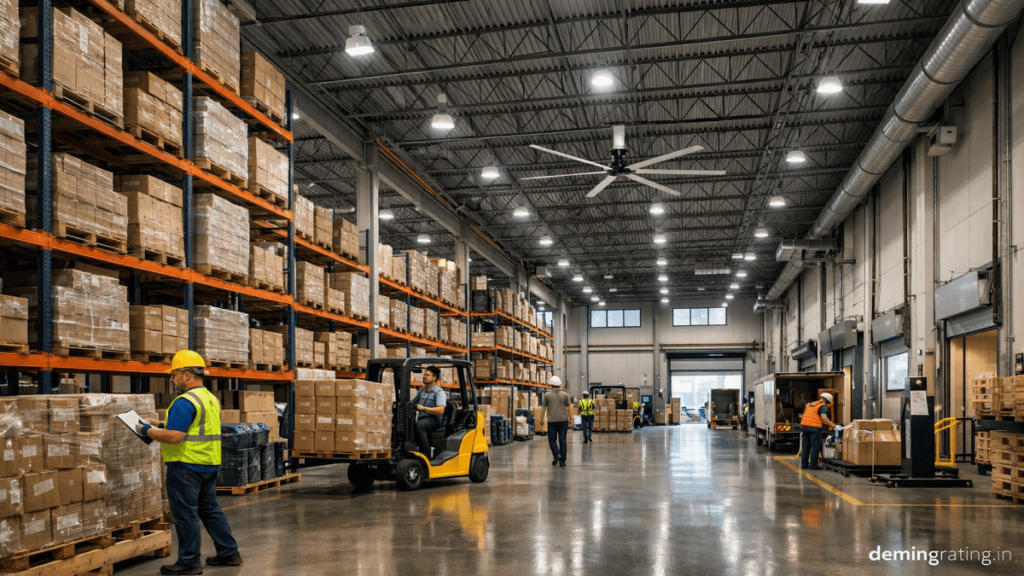
Warehouses are another major application for energy-efficient lighting. High ceilings, extensive floor areas, long operating hours, and intermittent occupancy make warehouses strong candidates for LED upgrades and automated controls.
Motion or occupancy sensors can reduce lighting levels when aisles or storage areas are unoccupied. LEDs can also respond quickly to control signals, allowing lighting levels to be adjusted according to activity. The DOE highlights occupancy sensing, dimming, and task tuning as strategies that can further improve the energy performance of LED systems. (U.S. Department of Energy)
Offices and Commercial Buildings
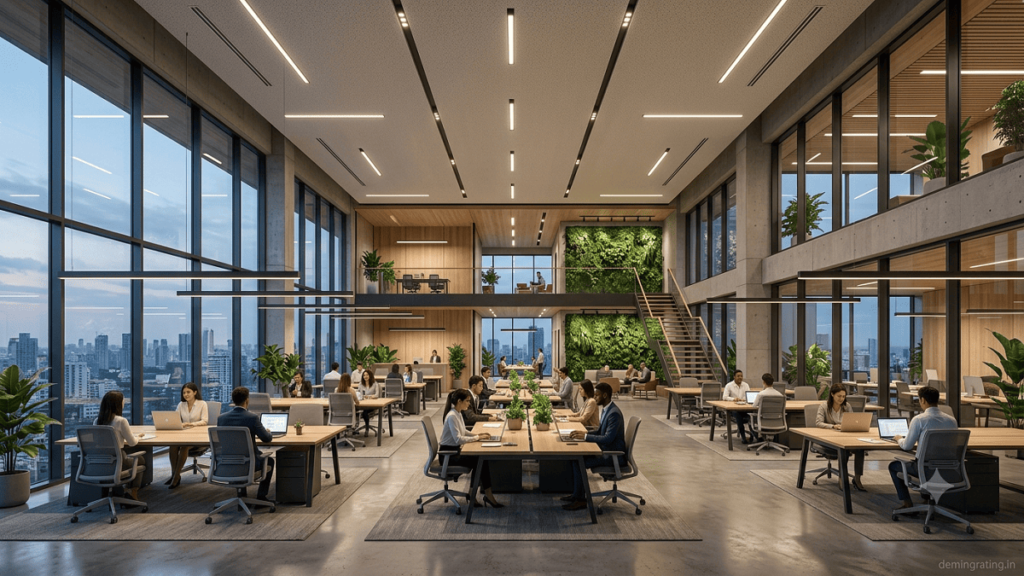
Commercial offices commonly use recessed troffers, linear fixtures, downlights, and suspended luminaires. Replacing inefficient lighting with LED systems can reduce electricity consumption while providing better control over brightness, color temperature, and light distribution.
Daylight-responsive controls can reduce artificial lighting near windows when natural light is sufficient. Occupancy sensors can also switch or dim lighting in meeting rooms, private offices, corridors, and other intermittently occupied areas.
Retail and Hospitality
Retail stores, hotels, and restaurants require lighting for both functional and aesthetic purposes. Energy-efficient LED fixtures can provide general illumination, accent lighting, display lighting, and architectural effects from the same basic technology platform.
LEDs are particularly useful for retail environments because their directional optical performance allows light to be concentrated on merchandise or architectural features. Dimming and color-control capabilities can also allow businesses to adjust lighting according to operating hours, events, or customer experience requirements.
Healthcare and Educational Facilities
Hospitals, clinics, schools, and universities operate diverse spaces with different lighting requirements. Classrooms require comfortable, uniform illumination, while hospitals may require specialized lighting for patient rooms, examination areas, corridors, and clinical spaces.
The DOE has conducted field studies of advanced LED lighting systems in classrooms, hospital rooms, and factories, examining their ability to adapt to occupancy, tasks, and daylight conditions while supporting occupant needs and energy performance.
Outdoor and Infrastructure Applications
Energy-efficient fixtures are also widely used for parking lots, garages, streets, security lighting, loading areas, and other outdoor applications. LED fixtures provide directional control and can operate with photocells, timers, motion sensors, and networked controls.
The DOE’s LED adoption research found that outdoor lighting has represented a particularly significant share of LED-related energy savings, demonstrating the potential of efficient fixtures in large-scale exterior applications. (U.S. Department of Energy)
Key Industry Benefits
Across these sectors, energy-efficient lighting can deliver four major benefits: lower electricity consumption, reduced maintenance costs, improved lighting quality, and greater operational control. LED fixtures can also support smart-building strategies by integrating with occupancy sensors, daylight harvesting, dimming systems, and building-management platforms.
For additional guidance, organizations can consult the DOE guidance on commercial and industrial LED luminaires, the DOE LED Basics resource, and the DOE LED retrofit application guide.
Overall, energy-efficient lighting fixtures have broad applications across manufacturing, warehousing, offices, retail, healthcare, education, hospitality, and outdoor infrastructure. By combining high-performance LED technology with appropriate lighting design and intelligent controls, industries can reduce operating expenses while creating safer, more productive, and more sustainable facilities.
#EnergyEfficientLighting
Ask FAQs
What are energy-efficient lighting fixtures?
Energy-efficient lighting fixtures are designed to provide effective illumination while consuming less electricity than conventional lighting systems. LED fixtures are among the most widely used options because they offer high efficiency, long service life, and flexible control capabilities.
How do LED fixtures reduce energy consumption?
LED fixtures produce more usable light with less electrical power compared with traditional incandescent and many older lighting technologies. Their efficiency can be further improved through dimming, occupancy sensors, daylight controls, and automated lighting systems.
Where are energy-efficient lighting fixtures commonly used?
They are widely used in manufacturing plants, warehouses, offices, retail stores, hotels, hospitals, schools, parking facilities, streets, and other commercial or industrial environments. High-bay LEDs are particularly suitable for warehouses and manufacturing facilities with high ceilings.
What factors should be considered when selecting an energy-efficient lighting fixture?
Important factors include luminous efficacy, light output, color temperature, color rendering, fixture lifespan, light distribution, operating conditions, controls compatibility, maintenance requirements, and total lifecycle cost. Choosing a fixture based only on its wattage may not provide the best overall result.
Can lighting controls improve the efficiency of LED fixtures?
Yes. Occupancy sensors, daylight sensors, dimmers, timers, and smart building controls can further reduce electricity consumption by operating lights only when required or adjusting their output according to occupancy and available natural light. Combining efficient fixtures with appropriate controls can significantly improve overall lighting performance.
Table of Contents
Disclaimer: The information provided is for general informational purposes only. Actual energy savings and performance may vary depending on the lighting system, installation, operating conditions, and building requirements.