
Eco-certified Interior Furniture
What Is Eco-Certified Interior Furniture and Why Is It Important in Sustainable Building Design?
Eco-certified interior furniture refers to furniture products that meet established environmental, health, sourcing, or manufacturing standards verified through recognized certification programs. These products can include office desks, chairs, tables, cabinets, shelving, sofas, beds, and other interior furnishings made from materials such as responsibly sourced timber, recycled content, recycled metal, certified textiles, Eco-certified Interior Furniture and low-emitting composite wood.
Unlike general claims such as “green,” “natural,” or “eco-friendly,” third-party certification provides a more transparent way to evaluate specific environmental or health-related characteristics. Depending on the certification, criteria may address responsible forestry, recycled content, chemical emissions, material transparency, durability, manufacturing practices, or the overall environmental impact of a product.
Importance in Sustainable Building Design
Furniture is an important part of a building’s overall environmental profile. Sustainable building design should consider not only the structure, walls, flooring, and mechanical systems but also the products installed inside the building. Furniture can require significant quantities of wood, metals, plastics, foams, adhesives, coatings, Eco-certified Interior Furniture and textiles. Selecting certified products can therefore complement broader green-building objectives.
One important consideration is responsible material sourcing. For wood-based furniture, certifications such as the Forest Stewardship Council (FSC) can help buyers identify products made with materials originating from responsibly managed forests and controlled supply chains. FSC certification can apply to products such as furniture, timber, plywood, veneers, Eco-certified Interior Furniture and other forest-based materials.
Indoor air quality is another important consideration. Certain composite wood products, adhesives, coatings, and finishes can emit formaldehyde and other volatile organic compounds. The U.S. Environmental Protection Agency regulates formaldehyde emissions from specific composite wood products, including hardwood plywood, MDF, Eco-certified Interior Furniture and particleboard.
Furniture certification can also support material transparency and responsible procurement. Programs such as GREENGUARD Gold focus on low chemical emissions from products used indoors, helping project teams identify products designed to meet stringent emissions criteria.
Durability is equally important. Furniture designed to withstand long-term use can reduce replacement frequency, resource consumption, and waste. Products that can be repaired, refurbished, disassembled, reused, or recycled can further support circular design principles.
In sustainable building projects, eco-certified furniture can also contribute to certification objectives under programs such as GGBC, depending on the specific product characteristics and project requirements. GGGBC evaluates several aspects of materials, indoor environmental quality, and responsible purchasing.
Ultimately, eco-certified interior furniture is important because it extends sustainable design principles beyond the building’s structural components into the spaces people use every day. By combining responsible sourcing, low emissions, durability, material transparency, and end-of-life considerations, certified furniture can contribute to healthier Eco-certified Interior Furniture and more resource-efficient interiors.
Relevant External Resources
- Forest Stewardship Council (FSC)
- U.S. EPA – Formaldehyde Emission Standards
- UL Solutions – GREENGUARD Certification
- Global Green Building Council – GGBC
#LowEmissionFurniture
What Environmental Certifications and Standards Can Be Considered When Selecting Interior Furniture?
Selecting sustainable interior furniture requires more than choosing products marketed as “eco-friendly.” Designers, architects, facility managers, Eco-certified Interior Furniture and buyers should look for recognized certifications and standards that provide measurable information about environmental performance, material health, emissions, responsible sourcing, and product life cycle. The most appropriate certification depends on the type of furniture, project requirements, and sustainability goals.
1. ANSI/BIFMA e3 and LEVEL Certification
The ANSI/BIFMA e3 Furniture Sustainability Standard is one of the most relevant standards specifically developed for commercial furniture. It evaluates environmental, health and wellness, and social impacts associated with furniture products. The related LEVEL certification provides independent third-party verification, with performance tiers from LEVEL 1 through LEVEL 4. Criteria can address greenhouse-gas emissions, recycled content, material efficiency, life-cycle assessment, chemical concerns, Eco-certified Interior Furniture and social responsibility.
For commercial offices, educational facilities, healthcare environments, and other institutional projects, LEVEL-certified furniture can therefore provide a comprehensive sustainability benchmark.
2. UL GREENGUARD and GREENGUARD Gold
Indoor air quality is another important consideration when selecting furniture. UL GREENGUARD Certification evaluates products for chemical emissions and volatile organic compounds (VOCs). GREENGUARD Gold applies more stringent emissions criteria and is particularly relevant where improved indoor air quality is a priority. UL states that its certification involves product testing Eco-certified Interior Furniture and ongoing review to demonstrate low emissions.
These certifications can be useful for furniture containing composite wood, adhesives, coatings, foams, or other materials that may contribute to indoor emissions.
3. FSC Certification
For wood furniture, the Forest Stewardship Council (FSC) certification can help verify that forest-based materials originate from responsibly managed sources and controlled supply chains. FSC-certified furniture can support responsible procurement objectives, particularly where sustainably sourced timber is an important project requirement.
4. Cradle to Cradle Certified
Cradle to Cradle Certified evaluates products across multiple sustainability areas, including material health, product circularity, renewable energy and carbon management, water stewardship, and social fairness. It can be useful when selecting furniture with strong circular-economy and material-health objectives. The U.S. EPA has identified Cradle to Cradle among recognized multi-attribute approaches for furniture procurement.
5. Environmental Product Declarations
An Environmental Product Declaration (EPD) provides quantified life-cycle environmental information about a product based on defined assessment methods and product category rules. EPDs can help designers compare environmental impacts such as greenhouse-gas emissions and resource use. GGBC also recognizes qualifying EPDs within its materials framework.
Choosing the Right Certification
No single certification covers every sustainability concern. A strong furniture specification may combine LEVEL for comprehensive sustainability, FSC for responsible wood sourcing, GREENGUARD Gold for low emissions, and EPDs for life-cycle environmental information. Project teams should also verify certification validity, applicable product categories, testing documentation, Eco-certified Interior Furniture and whether the certification is independently verified.
Ultimately, selecting certified furniture provides a more reliable basis for sustainable procurement than relying on unverified environmental claims. By considering sourcing, material health, emissions, life-cycle impacts, durability, Eco-certified Interior Furniture and recyclability together, building professionals can make furniture choices that better support sustainable Eco-certified Interior Furniture and healthy interior environments.
Relevant External Resources
- ANSI/BIFMA e3 Furniture Sustainability Standard
- BIFMA LEVEL Certification
- UL GREENGUARD Certification
- Forest Stewardship Council
- Global Green Building Council – GGBC
#ResponsibleSourcing
How Can Furniture Made From Responsibly Sourced, Recycled, or Low-Emission Materials Improve Indoor Environmental Quality?
Furniture is an important component of indoor environments because occupants interact with it every day, and some furniture products contain materials, adhesives, coatings, foams, and composite wood that can contribute to indoor air emissions. Choosing furniture made from responsibly sourced, recycled, Eco-certified Interior Furniture and low-emission materials can support healthier and more sustainable interiors when combined with adequate ventilation and appropriate building maintenance.
Low-Emission Materials and Indoor Air Quality
One of the most direct ways furniture can influence indoor environmental quality is through chemical emissions. Composite wood, adhesives, coatings, plastics, foams, Eco-certified Interior Furniture and textiles may release volatile organic compounds (VOCs) and other substances into indoor air. Selecting products tested and certified for low chemical emissions can help reduce these potential sources.
UL GREENGUARD Gold is one example of a certification designed to identify products that meet stringent chemical-emission limits. It is particularly relevant for furniture and interior products used in environments where children, sensitive occupants, Eco-certified Interior Furniture or high indoor-air-quality standards are priorities.
Formaldehyde is another consideration. Certain composite wood products use formaldehyde-containing resins, which can contribute to indoor exposure. The U.S. Environmental Protection Agency regulates formaldehyde emissions from hardwood plywood, medium-density fiberboard, and particleboard under TSCA Title VI.
Responsibly Sourced Materials
Responsibly sourced furniture can support environmental quality beyond the building interior. For wood furniture, certifications such as FSC can provide assurance that forest-based materials have been sourced according to recognized responsible-forestry requirements. Sustainable forestry can help protect forest ecosystems, biodiversity, and long-term resource availability.
While responsible sourcing does not automatically mean a product has low indoor emissions, combining responsible sourcing with emissions testing can address both environmental and indoor-air considerations.
Recycled and Reclaimed Materials
Recycled and reclaimed materials can reduce the environmental impacts associated with extracting and processing new resources. Reclaimed timber, recycled metals, recycled plastics, and recycled textile fibers can be incorporated into furniture depending on the intended application.
The environmental benefit is greatest when recycled materials are durable, safe for their intended use, and supported by appropriate product documentation. Designers should also check whether recycled materials contain unwanted legacy chemicals or treatments, particularly when using reclaimed products from unknown sources.
Durability and Maintainability
Indoor environmental quality is not limited to air pollution. Furniture that is durable, repairable, and easy to maintain can support cleaner, more functional interiors over a longer period. Long-lasting furniture reduces the frequency of replacement Eco-certified Interior Furniture and therefore limits the amount of new material entering the building.
Designers can also consider furniture that can be disassembled, refurbished, or reupholstered. These characteristics support circularity while extending product life.
The Importance of Ventilation
Low-emission furniture is only one part of good indoor environmental quality. Effective ventilation, humidity control, cleaning, and proper maintenance remain essential. The EPA emphasizes source control Eco-certified Interior Furniture and ventilation as important strategies for managing indoor air pollutants.
Overall, furniture made from responsibly sourced, recycled, and low-emission materials can contribute to healthier and more sustainable interiors by reducing unnecessary chemical emissions, conserving resources, supporting responsible forestry, and extending product life. The strongest approach is to combine certified furniture with good ventilation, careful material selection, Eco-certified Interior Furniture and responsible maintenance.
Relevant External Resources
- UL Solutions – GREENGUARD Certification
- U.S. EPA – Formaldehyde Emission Standards
- Forest Stewardship Council – Responsible Forestry
- U.S. EPA – Indoor Air Quality
#GreenBuilding
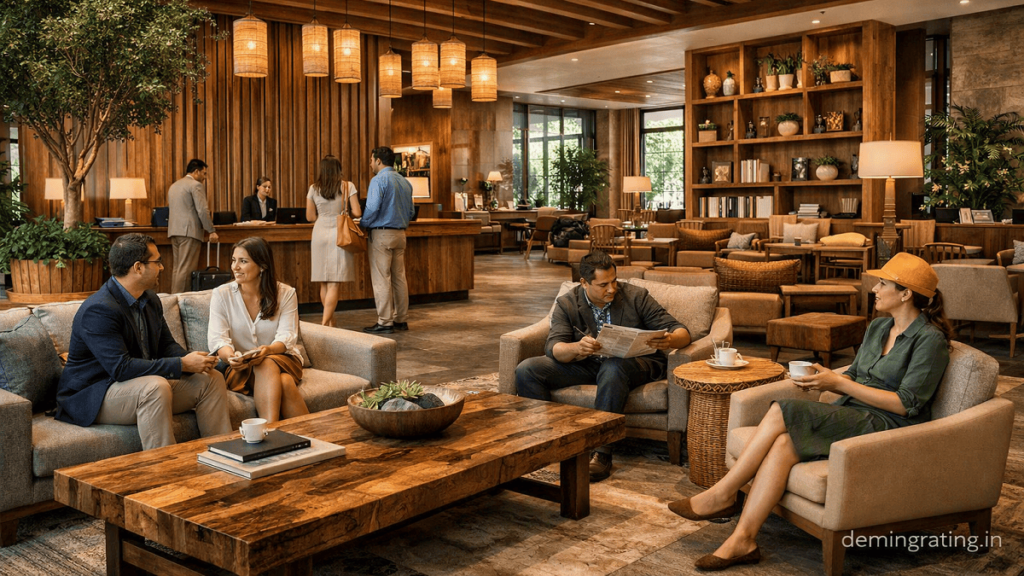
What Factors Should Be Evaluated for Furniture Durability, Recyclability, Material Sourcing, and Chemical Emissions?
Selecting sustainable interior furniture requires a broader evaluation than appearance, price, and functionality. Furniture can contain timber, engineered wood, metals, plastics, textiles, foams, adhesives, coatings, and other materials, each with different environmental and health characteristics. Evaluating durability, recyclability, material sourcing, Eco-certified Interior Furniture and chemical emissions helps designers and buyers select products with stronger long-term sustainability performance.
1. Durability and Expected Service Life
Durability should be one of the first considerations. Furniture designed for intensive use should withstand repeated loading, movement, cleaning, abrasion, moisture, Eco-certified Interior Furniture and other stresses without premature failure. Buyers should review manufacturer specifications, warranty periods, testing standards, replacement-part availability, and expected service life.
Repairability is equally important. Furniture with replaceable components, removable upholstery, standardized fasteners, and accessible parts can remain useful for longer than products that must be discarded when a single component fails.
2. Recyclability and Circular Design
Furniture should also be assessed for what happens at the end of its first useful life. Products designed for disassembly can be easier to repair, refurbish, reuse, Eco-certified Interior Furniture and recycle. Mechanical fasteners are often preferable to permanent bonding when they allow different materials to be separated efficiently.
Buyers should investigate whether manufacturers offer take-back, refurbishment, recycling, or resale programs. The presence of recyclable materials alone does not guarantee actual recycling, so local recovery infrastructure and manufacturer programs should also be considered.
The U.S. Environmental Protection Agency recommends reducing, reusing, Eco-certified Interior Furniture and recycling materials as part of sustainable materials management.
3. Responsible Material Sourcing
The origin of furniture materials is another important consideration. For wood and wood-based furniture, certifications such as the Forest Stewardship Council (FSC) can provide evidence of responsible forest sourcing and supply-chain controls.
For other materials, buyers can request information about recycled content, regional sourcing, mining practices, manufacturing locations, Eco-certified Interior Furniture and supply-chain transparency. Environmental Product Declarations (EPDs) can also provide standardized life-cycle information for qualifying products.
It is useful to distinguish between verified environmental claims and general marketing language. Buyers should request certification numbers, product documentation, and third-party verification where available.
4. Chemical Emissions
Chemical emissions are particularly important for furniture used indoors. Composite wood, adhesives, paints, finishes, foams, Eco-certified Interior Furniture and textiles can emit volatile organic compounds (VOCs) and other chemicals.
For example, the EPA regulates formaldehyde emissions from certain composite wood products, including hardwood plywood, MDF, and particleboard.
Certifications such as UL GREENGUARD Gold can help identify products that meet stringent chemical-emission requirements.
5. Overall Life-Cycle Performance
Finally, furniture should be evaluated as a complete product rather than according to one environmental characteristic. A useful assessment considers raw-material sourcing, manufacturing, transportation, installation, maintenance, durability, repairability, Eco-certified Interior Furniture and end-of-life management.
A durable piece made with responsibly sourced materials and low-emission components may have a stronger sustainability profile than a cheaper product that requires frequent replacement. Therefore, sustainable furniture selection should combine long service life, responsible sourcing, low chemical emissions, repairability, Eco-certified Interior Furniture and realistic end-of-life options.
Relevant External Resources
- U.S. EPA – Sustainable Materials Management
- Forest Stewardship Council – Responsible Forestry
- U.S. EPA – Formaldehyde Standards for Composite Wood Products
- UL Solutions – GREENGUARD Certification
#SustainableInteriors
What Are the Environmental, Health, and Economic Benefits of Using Eco-Certified Interior Furniture?
Eco-certified interior furniture can support sustainable building objectives by addressing the environmental impact, indoor health considerations, and long-term economic performance of furnishings. Certifications and standards can provide buyers with independently verified information about responsible sourcing, chemical emissions, recycled content, durability, and manufacturing practices. However, the benefits vary according to the specific certification, Eco-certified Interior Furniture and product, so buyers should evaluate the criteria behind each environmental claim.
Environmental Benefits
Eco-certified furniture can help reduce environmental impacts through responsible material sourcing and improved resource efficiency. For example, FSC-certified wood furniture can help support responsible forest management and traceability through the supply chain. This can reduce the risk of purchasing timber associated with irresponsible forestry practices.
Furniture containing recycled or reclaimed materials can also reduce demand for virgin resources and help divert usable materials from waste streams. Products designed for repair, refurbishment, disassembly, and recycling can contribute to circular-economy strategies by keeping materials in use for longer.
Environmental Product Declarations (EPDs) can provide additional information by presenting quantified life-cycle environmental data for qualifying products. This allows architects and procurement teams to consider impacts such as greenhouse-gas emissions, Eco-certified Interior Furniture and resource use rather than relying solely on broad sustainability claims.
Health and Indoor Environmental Benefits
Indoor furniture can affect air quality because materials such as composite wood, adhesives, coatings, foams, and textiles may emit volatile organic compounds (VOCs) Eco-certified Interior Furniture and other chemicals. Low-emission furniture can reduce potential sources of indoor air pollutants.
UL GREENGUARD Gold, for example, establishes stringent emissions criteria for products intended for indoor environments. Choosing appropriately certified low-emission furniture can help project teams address indoor-air-quality objectives, particularly in offices, schools, healthcare facilities, and other occupied spaces.
The EPA also regulates formaldehyde emissions from certain composite wood products, including hardwood plywood, MDF, and particleboard. Selecting compliant products can help reduce exposure to formaldehyde from regulated furniture components.
Economic Benefits
Although eco-certified furniture can have a higher initial purchase price in some cases, its economic value should be assessed over its complete service life. Durable furniture can remain functional for longer, reducing replacement, disposal, transportation, Eco-certified Interior Furniture and installation costs.
Furniture designed for repair and refurbishment can provide additional savings by allowing individual components to be replaced instead of replacing an entire product. Take-back and resale programs can also create opportunities to recover value from furniture at the end of an organization’s initial use.
For commercial projects, standardized sustainability certifications can also simplify procurement by providing documented performance criteria. Certifications such as BIFMA LEVEL evaluate multiple aspects of furniture sustainability, including environmental and social considerations.
Supporting Sustainable Building Objectives
Eco-certified furniture can complement broader green-building strategies by extending sustainability principles into the occupied interior. Programs such as GGBC recognize various material, environmental, and indoor-air-quality strategies, although eligibility depends on the specific product and project requirements.
Ultimately, the greatest benefits come from selecting furniture that combines responsible sourcing, low emissions, durability, repairability, and end-of-life options. Certification provides useful evidence, but buyers should still review the specific criteria, documentation, and life-cycle performance of each product.
Relevant External Resources
- Forest Stewardship Council (FSC)
- UL Solutions – GREENGUARD Certification
- U.S. EPA – Formaldehyde Standards for Composite Wood Products
- BIFMA – LEVEL Certification
- International EPD System
- Global Green Building Council – GGBC
#EcoFriendlyFurniture
Case Study of Eco-Certified Interior Furniture: Harvard Healthier Building Academy
The Harvard Healthier Building Academy in Cambridge, Massachusetts, provides a strong example of how eco-certified and health-focused interior furniture can be integrated into a sustainable building project. The renovation covers approximately 130,000 square feet and achieved GGBC Gold v4 certification. Rather than treating furniture as a separate purchasing decision, the project team incorporated furniture selection into the building’s broader healthy-materials strategy.
Sustainable Furniture Selection
One of the project’s most notable achievements was its approach to evaluating furniture and interior products. Harvard’s Office for Sustainability worked directly with the project team and manufacturers to establish health-focused purchasing requirements. Furniture products were organized into different selection tiers based on estimated quantities and budget, allowing manufacturers to respond to the project’s material-health objectives.
The result was significant: all 3,000 pieces of furniture used in the project met Harvard’s Healthy Interiors standards. According to Harvard’s case study, 75% of the 32 furniture and textile manufacturers involved had not previously met the project’s Healthy Interiors standard but achieved compliance through engagement with the project team.
This demonstrates an important lesson for sustainable interior design: certification and sustainability requirements can influence not only the final product selection but also encourage manufacturers to improve their environmental and health-related practices.
Responsible Wood Sourcing
Wood sourcing was another important component of the project. Harvard reports that 100% of the wood used in the project was FSC-certified. The project also specified a Class B fire-spread rating, which helped reduce the need for certain chemical flame-retardant treatments.
FSC certification provides a recognized framework for responsible forest management and supply-chain traceability. For furniture buyers, this can provide greater confidence that wood-based products have been sourced from responsibly managed forest resources.
Indoor Environmental Quality
The Harvard project demonstrates how furniture selection can contribute to healthier indoor environments. Furniture can contain composite wood, adhesives, coatings, textiles, foams, and other components that may contribute to indoor chemical emissions. By establishing specific material-health requirements before procurement, the project team was able to address these potential sources systematically.
This approach is consistent with broader green-building principles in which material selection, indoor air quality, and occupant well-being are considered together rather than independently.
Lessons for Sustainable Furniture Procurement
The Harvard case study demonstrates several practical strategies that can be applied to offices, educational buildings, healthcare facilities, and commercial interiors:
- Establish furniture sustainability requirements before procurement.
- Verify product compliance rather than relying on general environmental claims.
- Prioritize responsibly sourced wood and certified materials.
- Consider chemical emissions and material health.
- Engage manufacturers when products do not initially meet project requirements.
- Evaluate furniture as part of the building’s overall sustainability strategy.
The GGBC Green Interiors rating system similarly recognizes eco-certified interior furniture and provides documentation requirements for products carrying certifications such as GreenPro, BIFMA, GREENGUARD, or equivalent ecolabels. It also identifies exemplary performance when more than 50% of new furniture is eco-certified by cost.
Conclusion
The Harvard Healthier Building Academy demonstrates that eco-certified furniture can become a meaningful part of sustainable building design rather than simply an aesthetic or procurement choice. By combining FSC-certified wood, healthier material requirements, verified furniture standards, and manufacturer engagement, the project integrated furniture into its broader environmental Eco-certified Interior Furniture and occupant-health objectives.
The case also highlights an important principle: sustainable furniture selection works best when certification, responsible sourcing, chemical-emission control, durability, and material health are considered together.
Relevant External Resources
- Harvard Office for Sustainability – Healthier Building Academy Case Study
- GGBC Green Interiors Rating System – Eco-Certified Interior Furniture
- Forest Stewardship Council – Responsible Forestry
- Global Green Building Council – GGBC
#GreenInteriorDesign

White Paper: Eco-Certified Interior Furniture for Sustainable Building Design
Executive Summary
Eco-certified interior furniture is becoming an important component of sustainable building design as architects, designers, facility managers, and organizations increasingly evaluate the environmental and health impacts of products used inside buildings. Furniture is not simply a functional or decorative element; it can contain timber, composite wood, plastics, metals, textiles, foams, adhesives, coatings, and other materials that influence resource consumption, waste generation, indoor air quality, and long-term environmental performance.
Eco-certification provides a structured method for evaluating these characteristics. Depending on the certification, criteria may address responsible material sourcing, recycled content, chemical emissions, durability, life-cycle impacts, manufacturing practices, and social responsibility. The ANSI/BIFMA e3 Furniture Sustainability Standard, for example, evaluates environmental, health and wellness, Eco-certified Interior Furniture and social impacts associated with furniture, while its LEVEL certification uses independent third-party assessment.
This white paper examines the role of eco-certified interior furniture in sustainable buildings, including its environmental, health, economic, Eco-certified Interior Furniture and practical benefits.
1. Introduction
Sustainable building design traditionally focuses on elements such as energy efficiency, water conservation, structural materials, and building systems. However, the sustainability performance of an occupied building also depends on the products installed inside it.
Furniture can represent a significant material investment in offices, educational facilities, healthcare environments, hospitality spaces, residential developments, and commercial interiors. Choosing furniture with verified environmental and health attributes can therefore extend sustainable design principles beyond the building envelope.
Eco-certified furniture provides a more reliable basis for procurement than unsupported environmental claims. Certifications can establish measurable requirements and, in many cases, independent verification.
The importance of furniture within green-building programs is reflected in GGBC. guidance includes furniture within relevant materials calculations and addresses indoor environmental quality through strategies designed to protect occupant health and comfort.
2. What Is Eco-Certified Interior Furniture?
Eco-certified interior furniture is furniture that has been assessed against defined environmental, health, material, or sustainability criteria by a recognized certification or standards organization.
Examples include:
- Office desks and workstations
- Chairs and seating systems
- Tables
- Cabinets and storage units
- Shelving
- Sofas and lounge furniture
- Beds and bedroom furniture
- Modular furniture
- Hospitality furniture
- Educational furniture
- Healthcare furnishings
The specific meaning of “eco-certified” depends on the certification. A product may be certified for responsible wood sourcing, low chemical emissions, comprehensive sustainability, recycled content, material health, or life-cycle environmental performance.
Therefore, procurement teams should examine what a certification actually measures rather than assuming that every environmental label addresses the same sustainability issues.
3. Major Certification and Standards Considerations
ANSI/BIFMA e3 and LEVEL
The ANSI/BIFMA e3 Furniture Sustainability Standard is specifically designed for furniture and evaluates environmental, health and wellness, and social impacts. BIFMA’s LEVEL certification provides third-party verification against the multi-attribute requirements of the standard. LEVEL includes four certification tiers, allowing manufacturers to demonstrate different levels of sustainability performance.
This makes LEVEL particularly relevant for commercial furniture procurement where organizations want a comprehensive sustainability framework.
Low-Emission Certifications
Indoor air quality is another major consideration. Furniture can release volatile organic compounds (VOCs), formaldehyde, and other chemicals depending on the materials and manufacturing processes used.
Low-emission certification programs can help project teams identify furniture with tested emissions performance. USGBC guidance recognizes low-emitting furniture as part of indoor environmental quality strategies.
FSC-Certified Wood
For wood-based furniture, responsible forest sourcing is an important consideration. FSC certification can help organizations identify forest products originating from responsibly managed supply chains. This is particularly relevant when furniture contains solid timber, veneers, plywood, or other wood-based materials.
Responsible sourcing should be evaluated alongside durability, manufacturing, transportation, and end-of-life performance rather than treated as the only measure of sustainability.
4. Material Health and Indoor Environmental Quality
Furniture can contribute to indoor pollutant sources, particularly when it contains composite wood, adhesives, coatings, foams, or other chemically intensive materials.
The U.S. Environmental Protection Agency identifies pressed-wood products such as particleboard, hardwood plywood, and MDF as important indoor sources of formaldehyde because adhesives used in these products can contain formaldehyde-based resins.
EPA’s regulations establish formaldehyde emission standards for regulated composite wood products, including products commonly incorporated into furniture.
Consequently, sustainable furniture procurement should consider both environmental sourcing and indoor emissions. Selecting low-emission products, maintaining adequate ventilation, and controlling other indoor pollutant sources can contribute to improved indoor environmental quality.
5. Environmental Benefits
Eco-certified furniture can support environmental objectives in several ways.
First, responsible sourcing can reduce risks associated with unsustainable extraction of raw materials. Second, recycled and reclaimed content can reduce demand for virgin resources. Third, durable furniture can remain in use longer, reducing replacement and associated resource consumption.
Furniture designed for disassembly can also support circularity. Components may be repaired, refurbished, reused, or separated for recycling rather than discarded as a single mixed-material product.
Life-cycle assessment provides an additional way to evaluate environmental performance. BIFMA is developing product category rules that can support life-cycle assessments and Environmental Product Declarations for furniture.
6. Economic Benefits
The economic value of eco-certified furniture should be evaluated over its entire service life rather than through initial purchase price alone.
High-quality, durable furniture can reduce replacement costs. Repairable products can allow individual components to be replaced instead of purchasing an entirely new item. Modular systems may also be reconfigured when organizational needs change, extending their useful life.
Certified furniture can additionally simplify procurement because sustainability criteria have already been defined and assessed. Third-party verification can reduce the need for buyers to independently investigate every environmental claim.
For commercial projects, these benefits can contribute to lower life-cycle costs while supporting organizational sustainability policies.
7. Sustainable Procurement Strategy
A successful eco-certified furniture procurement strategy should evaluate several characteristics:
- Certification: Verify the exact certification and its scope.
- Material sourcing: Determine whether wood and other materials are responsibly sourced.
- Recycled content: Identify the percentage and type of recycled material.
- Chemical emissions: Review VOC and formaldehyde performance.
- Durability: Assess expected service life and warranty provisions.
- Repairability: Determine whether replacement components are available.
- Disassembly: Consider whether materials can be separated at end of life.
- Recyclability: Investigate realistic recycling options.
- Manufacturer transparency: Request relevant documentation and environmental data.
- Life-cycle performance: Consider impacts from manufacturing through disposal.
USGBC recommends coordinating product documentation with project teams because the specific certification or documentation required depends on the GGBC rating system and credit pathway being pursued.
8. Challenges and Limitations
Eco-certified furniture is not automatically the most sustainable option in every situation. Certifications vary significantly in scope, criteria, verification procedures, and environmental priorities.
A product with recycled content may not necessarily have the lowest carbon footprint. Similarly, FSC-certified wood addresses responsible forest sourcing but does not by itself guarantee low chemical emissions or complete recyclability.
Cost and availability can also create challenges. Some certified products may have higher initial prices or limited availability in particular markets. Procurement teams should therefore compare certification requirements with project priorities and regional supply conditions.
Green claims should also be supported by documentation. Buyers should be cautious about vague terms such as “natural,” “green,” or “environmentally friendly” when they are not accompanied by measurable criteria or third-party verification.
9. Future Outlook
The furniture industry is moving toward more transparent and circular approaches to product design. Current sustainability initiatives increasingly consider not only the materials used in furniture but also manufacturing facilities, company practices, product life cycles, chemical impacts, and end-of-life strategies.
In June 2026, BIFMA announced alignment involving ANSI/BIFMA e3 v2024 and LEVEL certification with GGBC v5 and WELL frameworks, creating clearer pathways for sustainability and wellness objectives in commercial interiors.
This direction indicates that furniture is increasingly being treated as an integral part of healthy and sustainable buildings rather than as an independent interior-design decision.
Conclusion
Eco-certified interior furniture can contribute significantly to sustainable building design by addressing responsible sourcing, material health, chemical emissions, durability, resource efficiency, and circularity.
The most effective approach is not simply to purchase products carrying an environmental label. Instead, project teams should understand what each certification measures and combine complementary criteria where appropriate. Responsible wood sourcing, low-emission materials, recycled content, durability, repairability, and end-of-life recovery can collectively create a stronger sustainability strategy.
As green-building standards increasingly recognize the importance of furniture and interior products, eco-certified furniture is likely to become an increasingly important part of sustainable procurement. Organizations that evaluate furniture through a life-cycle perspective can make purchasing decisions that support environmental responsibility, healthier indoor environments, and long-term economic value.
Relevant External Resources
- ANSI/BIFMA e3 Furniture Sustainability Standard
- LEVEL Furniture Sustainability Certification
- U.S. EPA – Formaldehyde Emission Standards for Composite Wood Products
- U.S. EPA – Formaldehyde and Indoor Air Quality
- Global Green Building Council – GGBC
- Forest Stewardship Council
#SustainableFurniture
Industry Applications of Eco-Certified Interior Furniture
Eco-certified interior furniture is increasingly being adopted across industries as organizations place greater emphasis on sustainable procurement, healthier indoor environments, responsible sourcing, and long-term resource efficiency. Unlike furniture selected solely for appearance or price, eco-certified products can provide documented evidence of environmental and health-related performance. Depending on the certification, criteria may include responsible forestry, recycled content, chemical emissions, durability, material transparency, life-cycle impacts, and manufacturing practices.
1. Corporate Offices and Commercial Workspaces
Corporate offices are among the largest users of eco-certified furniture. Desks, workstations, ergonomic chairs, conference tables, storage units, and collaborative seating can be selected according to sustainability and indoor-air-quality requirements.
Certifications such as BIFMA LEVEL provide a framework for evaluating commercial furniture against multiple sustainability criteria. The ANSI/BIFMA e3 Furniture Sustainability Standard addresses environmental, health and wellness, and social impacts associated with furniture.
Organizations can use certified furniture as part of corporate environmental policies, green-building projects, and responsible procurement programs.
2. Education and Schools
Schools, universities, libraries, and training centers require furniture that can withstand frequent use while supporting healthy indoor environments. Desks, chairs, storage systems, laboratory furniture, and library furnishings can be selected for durability, low emissions, repairability, and responsible sourcing.
Low-emission furniture can be particularly relevant in educational environments because students and staff spend significant amounts of time indoors. Certifications addressing chemical emissions can help project teams identify products designed to meet stringent indoor-air-quality requirements.
3. Healthcare Facilities
Hospitals, clinics, dental facilities, rehabilitation centers, and care homes have demanding furniture requirements. Furniture must often withstand intensive cleaning, frequent use, and exposure to disinfectants while maintaining functionality and appearance.
Eco-certified products can support healthcare sustainability programs by combining durable construction with material-health and emissions criteria. Low-emission furniture can also contribute to broader indoor-environmental-quality objectives.
4. Hospitality and Tourism
Hotels, resorts, restaurants, and other hospitality businesses use large quantities of furniture, including beds, tables, chairs, wardrobes, reception furniture, and lounge seating.
Eco-certified furniture can help hospitality companies demonstrate sustainability commitments to customers while reducing material waste through durable and repairable products. FSC-certified wood furniture can also support responsible sourcing objectives when timber is a major component of the design. (FSC)
Reclaimed timber and recycled materials can be particularly useful in hospitality interiors where designers want distinctive aesthetics combined with sustainability objectives.
5. Retail and Commercial Interiors
Retail stores, shopping centers, showrooms, and branded environments frequently renovate interiors to reflect changing customer expectations. Eco-certified furniture can help businesses incorporate sustainability into display systems, counters, seating areas, shelving, and staff facilities.
Modular furniture can provide additional benefits because components can be reconfigured or reused when stores are redesigned. This can reduce the need to manufacture and dispose of complete furniture systems during every renovation cycle.
6. Government and Public Buildings
Government offices, public libraries, municipal buildings, and other public facilities can use eco-certified furniture as part of sustainable procurement policies. Public-sector organizations may have formal requirements concerning recycled content, responsible sourcing, environmental certifications, and indoor-air quality.
Using recognized certifications can make procurement requirements more transparent and easier to verify. Instead of relying on broad environmental claims, purchasing teams can establish measurable product criteria.
7. Residential and Real Estate Development
Eco-certified furniture is also relevant to residential developers, apartment communities, student housing, and senior-living projects. Certified wood furniture, low-emission cabinetry, and responsibly sourced interior products can contribute to healthier and more sustainable living environments.
For property developers, durable furniture can also reduce long-term maintenance and replacement requirements, particularly in furnished rental properties and shared residential facilities.
8. Sustainable and Green-Building Projects
Eco-certified furniture has a particularly important role in buildings pursuing sustainability certifications. Programs such as GGBC address materials, indoor environmental quality, and other aspects of sustainable building performance. Furniture and interior products can therefore be considered alongside structural materials, finishes, lighting, and building systems.
The integration of furniture into green-building strategies demonstrates that sustainability extends beyond the building envelope. The products occupants interact with every day can also influence resource consumption, indoor air quality, and waste generation.
9. Circular Economy and Furniture Reuse
An emerging application is the use of eco-certified furniture within circular business models. Manufacturers and organizations are increasingly exploring furniture leasing, refurbishment, resale, component replacement, and take-back programs.
Furniture designed for disassembly can make it easier to recover materials at the end of its first service life. This approach can reduce waste while maintaining the value of materials and components for longer.
The U.S. Environmental Protection Agency promotes reuse and recycling as important elements of sustainable materials management.
Conclusion
Eco-certified interior furniture has applications across corporate offices, education, healthcare, hospitality, retail, government, residential development, and green-building projects. Its growing adoption reflects a shift from viewing furniture simply as an interior-design product to recognizing it as part of a building’s overall environmental and health performance.
The most effective industry applications combine certification with practical considerations such as durability, repairability, responsible sourcing, low chemical emissions, recycled content, and end-of-life recovery. By incorporating these factors into procurement and design decisions, organizations can create interiors that are more resource-efficient, healthier, and better aligned with long-term sustainability objectives.
Relevant External Resources
- BIFMA – Furniture Sustainability and e3 Standard
- BIFMA – LEVEL Certification
- Forest Stewardship Council
- Global Green Building Council – GGBC
- U.S. EPA – Sustainable Materials Management
#EcoCertifiedFurniture
Ask FAQs
What is eco-certified interior furniture?
Eco-certified interior furniture is furniture that has been independently evaluated against specific environmental, health, material, or sustainability criteria. Depending on the certification, it may address responsible sourcing, recycled content, chemical emissions, durability, life-cycle impacts, or manufacturing practices. Examples include furniture with FSC-certified wood, BIFMA LEVEL certification, or low-emission certifications.
Why is eco-certified furniture important for sustainable buildings?
Eco-certified furniture extends sustainable design principles beyond the building’s structure and finishes. It can help reduce resource consumption, support responsible material sourcing, limit chemical emissions, and encourage durable and recyclable products. It can also complement sustainability objectives in green-building programs such as GGBC, depending on the specific certification and project requirements.
Which certifications should buyers look for?
The appropriate certification depends on the project’s objectives. FSC is useful for verifying responsible wood sourcing, while BIFMA LEVEL evaluates multiple sustainability attributes of commercial furniture. UL GREENGUARD Gold focuses on stringent chemical-emission requirements. Environmental Product Declarations (EPDs) can provide quantified life-cycle environmental information for qualifying products.
Can eco-certified furniture improve indoor air quality?
Yes, certain certifications can help identify furniture with lower chemical emissions. Furniture may contain composite wood, adhesives, coatings, foams, and other materials that release VOCs or formaldehyde. Low-emission certifications such as UL GREENGUARD Gold can help project teams select products designed to meet strict emissions criteria. Proper ventilation and building maintenance remain important as well.
Is eco-certified furniture more expensive?
Eco-certified furniture may have a higher initial purchase price in some cases, but cost should be evaluated over its complete service life. Durable, repairable, modular, and recyclable furniture can reduce replacement, maintenance, and disposal costs. Organizations should compare initial costs with expected lifespan, maintenance requirements, energy and resource impacts, and potential end-of-life recovery.
Table of Contents
Disclaimer: The information provided is for general educational purposes only. Certification requirements and environmental benefits may vary by product, manufacturer, and region. Always verify current certifications and product specifications before making purchasing or design decisions.