
Commissioning Plan
A commissioning plan is a structured document that defines the processes, responsibilities, schedules, and verification methods required to ensure that a building, industrial facility, or engineered system performs according to the owner’s requirements and design intent. It is commonly used in construction, manufacturing, energy, and infrastructure projects to reduce operational risks and improve long-term performance.
The primary purpose of a commissioning plan is to establish a clear roadmap for testing and validating systems before they are handed over for operation. It typically begins during the design phase and continues through construction, installation, testing, and final acceptance. Early planning is critical because many performance issues originate from coordination gaps between design, procurement, and installation teams.
A comprehensive commissioning plan generally includes several key components. First, it identifies the project scope and the systems to be commissioned, such as HVAC, electrical distribution, plumbing, fire protection, automation, or production equipment. Second, it defines roles and responsibilities for owners, consultants, contractors, vendors, and commissioning authorities. Third, it establishes a detailed schedule that aligns commissioning activities with overall project milestones.
The document also specifies testing and verification procedures. These may include factory acceptance tests, site acceptance tests, pre-functional inspections, functional performance tests, and integrated system testing. Proper documentation of test results is essential for demonstrating compliance and supporting future maintenance activities.
In addition to technical verification, a commissioning plan addresses training and handover requirements. Operators and maintenance personnel must receive adequate instruction on system operation, safety procedures, troubleshooting, and preventive maintenance. This step helps ensure that the facility continues to perform efficiently after occupancy or startup.
The benefits of a well-executed commissioning plan are substantial. It can improve energy efficiency, enhance occupant comfort, increase equipment reliability, reduce warranty claims, and lower lifecycle operating costs. According to the U.S. Department of Energy, effective building commissioning can produce significant energy savings and operational improvements. More information is available at U.S. Department of Energy – Building Commissioning . Industry guidance is also provided by ASHRAE in its commissioning standards and guidelines: ASHRAE Commissioning Resources .
In conclusion, a commissioning plan is not merely a testing checklist; it is a strategic quality assurance tool that integrates design intent, construction quality, system performance, and operational readiness. Organizations that invest in thorough commissioning planning are better positioned to deliver reliable, efficient, and compliant facilities that meet both immediate project goals and long-term operational expectations.
What Is a Commissioning Plan?
A commissioning plan is a formal document that outlines the procedures, responsibilities, schedules, and verification activities required to ensure that a building, industrial facility, or engineered system operates according to the owner’s requirements and the design intent. It serves as a roadmap for testing and validating systems before they are placed into full operation.
Commissioning is commonly used in construction projects, manufacturing plants, power facilities, data centers, and other complex environments where multiple systems must work together reliably. The commissioning plan is typically developed during the early stages of a project and updated throughout design, construction, testing, and handover.
The plan begins by defining the scope of commissioning. This includes identifying which systems will be tested, such as HVAC, electrical, plumbing, fire protection, automation, or production equipment. It also establishes the project objectives, performance criteria, and documentation requirements.
Another important element is the assignment of roles and responsibilities. The commissioning plan specifies who is responsible for inspections, testing, documentation, issue resolution, and final approval. Participants may include the owner, design consultants, contractors, equipment suppliers, and a commissioning authority.
Testing and verification procedures form the core of the plan. These activities may include pre-functional inspections, functional performance testing, integrated system testing, and acceptance testing. The purpose is to confirm that each component has been installed correctly and that all systems operate together as intended under various operating conditions.
The commissioning plan also includes a schedule that coordinates commissioning activities with construction milestones. Proper scheduling helps avoid delays and ensures that testing occurs when systems are ready and accessible.
In addition to technical verification, the plan addresses training and handover requirements. Facility operators and maintenance personnel receive instruction on system operation, safety procedures, troubleshooting, and maintenance practices. Complete documentation, including test reports, manuals, and warranties, is typically provided at project closeout.
A well-prepared commissioning plan offers several benefits. It reduces operational risks, improves energy efficiency, increases equipment reliability, enhances occupant comfort, and lowers long-term maintenance costs. Industry organizations such as ASHRAE provide detailed guidance on commissioning practices and standards: ASHRAE Commissioning Resources . Additional information on building commissioning is available from the U.S. Department of Energy: U.S. Department of Energy – Building Commissioning .
In summary, a commissioning plan is a structured quality assurance document that ensures systems are designed, installed, tested, and handed over in a condition that supports safe, efficient, and reliable operation throughout the life of the facility.
What Are the Key Components of an Effective Commissioning Plan?
An effective commissioning plan is a critical document that ensures building systems, industrial equipment, or infrastructure assets are designed, installed, tested, and operated according to project requirements. It provides a structured approach to quality assurance and helps reduce operational risks, delays, and costly rework. While the exact format may vary by industry, several key components are essential for a successful commissioning process.
Project Scope and Objectives
The commissioning plan should clearly define the scope of work and identify which systems will be commissioned. These may include HVAC, electrical, plumbing, fire protection, automation, process equipment, or renewable energy systems. The document should also state the project objectives, such as energy efficiency, safety, reliability, regulatory compliance, or performance optimization.
Owner’s Project Requirements and Design Intent
A strong commissioning plan aligns all activities with the owner’s expectations and the original design intent. This ensures that the final installation delivers the required functionality, capacity, and operational performance. Any deviations from the design should be documented and approved.
Roles and Responsibilities
The plan must assign responsibilities to all parties involved, including the owner, design consultants, contractors, subcontractors, equipment vendors, and the commissioning authority. Clear accountability prevents confusion and improves coordination during testing and issue resolution.
Commissioning Schedule
An effective plan includes a detailed schedule integrated with the overall project timeline. It identifies key milestones such as equipment delivery, installation completion, pre-functional inspections, functional testing, integrated system testing, and final acceptance. Proper scheduling helps avoid delays and ensures resources are available when needed.
Testing and Verification Procedures
This is the core of the commissioning plan. The document should describe the methods, acceptance criteria, required instruments, and documentation for each test. Common activities include factory acceptance tests (FAT), site acceptance tests (SAT), pre-functional checklists, functional performance tests, and integrated system tests.
Documentation and Issue Tracking
All commissioning activities should be recorded in a structured manner. The plan should specify how deficiencies, non-conformances, corrective actions, and retesting will be tracked and resolved. Accurate documentation is essential for compliance, warranties, and future maintenance.
Training and Handover
Operators and maintenance personnel must receive adequate training on system operation, safety procedures, troubleshooting, and preventive maintenance. The final handover package should include manuals, test reports, as-built drawings, warranties, and commissioning records.
Industry guidance from ASHRAE provides detailed recommendations for commissioning processes: ASHRAE Commissioning Resources . Additional best practices are available from the U.S. Department of Energy: Building Commissioning | Department of Energy .
In conclusion, the most effective commissioning plans combine clear objectives, defined responsibilities, rigorous testing, thorough documentation, and comprehensive training. These components work together to ensure that systems perform safely, efficiently, and reliably throughout the operational life of the facility.
How Does a Commissioning Plan Improve Building and System Performance?
A commissioning plan improves building and system performance by providing a structured process for verifying that all installed systems operate according to the owner’s requirements and the original design intent. Rather than relying solely on construction completion, commissioning focuses on functional performance, integration, and long-term operational efficiency. This approach helps identify and correct problems before the facility becomes fully operational.
One of the most significant benefits is improved energy efficiency. Systems such as HVAC, lighting, controls, and electrical distribution are tested under real operating conditions to ensure they are properly calibrated and coordinated. Incorrect sensor settings, control sequences, airflow rates, or equipment configurations can lead to unnecessary energy consumption. By detecting and correcting these issues early, commissioning can reduce utility costs and improve overall energy performance.
Commissioning also enhances system reliability. Pre-functional inspections and functional performance tests verify that equipment has been installed correctly and operates within specified parameters. This reduces the likelihood of premature failures, unexpected shutdowns, and costly emergency repairs. In complex facilities such as hospitals, data centers, and industrial plants, improved reliability is essential for maintaining continuous operations.
Another important advantage is better occupant comfort and indoor environmental quality. Properly commissioned HVAC systems maintain stable temperature, humidity, ventilation, and air quality conditions. Occupants are less likely to experience hot and cold spots, poor airflow, excessive noise, or inadequate fresh air supply. These improvements can contribute to higher satisfaction and productivity.
A commissioning plan also ensures that different building systems work together effectively. Integrated testing verifies interactions between HVAC, fire alarm, smoke control, security, lighting, and building automation systems. Without this step, individually functional systems may fail to perform correctly when operating as a complete building.
From a maintenance perspective, commissioning provides comprehensive documentation, including test reports, as-built drawings, control sequences, and operating procedures. This information helps facility staff troubleshoot problems more efficiently and supports preventive maintenance programs throughout the building’s lifecycle.
Training is another critical factor. Operators receive instruction on system operation, safety procedures, alarms, and maintenance requirements. Well-trained personnel are more likely to operate equipment correctly and maintain performance over time.
Research from the U.S. Department of Energy shows that commissioning can deliver measurable energy savings and operational improvements in both new and existing buildings. Additional information is available at U.S. Department of Energy – Building Commissioning . Industry standards and best practices are also provided by ASHRAE: ASHRAE Commissioning Resources .
In conclusion, a commissioning plan improves building and system performance by optimizing energy efficiency, increasing reliability, enhancing occupant comfort, ensuring system integration, supporting maintenance, and preparing operators for effective long-term operation. It is a proactive investment that delivers technical, financial, and operational benefits throughout the life of the facility.

What Roles and Responsibilities Are Involved in the Commissioning Process?
The commissioning process is a collaborative effort that involves multiple stakeholders working together to ensure that building systems or industrial equipment are designed, installed, tested, and operated according to the owner’s requirements. Clearly defined roles and responsibilities are essential for avoiding confusion, improving coordination, and achieving successful project outcomes.
Owner or Client
The owner is the primary stakeholder and establishes the project objectives, budget, performance expectations, and operational requirements. The owner approves the commissioning scope, selects the commissioning authority, reviews key documentation, and accepts the final commissioned systems. The owner also ensures that facility staff participate in training and handover activities.
Commissioning Authority (CxA)
The commissioning authority leads and coordinates the commissioning process. This role may be performed by an independent consultant or a qualified internal professional. The CxA develops the commissioning plan, reviews design documents, monitors installation quality, coordinates testing activities, tracks deficiencies, verifies corrective actions, and prepares the final commissioning report. Independence is often recommended to ensure objective evaluation.
Design Team
Architects and engineers are responsible for producing design documents that reflect the owner’s requirements. During commissioning, they review submittals, respond to technical questions, clarify design intent, and participate in resolving performance issues identified during testing.
General Contractor
The general contractor coordinates construction activities and ensures that subcontractors complete their work in accordance with project specifications. The contractor supports scheduling, provides access for inspections and testing, addresses deficiencies, and submits required documentation.
Subcontractors and Installers
Mechanical, electrical, plumbing, fire protection, controls, and other specialized subcontractors are responsible for installing systems correctly and performing initial startup activities. They complete pre-functional checklists, assist with functional testing, correct identified issues, and provide operation and maintenance documentation.
Equipment Vendors and Manufacturers
Vendors supply technical data, startup services, calibration support, and warranty information. For complex equipment, manufacturer representatives may witness or conduct specific performance tests and confirm that installation and operation meet factory requirements.
Facility Operations and Maintenance Staff
Operations personnel play a critical role in long-term performance. They participate in training sessions, review operating procedures, witness selected tests, and become familiar with system controls, alarms, maintenance requirements, and troubleshooting methods before occupancy or startup.
Effective communication among all participants is fundamental to successful commissioning. Industry guidance from ASHRAE provides detailed descriptions of commissioning roles and responsibilities: ASHRAE Commissioning Resources . Additional best practices are available from the U.S. Department of Energy: Building Commissioning | Department of Energy .
In summary, the commissioning process relies on coordinated contributions from the owner, commissioning authority, design professionals, contractors, subcontractors, vendors, and facility staff. When each party understands and fulfills its responsibilities, the result is a safer, more reliable, and better-performing facility that meets both technical and operational expectations.
What Are the Benefits and Challenges of Implementing a Commissioning Plan?
Implementing a commissioning plan is an important strategy for ensuring that buildings, industrial facilities, and engineered systems operate as intended. A commissioning plan establishes the procedures, responsibilities, and testing activities required to verify performance before final handover. While the process offers significant operational and financial benefits, it also presents several challenges that organizations must manage effectively.
One of the primary benefits is improved system performance. Commissioning verifies that HVAC, electrical, plumbing, fire protection, automation, and other systems function according to the owner’s requirements and design intent. Early identification of installation errors, control issues, or equipment deficiencies prevents many operational problems that would otherwise appear after occupancy or startup.
Energy efficiency is another major advantage. Proper calibration of sensors, controls, airflow, and equipment settings can significantly reduce energy consumption. Studies cited by the U.S. Department of Energy show that commissioning can deliver measurable energy savings and improve overall building performance. Additional information is available at U.S. Department of Energy – Building Commissioning .
Commissioning also increases equipment reliability and reduces maintenance costs. Functional testing ensures that systems operate within specified parameters, which helps prevent premature failures and unplanned downtime. Comprehensive documentation, including test reports, control sequences, and operation manuals, supports more effective preventive maintenance throughout the facility lifecycle.
Occupant comfort and safety are further benefits. Properly commissioned ventilation, temperature control, lighting, and life-safety systems contribute to a healthier and more comfortable environment. Integrated testing confirms that interconnected systems respond correctly during normal operation and emergency conditions.
Despite these advantages, implementing a commissioning plan can be challenging. One common challenge is the perception of additional cost. Owners and contractors may view commissioning as an extra project expense, particularly on smaller projects. However, many organizations find that the long-term savings from reduced energy use, fewer callbacks, and lower maintenance costs outweigh the initial investment.
Schedule constraints are another difficulty. Commissioning activities must be coordinated with construction and startup milestones. Delays in equipment delivery, incomplete installations, or late design changes can compress the testing period and reduce the effectiveness of the process.
Coordination among multiple stakeholders can also be complex. Designers, contractors, vendors, commissioning authorities, and facility staff must communicate effectively and respond promptly to identified issues. Poor coordination may lead to unresolved deficiencies or repeated testing.
Finally, maintaining performance after handover can be challenging if operators are not adequately trained or if documentation is incomplete. Continuous attention is required to preserve the benefits achieved during commissioning.
ASHRAE provides detailed standards and guidance for addressing these challenges and implementing effective commissioning practices: ASHRAE Commissioning Resources .
In conclusion, a commissioning plan offers substantial benefits in performance, efficiency, reliability, safety, and lifecycle cost reduction. Although challenges related to cost, scheduling, coordination, and long-term operation exist, careful planning and stakeholder collaboration can make commissioning a highly valuable investment for successful facility delivery.
Case Study: Implementing a Commissioning Plan for a Commercial Building
A well-structured commissioning plan can play a critical role in ensuring that a commercial building operates efficiently and according to its original design intent. Consider a hypothetical 10-story commercial office building equipped with centralized HVAC systems, electrical distribution, lighting controls, fire protection, and a building management system (BMS).
At the beginning of the project, the owner established several key objectives, including reliable system operation, energy efficiency, occupant comfort, and a smooth transition to the facility management team. A commissioning authority was appointed to coordinate the process from the design stage through final handover.
The first step was to develop a detailed commissioning plan identifying the systems to be commissioned, project responsibilities, testing procedures, documentation requirements, and acceptance criteria. The commissioning authority reviewed the design documents to confirm that the proposed systems were capable of meeting the owner’s requirements.
During construction, commissioning activities focused on verifying installation quality. Mechanical and electrical equipment was inspected against approved drawings and specifications. Pre-functional checklists were completed for major equipment, including air-handling units, pumps, chillers, electrical panels, sensors, and control systems. Several installation deficiencies were identified and corrected before functional testing began.
Functional performance testing was then performed under different operating conditions. The HVAC system was tested to verify temperature control, airflow, equipment sequencing, and response to changes in occupancy. The BMS was tested to confirm that sensors, alarms, schedules, and control sequences operated correctly. Integrated testing was also performed to evaluate the interaction between building systems during normal and emergency conditions.
During testing, the commissioning team identified incorrect control settings and several sensor calibration issues. These problems could have resulted in inefficient operation and inconsistent indoor conditions if they had remained undetected. Contractors corrected the deficiencies, and the affected systems were retested until the required performance criteria were achieved.
The commissioning process also included operator training. Facility personnel were provided with instructions covering system operation, alarm management, preventive maintenance, troubleshooting, and emergency procedures. Final documentation, including test results, equipment information, operating manuals, and outstanding issue records, was compiled as part of the handover package.
This case demonstrates that commissioning is more than a final inspection. It provides a systematic method for identifying performance problems before they affect building occupants and facility operations. The U.S. Department of Energy highlights commissioning as a process that can improve building performance, energy efficiency, and operational reliability. U.S. Department of Energy – Building Commissioning
Professional guidance from ASHRAE also supports the use of structured commissioning procedures for verifying building performance.
In conclusion, this case study illustrates how a comprehensive commissioning plan can identify defects, improve system operation, support energy efficiency, and prepare facility personnel for effective long-term management. By involving commissioning throughout the project lifecycle rather than only at the end, building owners can reduce operational risks and achieve a more reliable and efficient facility.
White Paper: Commissioning Plans for High-Performance Buildings and Systems
Executive Summary
A commissioning plan provides a structured framework for verifying that building systems, equipment, and infrastructure perform according to the owner’s requirements and the project’s design intent. As buildings become increasingly complex, commissioning has become an important component of quality assurance, energy management, operational reliability, and successful project handover.
A commissioning plan establishes the scope, responsibilities, procedures, schedules, testing requirements, documentation, and acceptance criteria needed to systematically evaluate project performance. It brings together owners, designers, contractors, equipment manufacturers, commissioning professionals, and facility operators throughout the project lifecycle.
Effective commissioning can identify design issues, installation deficiencies, control problems, and equipment performance concerns before they develop into costly operational problems. It can also improve energy efficiency, occupant comfort, equipment reliability, and maintainability.
1. Introduction
Modern buildings depend on the coordinated operation of multiple systems, including heating, ventilation and air conditioning (HVAC), electrical distribution, lighting, plumbing, fire protection, security, and building automation. Although individual components may operate correctly, problems can occur when these systems interact.
A commissioning plan addresses this challenge by establishing a systematic process for verifying performance. Rather than treating commissioning as a final inspection, organizations can incorporate commissioning activities into design, construction, testing, and handover.
The U.S. Department of Energy identifies commissioning as a process that can help building owners achieve intended performance and improve energy and operational outcomes. U.S. Department of Energy – Building Commissioning
2. Purpose of a Commissioning Plan
The primary purpose of a commissioning plan is to define how project systems will be evaluated and accepted. It establishes measurable performance requirements and provides a consistent method for confirming that those requirements have been achieved.
A typical commissioning plan defines:
- Systems and equipment included within the commissioning scope
- Owner’s project requirements and performance objectives
- Roles and responsibilities of project participants
- Commissioning activities and milestones
- Inspection and testing procedures
- Performance criteria and acceptance requirements
- Deficiency tracking and corrective-action procedures
- Documentation and reporting requirements
- Training and handover requirements
This structure helps ensure that commissioning activities are coordinated with the overall project schedule.
3. Key Stakeholders
Successful commissioning requires collaboration between multiple parties.
The owner establishes project objectives and approves the commissioning requirements. The commissioning authority (CxA) manages and coordinates commissioning activities, reviews documentation, oversees testing, records deficiencies, and verifies corrective actions.
The design team provides technical information and clarifies design intent. The general contractor and subcontractors are responsible for proper installation, startup, testing support, and correction of deficiencies. Equipment manufacturers may provide technical assistance, startup services, and specialized testing.
Facility operators should also participate in commissioning because they will ultimately be responsible for operating and maintaining the systems.
4. Commissioning Process
A comprehensive commissioning process generally begins during the design phase. Early involvement allows potential performance problems to be identified before construction begins.
During construction, the commissioning team verifies installation quality through inspections and pre-functional checklists. Equipment must be installed, connected, calibrated, and ready before functional testing begins.
Functional performance testing then evaluates whether systems operate according to specified sequences and conditions. For example, an HVAC system may be tested for temperature control, airflow, equipment sequencing, alarms, and response to changing operating conditions.
Integrated system testing evaluates how interconnected systems operate together. This can be particularly important for facilities where HVAC, electrical, fire protection, emergency power, and automation systems must respond correctly during abnormal or emergency conditions.
5. Documentation and Deficiency Management
Documentation is a fundamental component of commissioning. Test procedures, results, inspection records, equipment information, deficiencies, corrective actions, and final verification should be maintained throughout the process.
A formal deficiency log allows the commissioning team to identify problems, assign responsibility, establish corrective actions, and document retesting. This creates an auditable record and reduces the risk of unresolved issues being carried into building operation.
Final commissioning documentation may include the commissioning report, completed checklists, test results, equipment documentation, control sequences, training records, and outstanding issue lists.
6. Benefits of Commissioning
A properly implemented commissioning plan can provide benefits throughout the facility lifecycle. These include improved energy performance, greater equipment reliability, reduced operational problems, improved indoor environmental conditions, and better coordination between building systems.
Commissioning can also reduce the likelihood of expensive corrective work after occupancy. Identifying a control sequence problem during commissioning is generally more manageable than discovering the same issue after a facility has been occupied and operating for an extended period.
Training and documentation further support long-term performance by giving facility personnel the information needed to operate, maintain, and troubleshoot systems effectively.
ASHRAE provides standards and technical guidance related to building commissioning and energy-efficient building operation. ASHRAE Standards and Guidelines
7. Common Challenges
Despite its benefits, commissioning can face several challenges. Limited budgets, compressed construction schedules, incomplete documentation, late design changes, and poor communication can reduce the effectiveness of the process.
Another challenge is treating commissioning as a final-stage activity. If commissioning begins only after construction is substantially complete, opportunities to identify design problems or improve system coordination may already have been lost.
Clear contractual requirements, early planning, defined responsibilities, and continuous communication can help address these challenges.
8. Best Practices
Organizations seeking effective commissioning should consider several best practices:
- Begin commissioning during the early design phase.
- Clearly document the owner’s performance requirements.
- Define responsibilities for every commissioning participant.
- Integrate commissioning milestones into the construction schedule.
- Use standardized inspection and testing procedures.
- Maintain a formal deficiency and corrective-action log.
- Require complete documentation from contractors and vendors.
- Test system interactions as well as individual components.
- Provide practical training for facility operators.
- Maintain commissioning records for future operation and maintenance.
These practices help transform commissioning from a one-time testing activity into a long-term performance management process.
9. Conclusion
A commissioning plan is an essential quality assurance tool for modern building and infrastructure projects. It establishes a systematic process for confirming that systems are properly installed, function as intended, interact correctly, and are ready for safe and efficient operation.
The greatest value of commissioning comes from involving the process throughout the project lifecycle rather than limiting it to final testing. Early planning, clear responsibilities, comprehensive testing, effective documentation, and operator training can significantly improve project outcomes.
For owners, commissioning represents an opportunity to protect their investment, reduce operational risks, and establish a strong foundation for long-term facility performance. For design and construction teams, it provides a structured method for identifying and resolving issues before they become costly operational problems.
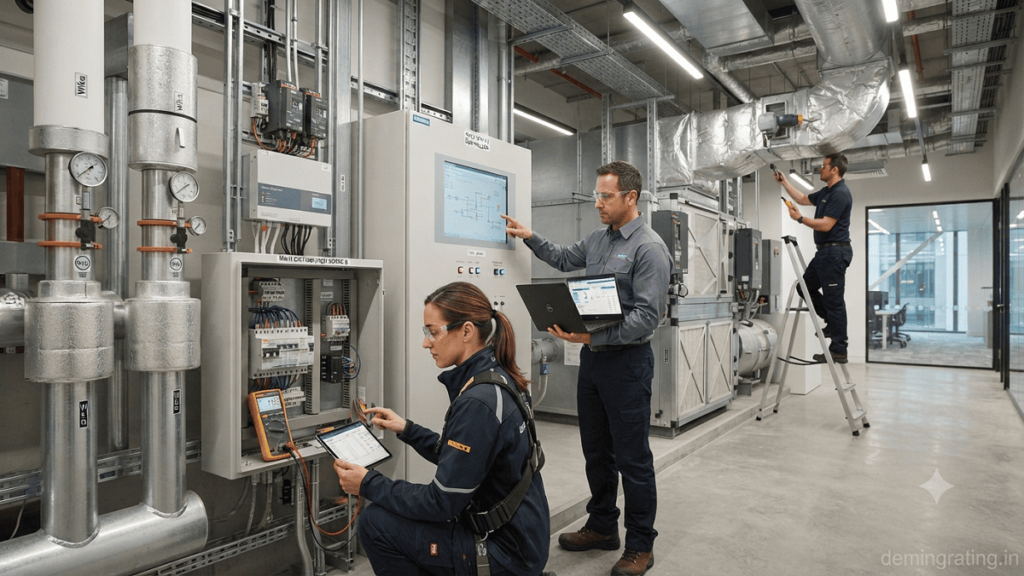
Industry Applications of a Commissioning Plan
A commissioning plan is widely used across industries to verify that buildings, equipment, infrastructure, and complex systems are installed correctly and perform according to specified requirements. As projects become more technically advanced, commissioning provides organizations with a structured method for improving reliability, safety, energy efficiency, and operational readiness.
Commercial and Office Buildings
In commercial construction, commissioning is commonly applied to HVAC, electrical, lighting, plumbing, fire protection, and building automation systems. Testing verifies that these systems operate according to design requirements and work effectively together. Commissioning can also help identify control issues, incorrect equipment settings, and installation deficiencies before a building is occupied.
Healthcare Facilities
Hospitals and healthcare facilities require highly reliable systems because failures can directly affect critical operations. Commissioning plans can cover medical HVAC systems, emergency power, ventilation, fire protection, medical gas systems, and building controls. Functional and integrated testing helps confirm that critical systems perform correctly under both normal and emergency conditions.
Data Centers
Data centers rely on continuous power, cooling, monitoring, and backup systems. Commissioning is therefore an important part of verifying operational resilience. Testing may include generators, uninterruptible power supplies (UPS), cooling systems, automatic transfer switches, fire protection, and monitoring systems. Integrated system testing can demonstrate how equipment responds to power failures or other simulated disruptions.
Manufacturing and Industrial Facilities
Manufacturing plants use commissioning to verify production equipment, process systems, electrical infrastructure, compressed air, HVAC, automation, and safety systems. Proper commissioning can help reduce startup problems, production interruptions, and equipment failures. It also ensures that process systems meet specified operating conditions before production begins.
Energy and Power Projects
Power generation and renewable energy projects use commissioning to confirm that equipment performs according to engineering specifications. Applications can include electrical substations, generators, turbines, solar installations, battery energy storage systems, and control systems. Testing is used to verify equipment performance, protection systems, control sequences, and grid-related functions.
Educational and Public Facilities
Schools, universities, government buildings, and other public facilities can use commissioning to improve energy efficiency, indoor environmental quality, and operational reliability. HVAC, lighting, controls, electrical systems, and life-safety equipment can be inspected and tested before occupancy.
Pharmaceutical and Laboratory Facilities
Highly controlled environments such as pharmaceutical manufacturing plants and laboratories require precise environmental conditions. Commissioning helps verify temperature, humidity, pressure relationships, ventilation, filtration, monitoring, and control systems. Proper documentation and testing are particularly important where regulatory requirements apply.
Benefits Across Industries
Although commissioning requirements differ between sectors, the fundamental objective remains the same: verify that systems perform as intended before they become fully operational. Effective commissioning can reduce defects, improve energy and resource efficiency, support safety, minimize downtime, and provide facility personnel with reliable operational documentation.
The U.S. Department of Energy provides resources on building commissioning and its role in improving facility performance. U.S. Department of Energy – Building Commissioning The ASHRAE Standards and Guidelines also provide widely used guidance for commissioning building systems.
In conclusion, commissioning plans have applications across virtually every industry where reliable system performance is important. By integrating inspection, testing, documentation, and training, commissioning helps organizations deliver facilities and systems that are safer, more efficient, reliable, and ready for long-term operation.
Ask FAQs
What is a commissioning plan?
A commissioning plan is a structured document that defines the scope, responsibilities, testing procedures, schedules, documentation, and acceptance criteria required to verify that a building or system performs according to the owner’s requirements and design intent.
Why is a commissioning plan important?
A commissioning plan helps identify design and installation issues before they become costly operational problems. It can improve system reliability, energy efficiency, safety, occupant comfort, and long-term maintenance.
Who is responsible for the commissioning process?
Commissioning typically involves the owner, commissioning authority, design team, general contractor, subcontractors, equipment manufacturers, and facility operators. Each participant has defined responsibilities for inspections, testing, documentation, corrective actions, and handover.
What systems can be included in a commissioning plan?
Depending on the project, commissioning may cover HVAC, electrical systems, plumbing, fire protection, lighting, building automation, emergency power, renewable energy systems, process equipment, and other critical infrastructure.
When should a commissioning plan be developed?
A commissioning plan should ideally be developed during the early design phase and maintained throughout construction, testing, and handover. Early involvement allows potential problems to be identified before they result in expensive modifications or project delays.
Table of Contents
Disclaimer: This content is for general informational purposes only and should not be considered professional, engineering, or legal advice. Always consult qualified professionals and applicable industry standards for project-specific commissioning requirements.