
Eco-friendly Housekeeping Chemicals
What Are Eco-Friendly Housekeeping Chemicals and Why Are They Important?
Eco-friendly housekeeping chemicals are cleaning and maintenance products formulated to reduce negative impacts on human health and the environment while still providing effective cleaning performance. They may be used for tasks such as cleaning floors, bathrooms, kitchens, windows, furniture, laundry areas, and other surfaces in homes, hotels, offices, healthcare facilities, and commercial buildings. Depending on the product, environmentally preferable formulations may use readily biodegradable ingredients, reduce hazardous substances, minimize volatile organic compounds (VOCs), Eco-friendly Housekeeping Chemicals and use more sustainable packaging.
Why Are Eco-Friendly Cleaning Chemicals Important?
Traditional cleaning products can contain ingredients that may contribute to indoor air pollution, aquatic pollution, or other environmental concerns when they are manufactured, used, or improperly disposed of. Choosing products with better environmental and human-health profiles can help organizations reduce these potential impacts.
One important consideration is indoor air quality. Some cleaning products can release VOCs and other chemicals into indoor environments. The U.S. Environmental Protection Agency (EPA) notes that cleaning products Eco-friendly Housekeeping Chemicals and other household products can be sources of VOC emissions indoors.
Eco-friendly housekeeping products can also support responsible water and wastewater management. Cleaning chemicals ultimately enter wastewater systems, and certain substances can create environmental concerns if they persist or reach aquatic ecosystems. Selecting products with environmentally preferable ingredients and following correct dilution and disposal procedures can help reduce unnecessary environmental impact.
Benefits for Housekeeping Operations
Eco-friendly chemicals can provide several operational benefits when selected appropriately. They may help organizations establish more sustainable cleaning practices, reduce exposure to unnecessarily hazardous ingredients, and support corporate environmental objectives.
For commercial facilities such as hotels and offices, switching to recognized environmentally preferable products can also strengthen sustainability programs. The EPA’s Safer Choice program evaluates cleaning and other chemical products against specific criteria related to human health and environmental characteristics. Products that meet the program’s requirements can carry the Safer Choice label. (epa.gov)
However, the term “eco-friendly” should not automatically be treated as proof that a product is environmentally superior. Organizations should look for credible certifications, transparent ingredient information, appropriate performance testing, Eco-friendly Housekeeping Chemicals and manufacturer documentation rather than relying solely on marketing claims.
Safe and Responsible Use
Even environmentally preferable cleaning chemicals should be handled responsibly. Housekeeping personnel should follow product labels, recommended dilution ratios, storage requirements, personal protective equipment instructions, and disposal procedures. Eco-friendly does not necessarily mean non-hazardous under every circumstance.
The U.S. Occupational Safety and Health Administration provides guidance on hazard communication, including requirements related to chemical hazards, labels, safety data sheets, and employee training. (osha.gov)
In conclusion, eco-friendly housekeeping chemicals are an important component of sustainable cleaning because they can help reduce environmental impacts while supporting healthier and more responsible housekeeping practices. The best approach combines environmentally preferable products with correct dosing, safe handling, efficient cleaning procedures, responsible waste management, and ongoing staff training.
Relevant External Resources
- EPA – Safer Choice
- EPA – Volatile Organic Compounds and Indoor Air Quality
- OSHA – Hazard Communication
#GreenHospitality
What Ingredients and Certifications Should Be Considered When Selecting Green Cleaning Products?
Selecting a genuinely green cleaning product requires more than looking for words such as “natural,” “eco-friendly,” or “green” on the packaging. These terms can be broad marketing claims and do not necessarily indicate that a product has been independently evaluated. A better approach is to examine the product’s ingredients, environmental characteristics, performance, packaging, and credible third-party or government-backed certifications.
Ingredients to Consider
When selecting green cleaning products, look for formulations that use ingredients with lower human-health and environmental hazards. Important characteristics include biodegradability, lower aquatic toxicity, reduced persistence, and limited potential for respiratory, skin, or other harmful effects. The U.S. Environmental Protection Agency’s Safer Choice program evaluates ingredients according to factors such as carcinogenicity, reproductive and developmental toxicity, aquatic toxicity, persistence, and other health Eco-friendly Housekeeping Chemicals and environmental concerns.
Surfactants are particularly important because they are responsible for helping water loosen and remove dirt, grease, and other soils. Environmentally preferable formulations should use surfactants with appropriate biodegradation characteristics and lower aquatic toxicity. EPA’s Safer Choice criteria specifically evaluate surfactants according to biodegradation, degradation products, and aquatic toxicity.
It is also useful to consider products with minimal unnecessary fragrance and additives, particularly in environments where cleaning products are used frequently or by people who may be sensitive to fragrances. Buyers should review ingredient disclosures and safety information rather than assuming that an ingredient is safe simply because it is plant-derived.
Certifications to Look For
One of the strongest indicators is the EPA Safer Choice label. EPA evaluates every chemical ingredient in certified products and also considers product performance, packaging, and other requirements.
For antimicrobial products such as certain disinfectants and sanitizers, the EPA Design for the Environment (DfE) label is another useful certification. EPA explains that DfE-certified antimicrobial products must meet stringent health and environmental requirements.
Other recognized ecolabels can also be considered, provided purchasers understand what the specific certification evaluates. EPA maintains recommendations for credible private-sector standards and ecolabels for several cleaning-product categories.
Consider Packaging and Performance
A green cleaning product should also perform effectively at the recommended dilution. Concentrated formulas, refillable containers, recyclable packaging, and reduced packaging can help lower material use and transportation impacts. EPA’s greener-product recommendations specifically identify concentrated formulations, recyclable or recycled-content packaging, refillable bottles, and clear usage and disposal information as desirable characteristics.
Ultimately, the best choice is not simply the product with the most natural-sounding ingredients. Look for transparent ingredient information, credible certification, effective performance, responsible packaging, and appropriate safety documentation. Combining these factors can help organizations avoid greenwashing and select cleaning products that provide a more credible balance between cleaning performance, worker safety, and environmental responsibility.
Relevant External Resources
- EPA – Safer Choice Standard and Criteria
- EPA – Safer Chemical Ingredients List
- EPA – Identifying Greener Cleaning Products
- EPA – Safer Choice Label
#HousekeepingChemicals
How Do Eco-Friendly Housekeeping Chemicals Reduce Environmental and Health Impacts?
Eco-friendly housekeeping chemicals are designed to provide effective cleaning while reducing unnecessary risks to people and the environment. They can be particularly valuable in homes, hotels, offices, hospitals, schools, and other facilities where cleaning products are used frequently. However, the term “eco-friendly” alone does not guarantee that a product is safer. Buyers should consider ingredients, credible certifications, product performance, and proper handling practices when selecting environmentally preferable cleaning products.
Reducing Indoor Air Pollution
One important benefit of greener cleaning products is their potential to reduce exposure to certain harmful chemical emissions. Conventional cleaning products can release volatile organic compounds (VOCs) and other chemicals into indoor air. Research has found that cleaning products and disinfectants can increase occupants’ exposure to potentially harmful airborne chemicals.
Products formulated with lower-emission ingredients and fewer problematic VOCs can therefore help support better indoor air quality. This can be particularly relevant for housekeeping employees who may use cleaning chemicals repeatedly throughout the working day.
Reducing Human Health Risks
Frequent exposure to some cleaning chemicals can cause eye, skin, or respiratory irritation. The U.S. Environmental Protection Agency (EPA) notes that certain conventional cleaning products may contain chemicals associated with these health concerns. Choosing products assessed for safer chemical profiles can help reduce unnecessary exposure.
The EPA’s Safer Choice program evaluates ingredients for potential effects on human health and the environment and helps purchasers identify products formulated with safer ingredients.
Protecting Water and Ecosystems
Cleaning chemicals can eventually enter wastewater systems after being used on floors, bathrooms, kitchens, and other surfaces. Ingredients with greater environmental persistence or aquatic toxicity can create concerns when they reach waterways.
Environmentally preferable formulations seek to reduce these impacts by selecting ingredients with more favorable environmental characteristics, such as appropriate biodegradability and lower aquatic toxicity. Choosing certified products can make it easier for organizations to identify formulations that have undergone environmental and health-related evaluation.
Reducing Waste and Resource Consumption
Eco-friendly housekeeping programs can also address packaging and resource use. Concentrated products, refillable containers, appropriate dilution systems, and recyclable packaging can reduce material consumption and waste. Using the correct quantity of cleaning chemical is important because excessive dosing does not necessarily improve cleaning performance and can increase chemical waste.
Sustainable cleaning practices can also reduce water and other material consumption when combined with efficient cleaning methods.
Supporting Safer Housekeeping Practices
Eco-friendly chemicals should be combined with proper housekeeping procedures. Staff should follow product labels, dilution instructions, storage requirements, safety data sheets, and manufacturer recommendations. “Green” does not mean a product is automatically harmless, and environmentally preferable products must still be handled responsibly.
Overall, eco-friendly housekeeping chemicals can reduce environmental and health impacts by using safer chemical formulations, limiting unnecessary emissions, supporting responsible wastewater management, reducing packaging and chemical waste, and improving workplace practices. Organizations should prioritize credible certifications and transparent product information rather than relying solely on marketing claims.
Relevant External Resources
- EPA – Safer Choice
- EPA – Identifying Greener Cleaning Products
- American Lung Association – Cleaning Supplies and Household Chemicals
#SustainableCleaning
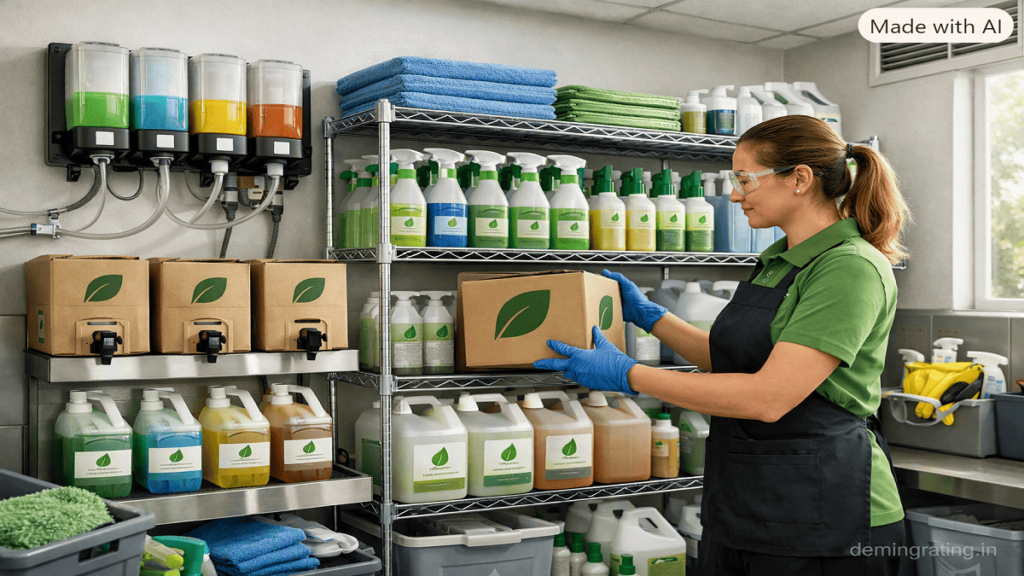
How Can Organizations Safely Store, Use, and Dispose of Green Cleaning Chemicals?
Organizations can improve workplace safety and environmental performance by establishing clear procedures for the storage, use, and disposal of green cleaning chemicals. Although environmentally preferable products are generally selected to reduce health and environmental concerns, the term “green” does not mean that a chemical is automatically harmless. Some concentrated cleaning products can still present handling, storage, or disposal hazards. The U.S. Environmental Protection Agency (EPA) recommends proper training and chemical-management procedures to minimize exposure during handling and use.
Safe Storage Practices
Green cleaning chemicals should be stored in their original, clearly labeled containers whenever possible. Labels should remain readable and should identify the product and relevant hazards. Organizations should maintain an up-to-date inventory of cleaning chemicals and keep Safety Data Sheets (SDSs) readily accessible to employees. OSHA’s Hazard Communication Standard requires employers to maintain SDSs for hazardous chemicals used in the workplace.
Storage areas should be cool, dry, adequately ventilated, and protected from unauthorized access. Products should be stored according to manufacturer instructions, with incompatible chemicals separated where required. For example, cleaning products should never be combined simply because employees believe mixing them will improve cleaning performance. The SDS provides information about safe storage conditions and chemical incompatibilities.
Safe Use and Handling
Employees should receive training before using cleaning chemicals. Training should cover product labels, dilution instructions, required personal protective equipment, ventilation, spill response, and appropriate disposal procedures.
Staff should use the correct concentration and quantity specified by the manufacturer. Overusing a cleaning product can increase chemical exposure, waste, and environmental releases without necessarily improving cleaning performance. EPA also recommends appropriate packaging and dilution systems that can reduce exposure during use.
Organizations should also avoid transferring chemicals into unmarked bottles or containers. If secondary containers are necessary, they should be appropriately identified according to applicable workplace requirements.
Responsible Disposal
Disposal should always follow the product label, SDS, manufacturer’s instructions, and applicable local regulations. Organizations should avoid pouring concentrated chemicals into drains, toilets, soil, or outdoor areas unless the product instructions and local requirements specifically permit it.
Unused or expired chemicals should be assessed before disposal, and hazardous waste requirements should be followed where applicable. Empty containers should also be managed according to the product instructions and local recycling or waste-management rules.
Creating a Chemical Management Program
A formal chemical-management program can make these practices more consistent. Organizations should maintain an inventory, review product hazards, train employees regularly, inspect storage areas, and establish procedures for spills and accidental exposure.
Choosing independently evaluated products can also support safer purchasing. For example, EPA’s Safer Choice program evaluates chemical ingredients and product requirements related to human health and environmental considerations.
In conclusion, organizations should treat green cleaning chemicals with the same level of care given to other workplace chemicals. Proper labeling, secure storage, employee training, correct dilution, appropriate protective equipment, accessible SDSs, and responsible disposal are essential for creating a safe and environmentally responsible housekeeping operation.
Relevant External Resources
- EPA – Identifying Greener Cleaning Products
- EPA – Safer Choice
- OSHA – Hazard Communication Standard
- OSHA – Cleaning Chemicals Safety Resources
#GreenHousekeeping
What Are the Benefits and Challenges of Switching to Eco-Friendly Housekeeping Chemicals?
Switching to eco-friendly housekeeping chemicals can help organizations create safer, more sustainable cleaning operations while supporting environmental goals. Hotels, offices, hospitals, schools, commercial buildings, and other facilities can benefit from replacing conventional products with cleaning solutions that have safer chemical profiles, lower environmental impacts, and credible sustainability certifications. However, the transition also requires careful product selection, staff training, budgeting, and operational planning.
Benefits of Eco-Friendly Housekeeping Chemicals
One of the major benefits is the potential to reduce health and environmental concerns associated with cleaning products. Conventional cleaning chemicals can contain ingredients associated with eye, skin, or respiratory irritation, while certain ingredients can also contribute to air or water pollution. The U.S. Environmental Protection Agency (EPA) recommends considering products with safer ingredients, lower VOC content, appropriate biodegradability, and lower aquatic toxicity.
Eco-friendly products can also support better workplace conditions for housekeeping employees who may handle cleaning chemicals regularly. Choosing products that have been independently evaluated for safer chemical ingredients can help organizations reduce unnecessary chemical exposure.
Another benefit is environmental sustainability. Products designed with safer ingredients, concentrated formulations, refillable containers, recyclable packaging, and reduced packaging can help decrease resource consumption and waste. EPA notes that greener products can address environmental impacts throughout their life cycle, including manufacturing, packaging, transportation, use, and disposal.
Certified products can also provide greater confidence when making purchasing decisions. For example, EPA’s Safer Choice program evaluates every chemical ingredient in certified products and also considers performance, packaging, and other requirements.
Challenges of Making the Switch
Despite these advantages, organizations may encounter several challenges. Initial purchasing costs can sometimes be higher, particularly when switching to specialized products, dispensing systems, or concentrated formulations. However, organizations should evaluate total operating costs rather than comparing purchase prices alone.
Another challenge is product performance and suitability. Different facilities have different cleaning requirements, and a product that works effectively for one application may not be suitable for another. Organizations should test products before making large-scale changes and verify that they meet required cleaning and sanitation standards.
Employee training is another important consideration. Housekeeping staff may need guidance on dilution ratios, dispensing equipment, storage, labeling, personal protective equipment, and disposal procedures. Incorrect use can reduce cleaning effectiveness and increase waste.
Finally, organizations must avoid greenwashing. Claims such as “natural” or “eco-friendly” do not automatically demonstrate that a product has a safer environmental or health profile. EPA recommends using credible ecolabels and carefully evaluating product claims.
In conclusion, switching to eco-friendly housekeeping chemicals can provide important benefits for worker safety, environmental sustainability, waste reduction, and responsible facility management. The transition is most successful when organizations combine credible product certifications, performance testing, staff training, proper chemical management, and lifecycle-based purchasing decisions.
Relevant External Resources
- EPA – Identifying Greener Cleaning Products
- EPA – Safer Choice
- EPA – Safer Choice Standard and Criteria
- EPA – Why Buy Greener Products?
#EcoFriendlyChemicals
Case Study of Eco-Friendly Housekeeping Chemicals
The adoption of eco-friendly housekeeping chemicals can help hotels and other large facilities reduce chemical consumption, packaging waste, operating costs, and potential exposure to harsh cleaning substances. A useful example comes from the hospitality sector, where housekeeping teams must maintain high cleaning standards while managing substantial daily consumption of cleaning products.
Case Study: Cedar Court Hotels
Cedar Court Hotels, a group of four-star hotels in Yorkshire, UK, introduced a more sustainable cleaning approach after identifying the need to reduce chemical use and packaging while maintaining effective housekeeping standards. The hotel group implemented the Toucan Eco system, which produces a disinfectant cleaning solution onsite using tap water and ordinary table salt through electrolysis. According to the published case study, the system was certified to several European disinfectant standards, including EN 14476, EN 16777, EN 1276, and EN 13697. (spectrumcleaningsolutions.co.uk)
Implementation and Operational Changes
One of the key objectives was to simplify the hotel’s housekeeping chemical system. Instead of maintaining large stocks of multiple cleaning products, the facility used an onsite production system that could create disinfectant when required. This reduced dependence on conventional packaged chemical supplies.
The case study reports that the approach reduced cleaning chemical costs by approximately 75% and that the investment paid for itself within 12 months. It also states that the system reduced packaging requirements because the cleaning solution was produced using water and salt rather than being repeatedly delivered in conventional chemical containers. (spectrumcleaningsolutions.co.uk)
Another operational benefit was the reduction in the number of products carried by housekeeping staff. According to the case study, housekeeping trolleys could use a multipurpose cleaner bottle that was refilled when necessary, reducing stock requirements and simplifying daily cleaning procedures.
Lessons for Housekeeping Operations
The Cedar Court example demonstrates that sustainable housekeeping does not necessarily require compromising operational efficiency. A successful transition can involve product reduction, accurate dispensing, staff training, appropriate equipment, and systematic monitoring rather than simply replacing one conventional chemical with another.
A broader EPA case study on green cleaning in the hospitality industry also documents how hotels have experimented with environmentally preferable cleaning products and dispensing systems while considering cost, cleaning performance, staff training, and guest expectations. (epa.gov)
Research from hotels in the Delhi-NCR region provides another relevant perspective. A 2025 study involving 30 midscale hotels reported that properties implementing green housekeeping practices, including biodegradable chemicals and microfiber cleaning tools, recorded lower reported water and chemical consumption than conventionally operated properties. (isroset.org)
Key Takeaways
The case study highlights several important principles for organizations considering eco-friendly housekeeping chemicals:
- Evaluate cleaning performance before large-scale implementation.
- Reduce unnecessary product variety where practical.
- Use controlled dispensing or dilution systems to minimize chemical waste.
- Consider packaging and transportation impacts alongside chemical ingredients.
- Train housekeeping employees on correct product use.
- Track chemical consumption and operating costs to measure results.
- Select products or systems supported by credible safety and performance information.
In conclusion, the Cedar Court Hotels example demonstrates how environmentally conscious housekeeping can combine sustainability, operational simplicity, and cost control. Organizations should evaluate their own cleaning requirements, local regulations, staff needs, and environmental objectives before adopting a similar approach.
Relevant External Resources
- Cedar Court Hotels – Sustainable Cleaning Case Study
- U.S. EPA – Green Cleaning in the Hospitality Industry
- Green Housekeeping Practices in Delhi-NCR Hotels – 2025 Study
- EPA – Safer Choice
#SustainableHousekeeping
White Paper on Eco-Friendly Housekeeping Chemicals
Executive Summary
Eco-friendly housekeeping chemicals are cleaning and maintenance products designed to achieve effective cleaning while reducing unnecessary risks to human health and the environment. They are increasingly relevant to hotels, offices, healthcare facilities, educational institutions, residential buildings, and commercial properties where housekeeping activities involve frequent chemical use.
The transition toward greener cleaning should not be based simply on labels such as “natural” or “eco-friendly.” Organizations should evaluate ingredients, product performance, packaging, environmental characteristics, worker safety, and credible certifications. The U.S. Environmental Protection Agency’s (EPA) Safer Choice program, for example, evaluates ingredients and finished products against human-health and environmental criteria.
1. Introduction
Housekeeping chemicals are essential for maintaining hygiene, appearance, and cleanliness. However, some conventional cleaning products can contain substances associated with respiratory, skin, or eye irritation and can create environmental concerns during manufacture, use, wastewater discharge, or disposal.
Eco-friendly housekeeping therefore aims to balance cleaning performance, worker safety, indoor environmental quality, and sustainability. EPA notes that greener cleaning products can help reduce health and environmental concerns associated with cleaning activities.
2. Characteristics of Eco-Friendly Chemicals
A greener housekeeping product may use ingredients selected for lower hazard profiles, appropriate biodegradability, reduced aquatic toxicity, and lower environmental persistence. Surfactants are particularly important because they are widely used to loosen and remove dirt. EPA evaluates surfactants according to biodegradation, degradation products, and aquatic toxicity.
Organizations should also consider products with responsible packaging, concentrated formulations, refill systems, and clear usage instructions. These characteristics can reduce packaging waste and unnecessary chemical consumption.
3. Certifications and Ecolabels
Credible certification can make sustainable purchasing decisions more reliable. The EPA Safer Choice label indicates that a product has undergone evaluation of its chemical ingredients and other product-level requirements. EPA also offers the Design for the Environment (DfE) label for qualifying antimicrobial products such as certain disinfectants and sanitizers.
Importantly, EPA warns that generic claims such as “green,” “eco-safe,” or “environmentally friendly” can be misleading without supporting evidence. Organizations should therefore prioritize recognized ecolabels and transparent product information.
4. Benefits for Organizations
Adopting eco-friendly housekeeping chemicals can provide several potential benefits. These include reducing exposure to certain hazardous ingredients, supporting improved indoor environmental quality, reducing chemical and packaging waste, and strengthening organizational sustainability programs.
The approach can also improve purchasing transparency. EPA’s Safer Choice program maintains a searchable database of certified products, allowing organizations to identify products that meet defined criteria rather than relying solely on marketing claims.
For housekeeping departments, concentrated products and controlled dispensing systems can also help standardize chemical usage and reduce over-dosing. However, organizations should evaluate the complete operating cost, including equipment, training, storage, disposal, and product performance.
5. Implementation Strategy
A successful transition should begin with a chemical inventory and needs assessment. Organizations should identify existing products, their applications, quantities, hazards, costs, and disposal requirements.
The next step is to establish purchasing criteria covering:
- Ingredient safety and environmental characteristics
- Cleaning and disinfecting performance
- Recognized certifications
- Packaging and refill options
- Concentration and dilution requirements
- Worker training requirements
- Storage and disposal considerations
Pilot testing should be conducted before full implementation. Housekeeping employees should receive training on dilution, labeling, storage, personal protective equipment, spill response, and correct application.
Organizations should then monitor chemical consumption, cleaning performance, waste generation, employee feedback, and operating costs. This creates measurable evidence of whether the sustainability program is delivering practical benefits.
6. Challenges and Considerations
The transition can involve challenges, including higher initial purchasing costs, limited availability of suitable products, employee training requirements, compatibility with existing equipment, and concerns about cleaning performance.
Another important consideration is that eco-friendly does not mean risk-free. A product can still require appropriate handling, storage, protective equipment, and disposal. Organizations should follow manufacturer instructions and applicable workplace chemical-safety requirements.
It is also important not to replace effective disinfectants with general-purpose green cleaners where disinfection is specifically required. EPA’s guidance emphasizes selecting products appropriate to their intended cleaning or antimicrobial application.
7. Conclusion
Eco-friendly housekeeping chemicals represent an important component of modern sustainable facility management. Their value extends beyond replacing conventional products; the strongest programs combine safer chemical selection with responsible purchasing, efficient dispensing, employee training, appropriate storage, waste reduction, and performance monitoring.
Organizations should focus on evidence-based sustainability rather than marketing claims. Credible certifications such as EPA Safer Choice can provide a useful benchmark because the program evaluates ingredients and broader product requirements.
When implemented systematically, eco-friendly housekeeping can support a cleaner and healthier working environment while helping organizations reduce unnecessary environmental impacts and strengthen their broader sustainability objectives.
Relevant External Resources
- EPA – Safer Choice
- EPA – Safer Choice Standard and Criteria
- EPA – Identifying Greener Cleaning Products
- EPA – Safer Choice-Certified Product Search
- EPA – Safer Chemical Ingredients List
#GreenCleaning

Industry Application of Eco-Friendly Housekeeping Chemicals
Eco-friendly housekeeping chemicals are increasingly being adopted across industries that require regular cleaning while also seeking to improve environmental performance, workplace safety, and sustainability. These products can be used in hotels, offices, healthcare facilities, educational institutions, commercial buildings, residential communities, and professional cleaning services. Their application extends beyond simply replacing conventional cleaners; organizations can combine greener chemicals with efficient dispensing, responsible purchasing, appropriate training, and waste-reduction practices.
Hospitality and Hotels
The hospitality industry is one of the most significant users of housekeeping chemicals. Hotels and resorts require frequent cleaning of guest rooms, bathrooms, kitchens, public areas, and laundry facilities. Using environmentally preferable products can help reduce chemical consumption and packaging waste while supporting sustainability objectives.
Hotels can select certified products for applications such as glass cleaning, floor care, bathroom cleaning, laundry, and general-purpose housekeeping. EPA’s Safer Choice program provides a searchable database of certified products that meet defined human-health and environmental criteria.
Corporate Offices and Commercial Buildings
Office buildings require daily cleaning of workstations, floors, washrooms, meeting rooms, kitchens, and common areas. Eco-friendly housekeeping chemicals can support corporate environmental policies while helping organizations manage chemical exposure for cleaning employees and building occupants.
Concentrated formulations, refillable containers, and controlled dilution systems can also reduce packaging and chemical waste. EPA specifically identifies concentrated formulas, recyclable packaging, refillable bottles, and packaging designed to reduce product exposure as desirable characteristics for greener cleaning products.
Healthcare Facilities
Hospitals, clinics, and healthcare facilities have demanding hygiene requirements. Eco-friendly cleaning products can be considered for appropriate cleaning applications where they meet required performance and regulatory standards. However, general-purpose green cleaners should not automatically replace disinfectants when a specific antimicrobial function is required.
EPA’s Design for the Environment (DfE) program provides a certification pathway for qualifying antimicrobial products, including certain disinfectants and sanitizers.
Schools and Educational Institutions
Schools, colleges, and universities can use greener housekeeping chemicals in classrooms, offices, washrooms, laboratories, cafeterias, and common areas. Because students and staff may spend many hours indoors, responsible product selection can form part of a broader strategy for maintaining healthy indoor environments.
EPA notes that some cleaning products can contain chemicals associated with eye, skin, or respiratory irritation, making careful product selection particularly relevant for frequently cleaned indoor spaces.
Professional Cleaning and Facility Management
Professional cleaning companies can incorporate eco-friendly chemicals into their service packages for corporate, retail, residential, hospitality, and institutional clients. Standardized purchasing policies can ensure that cleaning teams use approved products consistently.
Training is essential. Employees should understand correct dilution, application, storage, labeling, and disposal procedures. Choosing environmentally preferable products does not eliminate the need for appropriate chemical-safety practices.
Residential and Property Management
Apartment complexes, residential communities, and property-management companies can also apply green housekeeping practices to shared spaces such as lobbies, elevators, gyms, corridors, parking areas, and recreational facilities. Sustainable cleaning programs can support property owners’ environmental objectives while providing occupants with responsibly maintained common areas.
Key Industry Benefits
Across these sectors, eco-friendly housekeeping chemicals can help organizations:
- Reduce exposure to certain hazardous ingredients.
- Support more responsible chemical purchasing.
- Reduce packaging and chemical waste.
- Improve sustainability performance.
- Support workplace environmental objectives.
- Demonstrate commitment to responsible facility management.
However, organizations should avoid relying solely on terms such as “natural,” “green,” or “eco-friendly.” EPA recommends using credible ecolabels because generic environmental claims can be difficult to verify.
In conclusion, eco-friendly housekeeping chemicals have broad applications across hospitality, healthcare, education, corporate, commercial, residential, and professional cleaning industries. Their greatest value is achieved when product selection is combined with effective cleaning procedures, employee training, responsible storage, efficient dispensing, and credible certification. This integrated approach allows organizations to pursue sustainability without compromising cleaning performance or operational requirements.
Relevant External Resources
- EPA – Safer Choice
- EPA – Safer Choice Certified Products
- EPA – Identifying Greener Cleaning Products
- EPA – Safer Choice FAQ
#EcoFriendlyCleaning
Ask FAQs
What are eco-friendly housekeeping chemicals?
Eco-friendly housekeeping chemicals are cleaning products designed to reduce potential impacts on human health and the environment while maintaining effective cleaning performance. They may use safer chemical ingredients, biodegradable components, concentrated formulations, or more sustainable packaging. Credible certifications can help verify environmental and safety claims.
Are eco-friendly cleaning chemicals safe for housekeeping employees?
Environmentally preferable products may reduce exposure to certain hazardous ingredients, but “eco-friendly” does not mean completely risk-free. Employees should always follow product labels, Safety Data Sheets (SDS), dilution instructions, storage requirements, and applicable personal protective equipment recommendations. The EPA Safer Choice program provides information about products evaluated against specific human-health and environmental criteria.
What certifications should organizations look for?
Organizations should consider recognized ecolabels and certifications rather than relying solely on terms such as “green” or “natural.” In the United States, the EPA Safer Choice label is an important reference for cleaning products because EPA evaluates their ingredients and other product requirements. For qualifying antimicrobial products, the EPA Design for the Environment (DfE) label can also be relevant. More information is available through the EPA’s greener cleaning products guidance.
Can eco-friendly chemicals provide the same cleaning performance as conventional products?
Yes, appropriately selected environmentally preferable products can provide effective cleaning performance. However, products should be tested for their intended application before full-scale adoption. Organizations should also follow manufacturer instructions regarding dilution, application, contact time, and surface compatibility. For disinfecting applications, products must meet the specific performance and regulatory requirements applicable to that use.
How can organizations successfully switch to eco-friendly housekeeping chemicals?
Organizations should begin by reviewing their existing chemical inventory, identifying cleaning requirements, and establishing purchasing criteria based on safety, environmental performance, certifications, cost, packaging, and effectiveness. They should then conduct product trials, train housekeeping employees, introduce proper storage and dispensing procedures, and monitor chemical consumption and cleaning results. This systematic approach can help organizations transition to greener housekeeping without compromising operational standards.
Table of Contents
Disclaimer: This content is for general informational purposes only and does not constitute professional, medical, or chemical-safety advice. Always follow product labels, Safety Data Sheets, and applicable local regulations.