
Latest Developments in Electric Vehicle Technology
Electric vehicle (EV) technology is evolving rapidly, with major advances in battery chemistry, charging infrastructure, software integration, and vehicle efficiency. These developments are making EVs more practical, affordable, and sustainable for both consumers and commercial fleets.
One of the most significant breakthroughs is the progress in solid-state batteries. Unlike conventional lithium-ion batteries that use liquid electrolytes, solid-state batteries use solid electrolytes, which can improve safety, increase energy density, and reduce charging time. Companies such as Toyota, Samsung, and QuantumScape are investing heavily in this technology, and commercial deployment is expected to begin in the coming years. Higher energy density means longer driving ranges without increasing battery size or weight. More information is available from Toyota: Toyota solid-state battery development .
Another important trend is the adoption of 800-volt electrical architectures. This technology, already used in vehicles such as the Hyundai Ioniq 5 and Porsche Taycan, enables ultra-fast charging and improved power efficiency. With compatible chargers, some EVs can add hundreds of kilometers of range in less than 20 minutes. Faster charging reduces range anxiety and makes EVs more suitable for long-distance travel. The U.S. Department of Energy explains fast-charging technologies here: Electric vehicle charging overview .
Battery manufacturing is also becoming more sustainable. Automakers are increasingly using lithium iron phosphate (LFP) batteries, which avoid expensive and supply-constrained materials such as cobalt and nickel. LFP batteries offer longer cycle life and lower cost, making them ideal for mass-market vehicles. BloombergNEF provides detailed analysis of battery trends: BloombergNEF EV Outlook .
Software has become a core component of modern EVs. Over-the-air updates allow manufacturers to improve performance, efficiency, and safety without requiring a dealership visit. Advanced energy management systems optimize battery temperature, regenerative braking, and power delivery in real time.
In India, EV technology is advancing through government support and infrastructure expansion. The Ministry of Heavy Industries and the PM E-DRIVE initiative aim to accelerate adoption of electric mobility and domestic manufacturing. Official information is available at Ministry of Heavy Industries .
What Are the Latest Advancements in Electric Vehicle Technology?
Electric vehicle (EV) technology has advanced significantly in recent years, driven by improvements in batteries, charging systems, software, and manufacturing. These innovations are making EVs more efficient, affordable, and convenient for everyday use while also supporting global efforts to reduce carbon emissions.
One of the most important advancements is the development of solid-state batteries. Traditional lithium-ion batteries use liquid electrolytes, whereas solid-state batteries use solid materials that improve safety and increase energy density. This means vehicles can potentially travel longer distances on a single charge while reducing the risk of overheating. Major automakers and technology companies are investing heavily in this field, and commercial deployment is expected within the next few years. Toyota has announced significant progress in solid-state battery research, which could dramatically improve EV range and charging performance. Toyota solid-state battery update .
Another major breakthrough is the adoption of 800-volt electrical architectures. Compared with the traditional 400-volt systems, 800-volt platforms enable much faster charging and better energy efficiency. Vehicles such as the Hyundai Ioniq 5 and Porsche Taycan can add substantial driving range in less than 20 minutes when connected to compatible ultra-fast chargers. The U.S. Department of Energy provides a useful overview of fast-charging technologies. Fast charging overview .
Battery chemistry is also evolving. Many manufacturers are increasingly using lithium iron phosphate (LFP) batteries, which are less expensive and have longer cycle life than nickel-based batteries. Although LFP batteries offer slightly lower energy density, they are well suited for mass-market vehicles and help reduce dependence on costly materials such as cobalt and nickel. BloombergNEF tracks these battery trends in detail. BloombergNEF EV Outlook .
Software is becoming a defining feature of modern EVs. Over-the-air updates allow manufacturers to improve performance, efficiency, navigation, and safety features remotely. Advanced battery management systems use artificial intelligence to optimize charging speed, temperature control, and energy consumption in real time.
In addition, vehicle-to-grid (V2G) technology is gaining attention. This allows EVs to send electricity back to the power grid during periods of high demand, turning vehicles into mobile energy-storage units. As renewable energy adoption grows, V2G could play an important role in balancing electricity supply.
Overall, the latest advancements show that electric vehicles are evolving from simple battery-powered cars into intelligent, connected, and energy-integrated transportation systems. These technologies are expected to accelerate global EV adoption and shape the future of sustainable mobility.
How Are New Battery Technologies Improving Electric Vehicle Performance?
Battery technology is the foundation of electric vehicle (EV) performance, and recent innovations are transforming how EVs operate in terms of range, charging speed, safety, durability, and cost. As manufacturers develop advanced battery chemistries and management systems, electric vehicles are becoming more practical for both personal and commercial transportation.
One of the most significant improvements comes from higher energy density. Modern batteries can store more energy in the same physical space, allowing vehicles to travel longer distances without increasing battery size or weight. This directly improves driving range and efficiency. For example, next-generation lithium-ion batteries with silicon-enhanced anodes can increase energy storage capacity compared with conventional graphite-based designs. The U.S. Department of Energy explains current battery research and its impact on EV performance here: U.S. Department of Energy battery research .
Another major advancement is the development of solid-state batteries. These batteries replace the liquid electrolyte with a solid material, which improves safety by reducing the risk of leakage and thermal runaway. Solid-state batteries also have the potential to deliver higher energy density and faster charging. Toyota and other manufacturers are actively developing this technology for future EVs. More information is available from Toyota’s official announcement: Toyota solid-state battery development .
Charging performance is also improving through faster ion movement and better thermal management. New battery designs can accept higher charging power without excessive heat generation. Combined with 800-volt vehicle architectures, some EVs can add hundreds of kilometers of range in under 20 minutes. This significantly reduces charging downtime and makes long-distance travel more convenient. The U.S. Department of Energy provides an overview of fast-charging technology here: Fast charging technology overview .
Durability has improved as well. Lithium iron phosphate (LFP) batteries offer longer cycle life and better thermal stability than many nickel-based batteries. Although they have slightly lower energy density, they can withstand more charging cycles, making them ideal for high-usage vehicles and fleet applications. BloombergNEF tracks these battery trends and their market impact: BloombergNEF EV Outlook .
Advanced battery management systems (BMS) further enhance performance by monitoring temperature, voltage, and charging conditions in real time. Artificial intelligence and predictive algorithms help optimize energy use, extend battery life, and improve safety.
Overall, new battery technologies are making electric vehicles faster to charge, safer to operate, longer lasting, and capable of traveling greater distances. These improvements are accelerating EV adoption and bringing electric mobility closer to becoming the mainstream transportation solution worldwide.
What Role Do Fast Charging and Smart Charging Systems Play in Modern EVs?
Fast charging and smart charging systems have become essential components of modern electric vehicles (EVs). While battery technology determines how much energy a vehicle can store, charging technology determines how quickly, efficiently, and intelligently that energy can be delivered. Together, these systems improve convenience, reduce operating costs, support the electricity grid, and accelerate the adoption of electric mobility.
Fast charging addresses one of the biggest concerns among EV users: charging time. Traditional home charging may take several hours, but modern DC fast chargers can add a significant amount of range in a much shorter period. Vehicles built on 800-volt architectures, such as several newer Hyundai, Kia, and Porsche models, can charge from around 10% to 80% in less than 20 minutes under optimal conditions. This makes long-distance travel far more practical and reduces downtime for commercial fleets. The U.S. Department of Energy provides a detailed overview of EV charging technologies and their applications: EV charging overview .
Fast charging also supports the expansion of public charging networks. High-power charging stations placed along highways and in urban centers enable drivers to recharge quickly during short stops. As charging infrastructure becomes more widespread, range anxiety decreases and EV ownership becomes more attractive to a broader group of consumers.
Smart charging adds intelligence to the charging process. Instead of simply delivering electricity as fast as possible, smart charging systems communicate with the vehicle, the charger, and sometimes the electricity grid. They can schedule charging during off-peak hours when electricity is cheaper and demand on the grid is lower. This helps reduce energy costs for users and improves overall grid efficiency.
A key feature of smart charging is load management. In homes, apartment buildings, or commercial parking facilities, the system can distribute available power among multiple vehicles without overloading the electrical connection. This is particularly important as EV adoption increases.
Smart charging also enables vehicle-to-grid (V2G) and vehicle-to-home (V2H) capabilities. In these systems, an EV can return stored electricity to the grid or power a home during outages or peak demand periods. This transforms EVs from simple transportation devices into mobile energy-storage assets. The International Energy Agency discusses the growing importance of smart charging and grid integration here: IEA Global EV Outlook 2026 .
In modern EVs, fast charging delivers convenience and mobility, while smart charging delivers efficiency and energy intelligence. Together, they create a charging ecosystem that benefits drivers, utilities, and the broader transition to a cleaner and more sustainable transportation system.
What Are the Future Trends and Challenges in Electric Vehicle Technology?
Electric vehicle (EV) technology is expected to evolve rapidly over the next decade, driven by advances in batteries, software, charging infrastructure, and renewable energy integration. As governments and industries pursue decarbonization goals, EVs are moving from a niche market to a central part of the global transportation system. However, this transition also brings significant technical, economic, and infrastructure challenges.
One of the strongest future trends is the development of next-generation battery technologies. Solid-state batteries, silicon-anode batteries, and sodium-ion batteries are being researched to improve energy density, reduce charging time, increase safety, and lower cost. These technologies could enable longer driving ranges and make EVs more affordable for mass adoption. The International Energy Agency provides a detailed analysis of emerging EV technologies and market trends: IEA Global EV Outlook 2026 .
Another important trend is the expansion of ultra-fast charging networks. High-power DC chargers combined with 800-volt vehicle architectures are expected to reduce charging times to levels closer to conventional refueling stops. Wireless charging and automated charging systems may also become more common, particularly for commercial fleets and autonomous vehicles.
Software and connectivity will continue to shape the future of EVs. Vehicles are increasingly becoming software-defined platforms that receive over-the-air updates, use AI for battery optimization, and integrate with smart homes and energy networks. Vehicle-to-grid (V2G) technology is another emerging trend that allows EVs to store renewable energy and supply electricity back to the grid during peak demand.
Despite these opportunities, several challenges remain. Battery raw materials such as lithium, nickel, and cobalt face supply-chain constraints, price volatility, and environmental concerns related to mining and processing. Recycling and second-life battery applications will be essential to reduce resource pressure and improve sustainability. The U.S. Department of Energy explains battery recycling initiatives here: Battery recycling initiatives .
Infrastructure is another major challenge. Many regions still lack sufficient public charging stations, especially in rural areas and developing economies. Upgrading electrical grids to support millions of EVs will require substantial investment.
Cost remains a barrier for many consumers, although battery prices have fallen significantly over the past decade. BloombergNEF tracks these cost trends and future projections: BloombergNEF EV Outlook .
In conclusion, the future of electric vehicle technology is likely to be defined by better batteries, faster charging, smarter software, and deeper integration with renewable energy systems. The greatest challenges will involve raw-material supply, recycling, infrastructure expansion, and grid modernization. Successfully addressing these issues will determine how quickly EVs become the dominant form of transportation worldwide.
Case Study: Hyundai Ioniq 5 and the Latest Electric Vehicle Technology
The Hyundai Ioniq 5 is one of the most significant examples of how the latest electric vehicle (EV) technologies are being integrated into a commercially successful mass-market vehicle. Introduced on Hyundai’s dedicated Electric-Global Modular Platform (E-GMP), the Ioniq 5 demonstrates advancements in battery systems, fast charging, software integration, and energy management that are shaping the future of electric mobility.
A key technological feature of the Ioniq 5 is its 800-volt electrical architecture. Traditional EVs generally use 400-volt systems, but the higher-voltage platform allows much faster charging and improved efficiency. Under optimal conditions, the vehicle can charge from approximately 10% to 80% in about 18 minutes using a compatible ultra-fast DC charger. This significantly reduces charging downtime and makes long-distance travel more practical. Hyundai provides official technical details here: Hyundai Ioniq 5 official page .
The vehicle is equipped with a 72.6 kWh or 84 kWh battery pack, depending on the variant, and offers a driving range exceeding 500 km in certain configurations under WLTP testing standards. Advanced thermal management helps maintain battery performance in both hot and cold conditions, improving charging consistency and battery longevity.
Another important innovation is Vehicle-to-Load (V2L) technology. The Ioniq 5 can supply electricity to external devices such as laptops, appliances, or even another electric vehicle. This feature highlights the growing role of EVs as mobile energy-storage systems rather than just transportation devices.
Software and connectivity are also central to the case study. The Ioniq 5 supports over-the-air updates, connected navigation, remote battery monitoring, and smart charging functions. These capabilities allow Hyundai to improve vehicle features after delivery and provide a more integrated digital experience for owners.
From a sustainability perspective, Hyundai has incorporated recycled and eco-friendly materials in the interior, including recycled plastics and bio-based components. This reflects the industry trend toward reducing the environmental impact of vehicle manufacturing in addition to eliminating tailpipe emissions.
The commercial results have been strong. The Ioniq 5 has received multiple international awards, including World Car of the Year 2022, demonstrating that advanced EV technology can be combined with mainstream consumer appeal. Information on the award is available here: World Car Awards 2022 results .
This case study shows that the latest EV technology is not limited to experimental prototypes. High-voltage charging, intelligent software, bidirectional energy use, and sustainable manufacturing are already being deployed in production vehicles. The Hyundai Ioniq 5 therefore represents a practical example of the technological direction in which the global electric vehicle industry is moving.
White Paper: Latest Advances in Electric Vehicle Technology
Executive Summary
Electric vehicle (EV) technology is entering a new phase of development in which improvements are extending beyond battery capacity and driving range. Advances in battery chemistry, ultra-fast charging, power electronics, artificial intelligence (AI), connected vehicle software, bidirectional charging, and battery recycling are collectively reshaping the automotive industry. According to the International Energy Agency (IEA), global electric car sales exceeded 20 million in 2025, representing approximately one-quarter of all new cars sold worldwide.
This white paper examines the latest technological developments, their benefits, challenges, and their expected impact on the future of mobility.
1. Introduction
The modern electric vehicle is increasingly becoming a software-defined, connected energy platform rather than simply a replacement for an internal-combustion vehicle. Electric drivetrains have fewer moving mechanical components, creating opportunities for faster technological development in software, automation, energy management, and digital services.
The IEA’s Global EV Outlook 2026 identifies batteries, charging infrastructure, software, artificial intelligence, affordability, and manufacturing as major areas influencing the next stage of EV development.
2. Advances in Battery Technology
Battery technology remains the most important area of EV innovation. In 2025, global EV battery deployment reached approximately 1.2 TWh, almost 30% higher than in 2024. Average battery prices also declined by approximately 8% during 2025, although raw-material prices remain a potential source of cost pressure.
Current development is focused on improving energy density, charging speed, durability, safety, and manufacturing costs. Lithium iron phosphate (LFP) chemistry has expanded because of its cost and durability advantages, while silicon-based anodes and other advanced cell designs aim to increase energy density.
Solid-state batteries remain an important future technology because replacing liquid electrolytes with solid materials could enable improvements in energy density and safety. However, large-scale commercial deployment still requires solutions to manufacturing complexity, cost, durability, and production scalability.
The IEA reports that average EV battery-pack energy density has increased by roughly 60% over the past decade while battery prices have fallen substantially.
3. Ultra-Fast Charging and Advanced Power Electronics
Charging technology is evolving alongside battery technology. New power-electronics materials, cell designs, and high-voltage architectures are enabling significantly faster charging. The first 1,000-volt EV models appeared in 2025, while manufacturers have continued announcing charging systems capable of extremely short charging times.
Higher-voltage architectures reduce the current required to deliver a given amount of power. This can improve charging efficiency and reduce thermal losses. Ultra-fast charging is particularly important for highway travel, commercial fleets, taxis, and heavy-duty vehicles where minimizing downtime is essential.
However, widespread deployment of high-power charging requires sufficient grid capacity, appropriate electrical infrastructure, reliable charging equipment, and effective thermal management.
4. Software, AI, and Connected Vehicles
Software is becoming a central component of EV technology. Modern vehicles can use AI and connected systems to optimize battery performance, estimate range, manage charging, analyze driving conditions, and support advanced driver-assistance functions.
Over-the-air software updates allow manufacturers to introduce improvements remotely, reducing dependence on traditional service visits. Connected applications can also allow drivers to monitor battery status, schedule charging, control cabin temperature, and locate charging stations.
The IEA’s 2026 outlook specifically identifies software and AI as an increasingly important area of automotive technology.
5. Smart Charging and Vehicle-to-Grid Technology
Smart charging is becoming increasingly important as EV adoption places additional demand on electricity networks. Instead of charging vehicles whenever they are plugged in, smart systems can shift charging to periods when electricity demand or prices are lower.
Vehicle-to-grid (V2G) technology takes this concept further by allowing compatible EVs to send electricity back to the grid. This can provide grid services, reduce peak demand, and potentially create financial opportunities for vehicle owners. The IEA identifies V2G and bidirectional charging as promising technologies, although vehicle availability, regulation, and technical standards remain barriers to wider deployment.
6. Battery Recycling and Sustainability
As the global EV fleet expands, responsible battery management will become increasingly important. Battery recycling can recover valuable materials and reduce dependence on newly mined resources.
Regulatory frameworks are also developing. The European Union’s Batteries Regulation focuses on the complete battery life cycle, including material sourcing, collection, recycling, reuse, and sustainability. The EU has also introduced measures designed to improve the recovery of critical and strategic raw materials from waste batteries.
Battery passports represent another emerging development, providing information about battery characteristics, performance, durability, repair, reuse, recycling, and sustainability. The European Commission states that battery-passport requirements for relevant batteries placed on the EU market are scheduled to become mandatory from February 2027.
7. Key Challenges
Despite rapid technological progress, the EV industry faces several challenges. These include the availability and price volatility of critical minerals, charging infrastructure gaps, grid capacity limitations, battery recycling, cybersecurity, manufacturing concentration, and affordability.
The IEA projects that electricity demand from EVs could exceed 1,500 TWh by 2035 under current-policy assumptions. Smart charging and V2G systems could help manage this additional demand, but substantial investment in electricity infrastructure will be required.
Battery manufacturing is also geographically concentrated. China, Europe, and North America accounted for approximately 95% of global battery production between 2023 and 2025, highlighting the importance of diversified and resilient supply chains.
8. Future Outlook
The future of EV technology is likely to be defined by integration rather than a single breakthrough. Advanced batteries will work alongside high-voltage charging, intelligent thermal management, AI-powered software, connected services, and bidirectional energy systems.
The IEA projects that global EV battery deployment could rise to nearly 5 TWh by 2035 under its stated-policies scenario, compared with approximately 1.2 TWh in 2025.
The industry is therefore moving toward vehicles that function simultaneously as transportation systems, computing platforms, and energy-storage assets.
Conclusion
The latest generation of electric vehicle technology is addressing many of the limitations that previously slowed EV adoption. Battery prices are declining, energy density is improving, charging is becoming substantially faster, and software and AI are creating new capabilities.
Nevertheless, technological progress must be matched by charging infrastructure, grid modernization, sustainable battery supply chains, recycling systems, cybersecurity, and affordable vehicle production.
The long-term success of electric mobility will depend not only on producing better vehicles but also on building an integrated ecosystem connecting vehicles, batteries, charging networks, electricity grids, software platforms, manufacturers, and consumers.
Authoritative External Resources
- International Energy Agency — Global EV Outlook 2026
- IEA — Electric Vehicle Batteries
- IEA — Ultra-Fast Charging Batteries
- IEA — Electric Vehicle Charging
- IEA — Vehicle-to-Grid Technology
- European Commission — Batteries and Sustainability
- European Commission — Battery Passport Information
Industry Applications of Latest Electric Vehicle Technology
Introduction
Electric vehicle (EV) technology is rapidly transforming multiple industries beyond personal transportation. Advances in battery systems, electric drivetrains, artificial intelligence (AI), connected software, autonomous systems, and charging infrastructure are enabling new applications across logistics, public transportation, manufacturing, agriculture, construction, and energy management.
Modern EVs are becoming more than zero-emission vehicles; they are evolving into intelligent energy platforms capable of improving operational efficiency, reducing costs, and supporting sustainable business models. Global EV adoption continues to expand, with electric vehicles increasingly becoming central to industrial innovation and clean transportation strategies. The International Energy Agency (IEA) highlights that EV technology development is being driven by improvements in batteries, digital systems, automation, and energy integration. (IEA)
1. Logistics and Commercial Transportation
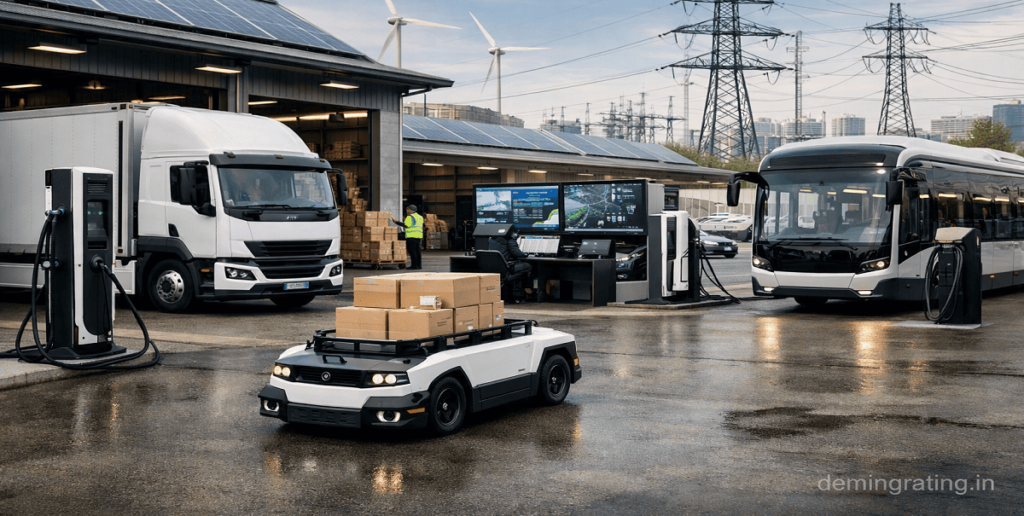
The logistics industry is one of the largest beneficiaries of EV technology. Electric delivery vans, trucks, and fleet vehicles are being adopted for last-mile delivery because they offer lower operating costs, reduced maintenance requirements, and zero tailpipe emissions.
Companies operating delivery fleets benefit from predictable routes because EVs can be optimized for daily travel patterns. Fleet management software can monitor battery health, energy consumption, driver behavior, and charging schedules. AI-based systems help companies reduce downtime and improve vehicle utilization.
Electric trucks are also gaining importance in regional transportation. Improvements in battery capacity and charging infrastructure are making medium- and heavy-duty electric vehicles more suitable for commercial operations.
2. Public Transportation and Electric Buses
Public transportation is experiencing significant transformation through electric buses and shared mobility solutions. Cities worldwide are replacing diesel buses with electric alternatives to reduce pollution, operating expenses, and noise levels.
Electric buses provide advantages such as regenerative braking, lower fuel costs, and reduced mechanical complexity. Smart charging systems allow transportation operators to schedule charging during low-demand electricity periods, reducing pressure on power networks.
In developing markets, including India, electric buses and three-wheelers are becoming important solutions for urban mobility due to rising fuel costs and increasing environmental requirements. The IEA reports strong growth in electric two- and three-wheeler adoption in emerging markets. (IEA)
3. Manufacturing and Industrial Vehicles
Manufacturing facilities are increasingly using electric vehicles internally for material handling and automation. Electric forklifts, autonomous guided vehicles (AGVs), and warehouse robots are replacing traditional fuel-powered equipment.
EV-based industrial systems improve workplace conditions because they produce fewer emissions and operate more quietly. Lithium-ion battery technology enables longer operating hours and faster charging compared with older lead-acid battery systems.
Industries such as automotive manufacturing, warehousing, and distribution centers are integrating connected EV fleets with industrial automation platforms to improve productivity.
4. Agriculture and Farming Applications
Electric vehicle technology is expanding into agriculture through electric tractors, autonomous farm vehicles, and battery-powered equipment.
Electric agricultural machines offer several benefits, including lower operating costs, reduced dependence on diesel fuel, and improved precision farming capabilities. AI-powered electric farming vehicles can analyze soil conditions, optimize routes, and perform automated operations.
Solar-powered charging systems are also being explored to support rural electric mobility and reduce dependence on traditional fuel sources.
5. Construction and Mining Industry
Construction and mining companies are adopting electric equipment to reduce emissions in environmentally sensitive areas. Electric excavators, loaders, and specialized vehicles help reduce fuel consumption while improving workplace safety.
Battery-powered construction equipment is particularly valuable for indoor projects, underground mining, and urban construction sites where emissions and noise restrictions are important.
6. Autonomous Vehicles and AI-Based Mobility
Electric vehicles provide an ideal platform for autonomous technologies because their electrical systems integrate well with sensors, computing hardware, and AI systems. Advanced driver-assistance systems (ADAS), automated vehicles, and robotaxi services are increasingly built around electric platforms.
AI enables features such as predictive maintenance, intelligent route planning, battery optimization, and automated driving functions. According to the IEA, electric vehicles are increasingly benefiting from advances in AI, computing power, and automated driving technologies. (IEA)
7. Energy Storage and Smart Grid Integration
One of the most innovative industrial applications of EV technology is vehicle-to-grid (V2G) integration. EV batteries can store electricity and supply energy back to buildings or power networks when required.
Businesses can use EV fleets as distributed energy storage systems, helping balance electricity demand and integrate renewable energy sources such as solar and wind power.
Smart charging platforms allow companies to control charging schedules, reduce electricity costs, and improve energy efficiency.
8. Automotive Component and Battery Manufacturing
The growth of EVs is creating new opportunities in battery production, power electronics, electric motors, charging equipment, and semiconductor manufacturing.
Companies are investing in advanced components such as silicon carbide power electronics, battery management systems, and integrated electric drive units. India, for example, has introduced initiatives supporting indigenous EV power electronics development, including advanced integrated drive systems. (Press Information Bureau)
9. Challenges in Industrial EV Adoption
Despite rapid growth, industries face several challenges when implementing EV technology. Major barriers include:
- High initial investment costs
- Charging infrastructure requirements
- Battery recycling and sustainability concerns
- Limited availability of heavy-duty EV solutions
- Grid capacity requirements
- Need for skilled technical workforce
Organizations must evaluate total ownership costs, operational requirements, and charging strategies before transitioning large fleets to electric technology.
Conclusion
The latest advancements in electric vehicle technology are creating significant opportunities across industries. From logistics and public transportation to manufacturing, agriculture, construction, and energy management, EVs are improving efficiency while supporting sustainability goals.
Future industrial applications will increasingly combine electric mobility with artificial intelligence, automation, connected software, and renewable energy systems. As battery technology improves and charging infrastructure expands, electric vehicles will become a critical technology platform for modern industries worldwide.
References
- International Energy Agency (IEA) — Global EV Outlook 2026
https://www.iea.org/reports/global-ev-outlook-2026 - U.S. Department of Energy — Transportation Technologies Office
https://www.energy.gov/cmei/vehicles/transportation-technologies-office - IEA — Vehicle Software and Software-Defined Vehicles
https://www.iea.org/reports/vehicle-software-and-software-defined-vehicles - IEA — Artificial Intelligence and Electric Vehicles
https://www.iea.org/reports/artificial-intelligence-and-evs
Ask FAQs
What are the latest advancements in electric vehicle technology?
The latest advancements in electric vehicle technology include improved battery systems, faster charging solutions, artificial intelligence (AI), connected vehicle software, and advanced energy management systems. New battery technologies such as solid-state batteries, lithium iron phosphate (LFP) batteries, and silicon-based anodes are improving driving range, safety, and battery lifespan. High-voltage charging platforms are reducing charging times, while AI-powered systems optimize energy consumption, navigation, and vehicle performance. These innovations are helping EVs become more efficient, affordable, and practical for consumers and industries.
How do new battery technologies improve electric vehicle performance?
New battery technologies improve EV performance by increasing energy density, reducing charging time, extending battery life, and improving safety. Advanced lithium-ion batteries and next-generation solid-state batteries allow vehicles to store more energy without significantly increasing battery size or weight. Improved thermal management systems help maintain battery performance in different weather conditions. Technologies such as LFP batteries provide longer cycle life and lower costs, making EVs more suitable for commercial fleets and mass-market applications.
What role does artificial intelligence play in modern electric vehicles?
Artificial intelligence plays an important role in improving EV efficiency, safety, and user experience. AI systems analyze driving patterns, battery conditions, traffic information, and energy consumption to optimize vehicle performance. They support features such as predictive maintenance, intelligent navigation, advanced driver-assistance systems (ADAS), and automated driving technologies. AI also helps battery management systems improve charging efficiency and extend battery lifespan.
How are fast charging and smart charging transforming EV adoption?
Fast charging systems reduce the time required to recharge electric vehicles, making EVs more convenient for long-distance travel and commercial operations. Modern high-voltage charging systems can significantly increase vehicle range within minutes when connected to compatible charging stations. Smart charging systems use digital communication between vehicles, chargers, and electricity networks to schedule charging during low-demand periods. Technologies such as vehicle-to-grid (V2G) allow EVs to supply stored energy back to the grid, supporting renewable energy integration and improving energy management.
What are the major challenges facing the future of electric vehicle technology?
Although EV technology is advancing rapidly, several challenges remain. These include high initial vehicle costs, limited charging infrastructure, battery raw material supply issues, recycling requirements, and electricity grid capacity concerns. The industry must also address cybersecurity, manufacturing scalability, and the environmental impact of battery production. Continued investment in research, renewable energy integration, recycling systems, and charging networks will be essential for achieving widespread electric vehicle adoption.
Table of Contents
Disclaimer:
The information provided in this article is for general informational and educational purposes only. Technology trends and industry developments may change over time. Readers should verify information from official sources before making business, investment, or technical decisions.