
EU Deforestation Regulation (EUDR)
The EU Deforestation Regulation (EUDR) is one of the most significant sustainability laws affecting global supply chains. Adopted as Regulation (EU) 2023/1115, it aims to ensure that products sold in, imported into, or exported from the European Union are not linked to deforestation or forest degradation. The regulation applies to seven high-risk commodities: cattle, cocoa, coffee, palm oil, rubber, soy, and wood, as well as many derived products such as leather, chocolate, EU Deforestation Regulation (EUDR) furniture, and paper.
Under the EUDR, companies must conduct mandatory due diligence. They need to collect precise geolocation data for the land where the commodity was produced, verify that no deforestation occurred after 31 December 2020, assess risks, EU Deforestation Regulation (EUDR) and take mitigation measures before placing products on the EU market. This creates a much higher level of traceability than previous sustainability frameworks.
The implementation timeline was postponed by one year. According to the European Commission, large and medium-sized operators must comply from 30 December 2026, while micro and small enterprises must comply from 30 June 2027. The Commission has also issued updated guidance and digital tools to support implementation. These dates are now the official application deadlines. European Commission Regulation on Deforestation-free Products European Commission Implementing the EUDR
For businesses in countries such as India, Brazil, Indonesia, EU Deforestation Regulation (EUDR) and Côte d’Ivoire, the EUDR is both a challenge and an opportunity. Compliance may increase costs, especially for smallholders, but it can also improve access to premium EU markets and strengthen sustainability credentials. Companies should begin supplier mapping, geolocation data collection, and traceability upgrades well before the deadlines.
What is the EU Deforestation Regulation (EUDR) and why was it introduced?
The EU Deforestation Regulation (EUDR) is a landmark environmental law adopted by the European Union in 2023 to ensure that products sold in, imported into, or exported from the EU are not linked to deforestation or forest degradation. Formally known as Regulation (EU) 2023/1115, it replaces the earlier EU Timber Regulation and introduces much stricter traceability EU Deforestation Regulation (EUDR) and due-diligence requirements for companies operating in EU supply chains.
The regulation applies to seven commodities that are strongly associated with global deforestation: cattle, cocoa, coffee, palm oil, rubber, soy, and wood, as well as many derived products such as leather, chocolate, furniture, and paper. Companies must be able to prove that these products were produced on land that was not deforested after 31 December 2020 and that production complied with relevant local laws. This includes collecting geolocation data for the farms or plots where the commodities originated and submitting a due-diligence statement through the EU’s information system. European Commission Regulation on Deforestation-free Products European Commission – Implementing the EUDR
The EUDR was introduced because the EU is a major consumer of products that contribute to deforestation in other parts of the world. Forest loss is a significant driver of climate change, biodiversity loss, soil degradation, and disruption of water systems. EU policymakers concluded that voluntary corporate commitments had not been sufficient to stop these impacts. The regulation is therefore designed to reduce the EU’s environmental footprint and support the objectives of the European Green Deal and international climate, EU Deforestation Regulation (EUDR) and biodiversity commitments. World Resources Institute What Is the EUDR?
For businesses worldwide, including exporters in India, the EUDR represents a shift from voluntary sustainability claims to legally enforceable supply-chain accountability. Companies that invest early in traceability, geolocation mapping, and supplier verification will be better positioned to maintain access to the EU market as the regulation is implemented.
Which products and industries are covered under the EUDR?
The EU Deforestation Regulation (EUDR) applies to a defined list of commodities and a wide range of products derived from them. The regulation focuses on sectors that have the greatest impact on global deforestation and forest degradation. Any company that imports, exports, or places these products on the EU market must ensure that they are deforestation-free, produced in accordance with relevant local laws, and supported by traceability and due-diligence documentation.
The seven commodities covered by the EUDR are:
- Cattle
- Cocoa
- Coffee
- Palm oil
- Rubber
- Soy
- Wood
In addition to these raw commodities, the regulation also covers many derived products listed in Annex I of the regulation. Examples include:
- Leather and hides from cattle
- Chocolate and cocoa powder
- Roasted and instant coffee
- Palm oil derivatives used in food, cosmetics, and industrial products
- Rubber tires, gloves, and other rubber goods
- Soybean meal, soy oil, and animal feed
- Timber, plywood, furniture, paper, and printed products
As a result, the EUDR affects multiple industries beyond agriculture. The most impacted sectors include food and beverage, retail, leather and footwear, automotive and tire manufacturing, cosmetics and personal care, furniture and construction materials, paper and packaging, and commodity trading and logistics.
For example, an Indian exporter of coffee, a furniture manufacturer using imported timber, or a tire producer using natural rubber may all fall within the scope of the regulation if their products are sold in the EU.
The European Commission provides the official list of covered commodities and products in Annex I of the regulation: European Commission – EUDR product scope . A practical overview is also available from the World Resources Institute: WRI – Explaining the EUDR .
What are the key due diligence requirements of the EUDR?
The EU Deforestation Regulation (EUDR) introduces one of the most comprehensive due diligence systems ever applied to agricultural and forest-risk commodities. Any operator or trader placing covered products on the EU market, or exporting them from the EU, must demonstrate that the products are deforestation-free, legally produced, and fully traceable.
The due diligence process has three core pillars: information collection, risk assessment, and risk mitigation.
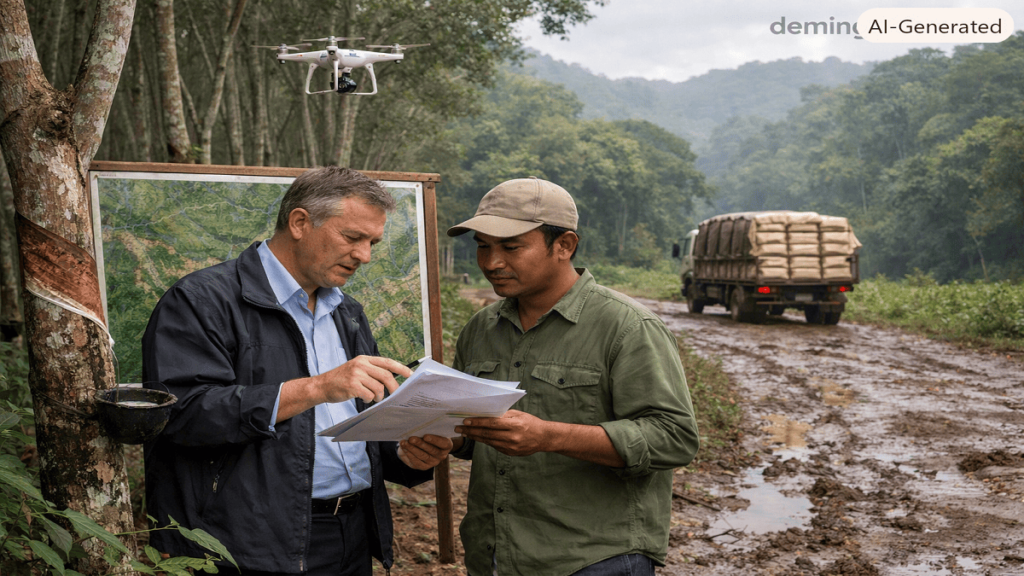
First, companies must collect detailed information about the product and its supply chain. This includes the commodity type, quantity, supplier details, country of production, and most importantly, the geolocation coordinates of all plots of land where the commodity was produced. For cattle, geolocation must cover all relevant establishments. Businesses must also obtain evidence that production complied with applicable laws in the country of origin, such as land-use, environmental, labor, and human-rights regulations.
Second, companies must conduct a risk assessment. They need to evaluate whether there is any risk that the product is linked to deforestation after 31 December 2020 or to illegal production. Factors such as the prevalence of deforestation in the region, the complexity of the supply chain, the reliability of suppliers, and the possibility of mixing compliant and non-compliant materials must be considered.
Third, where risks are not negligible, companies must implement risk mitigation measures. These may include obtaining additional documentation, conducting supplier audits, using satellite monitoring, or changing sourcing practices.
Before products can be placed on the EU market, operators must submit a due diligence statement through the EU information system, confirming that they have completed the required checks and found no more than a negligible risk.
The European Commission provides official guidance on these obligations: European Commission – EUDR Due Diligence . Additional implementation guidance is available here: European Commission – EUDR Implementation .
How does the EUDR impact companies involved in global supply chains?
The EU Deforestation Regulation (EUDR) has a significant impact on companies involved in global supply chains because it extends responsibility far beyond European borders. Any business that produces, processes, trades, imports, or exports covered commodities and products connected to the EU market must now demonstrate that those goods are deforestation-free, legally produced, and fully traceable.
One of the biggest changes is the requirement for end-to-end supply chain visibility. Companies can no longer rely solely on supplier declarations or sustainability certificates. They must collect precise geolocation data for farms or forest plots, maintain detailed records, and ensure that materials have not been mixed with non-compliant sources. This is particularly challenging for complex supply chains involving smallholders, intermediaries, cooperatives, and multiple processing stages.
The regulation also increases compliance costs and operational risks. Businesses may need to invest in satellite monitoring, digital traceability systems, supplier audits, legal verification, and data management platforms. Companies that fail to comply can face penalties, product seizures, exclusion from public procurement, and reputational damage within the EU market.
For exporters in countries such as India, Brazil, Indonesia, and Vietnam, the EUDR may require substantial changes in sourcing and documentation practices. Smaller suppliers could struggle with data collection and verification, while larger companies may gain a competitive advantage by implementing robust traceability systems early.
At the same time, the EUDR creates opportunities. Companies that can prove sustainable and legal production may strengthen relationships with international buyers, access premium markets, improve ESG performance, and enhance long-term supply chain resilience.
The European Commission’s official guidance is available here: European Commission – EUDR Overview . A business-focused explanation is provided by the World Resources Institute: WRI – Explaining the EUDR .
Overall, the EUDR shifts global trade toward mandatory environmental accountability, making traceability, transparency, and responsible sourcing essential requirements for companies participating in EU-linked supply chains.
What are the benefits and challenges of complying with the EUDR?
Complying with the EU Deforestation Regulation (EUDR) presents both significant opportunities and substantial operational challenges for businesses involved in agricultural, forest, and commodity-based supply chains. The regulation is reshaping how companies manage sourcing, traceability, and sustainability.
One of the main benefits is improved market access. Companies that meet EUDR requirements can continue supplying the European Union, one of the world’s largest consumer markets. Compliance can also strengthen relationships with international buyers that increasingly demand transparent and responsible sourcing. In addition, businesses may enhance their ESG performance, brand reputation, and investor confidence by demonstrating measurable action against deforestation.
Another important advantage is greater supply chain visibility. The process of collecting geolocation data, verifying suppliers, and mapping sourcing areas can help companies identify inefficiencies, reduce the risk of illegal sourcing, and improve long-term procurement resilience. Early adopters may also gain a competitive edge as customers favor suppliers with established traceability systems.
However, the challenges are considerable. The most difficult issue for many companies is obtaining accurate geolocation and traceability data, especially when sourcing from thousands of smallholders or multiple intermediaries. Businesses may need to invest in satellite monitoring, digital platforms, audits, staff training, and legal verification, which can increase compliance costs significantly.
There is also uncertainty around data quality, supplier readiness, and regulatory interpretation. Small and medium-sized enterprises may lack the technical capacity and financial resources required for implementation. In some regions, fragmented land records and limited digital infrastructure make verification particularly complex.
The European Commission provides official implementation guidance: European Commission – EUDR Guidance . A practical business perspective is available from the World Resources Institute: WRI – Explaining the EUDR .
Case Study of EU Deforestation Regulation (EUDR)
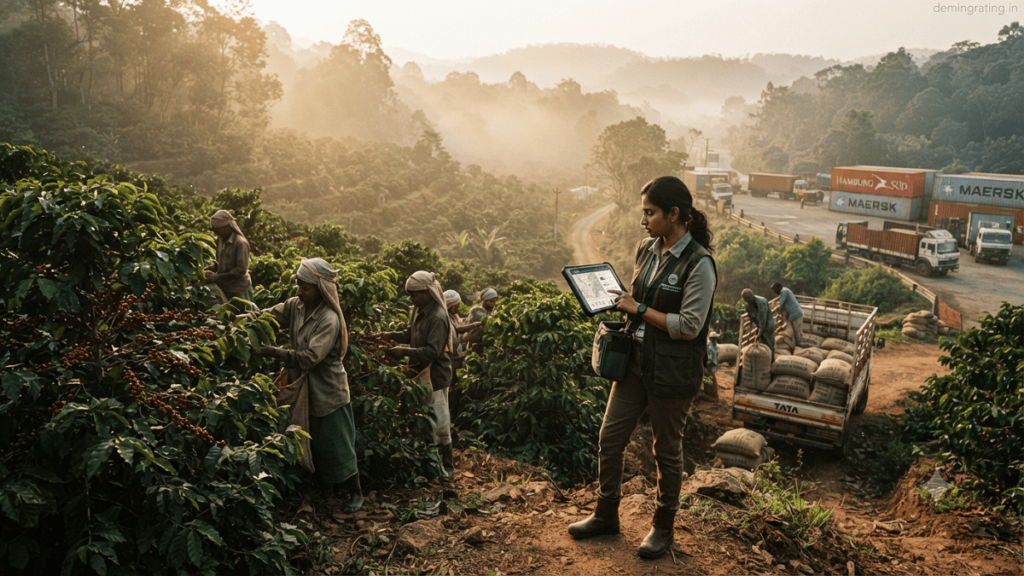
The EU Deforestation Regulation (EUDR) is already influencing how global agricultural supply chains operate, particularly in commodities such as coffee, cocoa, rubber, and palm oil. A useful case study is the impact of the EUDR on a hypothetical Indian coffee exporter supplying specialty coffee to European buyers.
Background
India is one of the world’s major coffee-producing countries, and the European Union is an important export destination. Under the EUDR, coffee placed on the EU market must be proven deforestation-free, meaning it cannot originate from land that was deforested after 31 December 2020. Exporters must also provide geolocation data for the farms where the coffee was produced and demonstrate compliance with relevant local laws.
The Challenge
The exporter sourced coffee from 3,500 smallholder farmers across Karnataka. Previously, traceability ended at the cooperative level, and farm-level GPS data was not systematically collected. European buyers informed the company that future contracts would require full EUDR compliance.
Actions Taken
The company launched a three-phase compliance program:
- Collected GPS coordinates for all participating farms using a mobile mapping application.
- Used satellite imagery to verify that no post-2020 deforestation had occurred.
- Implemented a digital traceability system linking each coffee lot to individual farms and supporting documents.
The exporter also trained farmers on record-keeping, EU Deforestation Regulation and sustainable land management.
Results
Within twelve months, the company achieved traceability for 98% of its export volume. It retained its EU customers and secured a premium contract with a specialty roaster that valued verified deforestation-free sourcing. Operational costs increased initially, but the company gained better visibility into its supply chain, EU Deforestation Regulation and reduced sourcing risks.
Key Lessons
This case illustrates that EUDR compliance is not only a regulatory requirement but also a catalyst for digital transformation, supplier engagement, and sustainability-driven market differentiation.
White Paper on EU Deforestation Regulation (EUDR)
Executive Summary
The EU Deforestation Regulation (EUDR) represents a major shift in global sustainability governance. Adopted as Regulation (EU) 2023/1115, it requires companies placing certain commodities and derived products on the European Union market to prove that they are deforestation-free, legally produced, and fully traceable. The regulation covers cattle, cocoa, coffee, palm oil, rubber, soy, and wood, along with numerous derived products such as leather, chocolate, furniture, paper, EU Deforestation Regulation, EU Deforestation Regulation and tires.
This white paper examines the objectives, scope, due-diligence requirements, business implications, challenges, and strategic responses associated with the EUDR. For companies engaged in global supply chains, the regulation is not merely a compliance exercise; it is a catalyst for digital traceability, supplier engagement, EU Deforestation Regulation and sustainable sourcing transformation.
Official EU overview: European Commission – Regulation on Deforestation-free Products
1. Introduction
Deforestation is a critical contributor to climate change, biodiversity loss, soil degradation, and disruption of water systems. The European Union has recognized that a significant share of global deforestation is linked to the production of commodities consumed within the EU. Previous voluntary sustainability initiatives were considered insufficient to address these impacts.
The EUDR was introduced to reduce the EU’s contribution to global deforestation and to support the objectives of the European Green Deal, the Paris Agreement, EU Deforestation Regulation and international biodiversity commitments.
2. Scope of the Regulation
The regulation applies to operators and traders dealing with the following commodities:
- Cattle
- Cocoa
- Coffee
- Palm oil
- Rubber
- Soy
- Wood
Derived products listed in Annex I are also covered, including:
- Chocolate and cocoa preparations
- Roasted and instant coffee
- Leather products
- Wooden furniture
- Paper and printed materials
- Rubber tires and industrial rubber goods
The exact coverage depends on the product’s customs classification.
3. Core Compliance Requirements
The EUDR establishes a mandatory due-diligence framework with three stages.
3.1 Information Collection
Companies must collect:
- Product description and quantity
- Supplier details
- Country of production
- Geolocation coordinates of production plots
- Evidence of legal compliance
3.2 Risk Assessment
Businesses must assess whether there is more than a negligible risk that products are linked to deforestation after 31 December 2020 or produced illegally.
3.3 Risk Mitigation
Where risks are identified, companies must take corrective measures such as:
- Additional documentation
- Supplier audits
- Satellite monitoring
- Segregation of supply streams
- Changes in sourcing practices
Before placing products on the EU market, operators must submit a due-diligence statement through the EU information system.
Implementation guidance: European Commission – EUDR Implementation
4. Implementation Timeline
The EU postponed application by one year. The current deadlines are:
Large and medium-sized operators
30 Dec 2026
Micro and small enterprises
30 Jun 2027
Companies should use this period to build traceability systems and engage suppliers.
5. Impact on Global Supply Chains
The EUDR extends regulatory responsibility across the entire value chain, including producers, cooperatives, processors, traders, importers, manufacturers, EU Deforestation Regulation and retailers.
Key impacts
- End-to-end traceability
- Higher compliance costs
- Increased data-management requirements
- Greater supplier scrutiny
- Enhanced legal and reputational risk
For exporters in countries such as India, Brazil, Indonesia, and Vietnam, access to the EU market will increasingly depend on the ability to provide verified geolocation and traceability data.
6. Benefits of Compliance
Despite the challenges, compliance offers strategic advantages.
Market access
Maintain and strengthen access to EU buyers and long-term contracts.
Brand reputation
Demonstrate measurable action on sustainability and responsible sourcing.
ESG performance
Support investor expectations and corporate reporting objectives.
Supply-chain resilience
Improve visibility, reduce illegal sourcing risk, and strengthen procurement decisions.
Early adopters may gain a competitive advantage as buyers prefer suppliers with mature traceability systems.
7. Key Challenges
7.1 Smallholder Integration
Many supply chains involve thousands of small farmers with limited digital capabilities.
7.2 Geolocation Accuracy
Collecting precise polygon or coordinate data can be complex and costly.
7.3 Data Quality
Inconsistent records and fragmented land documentation create verification difficulties.
7.4 Technology Investment
Companies may need to invest in:
- GIS and satellite tools
- Traceability platforms
- Audit systems
- Staff training
- Cybersecurity and data governance
8. Case Study: Indian Coffee Exporter
A medium-sized Indian coffee exporter supplying European specialty roasters sourced from 3,500 smallholders. To prepare for the EUDR, the company:
- Mapped all farms using GPS-enabled mobile applications.
- Verified land-use history through satellite imagery.
- Linked coffee lots to individual farms in a digital traceability platform.
- Trained farmers on documentation and legal compliance.
Outcome
- 98% traceability achieved
- EU contracts retained
- Premium pricing secured for verified deforestation-free coffee
- Improved visibility into sourcing risks
This illustrates how compliance can support both sustainability and commercial performance.
9. Strategic Recommendations
For Producers
- Map farms and land boundaries
- Maintain production records
- Participate in cooperative traceability programs
For Exporters and Traders
- Conduct supplier segmentation
- Implement digital traceability
- Establish audit and grievance mechanisms
For Manufacturers and Retailers
- Integrate EUDR into procurement policies
- Require standardized supplier data
- Monitor high-risk sourcing regions
For Policymakers
- Support smallholder financing
- Improve land-record systems
- Promote interoperable traceability standards
10. Technology and Traceability
The EUDR is accelerating adoption of:
- Satellite monitoring
- Geographic Information Systems (GIS)
- Blockchain and distributed ledgers
- Mobile data-collection tools
- AI-assisted risk analysis
Technology alone is not sufficient; effective governance and supplier collaboration remain essential.
11. Risks of Non-Compliance
Potential consequences include:
- Financial penalties
- Confiscation of goods
- Exclusion from public procurement
- Suspension of market access
- Reputational damage
Companies should treat EUDR compliance as a board-level risk management issue.
12. Conclusion
The EU Deforestation Regulation is reshaping global commodity trade by making traceability, legality, and deforestation-free sourcing legally enforceable requirements. While implementation will be challenging—particularly for smallholders and complex supply chains—the regulation also creates an opportunity to build more transparent, resilient, and sustainable business models.
Organizations that invest early in geolocation mapping, supplier engagement, digital traceability, and risk management will be better positioned to maintain EU market access and meet the growing global demand for verifiable sustainability.
Further Reading
- European Commission – EUDR Overview
- European Commission – Implementation Guidance
- World Resources Institute – Explaining the EUDR
- Official Text of Regulation (EU) 2023/1115
Industry Application of the EU Deforestation Regulation (EUDR)
The EU Deforestation Regulation (EUDR) is transforming how industries source, process, and trade commodities associated with deforestation. Rather than targeting only primary producers, the regulation applies across the value chain, affecting manufacturers, exporters, importers, retailers, and distributors connected to the EU market. Its practical application varies by industry depending on the commodity involved and the complexity of the supply chain.
Food and Beverage Industry
Coffee, cocoa, soy, and palm oil are widely used in food products. Companies must trace these ingredients back to the farm level and verify that production did not involve deforestation after 31 December 2020. Large food brands are investing in digital traceability systems and supplier verification programs.
Leather and Footwear Industry
Because cattle are covered by the EUDR, leather used in shoes, bags, and accessories may fall within the regulation’s scope. Manufacturers must obtain documentation linking hides to compliant production areas and ensure legal sourcing throughout the supply chain.
Furniture and Wood Products
Timber, plywood, furniture, and paper products are directly affected. Wood processors and furniture exporters must maintain geolocation data for harvesting areas, legality documents, and chain-of-custody records.
Automotive and Tire Industry
Natural rubber is a covered commodity. Tire manufacturers and automotive suppliers must identify plantation sources, assess deforestation risks, and implement segregation or traceability measures where necessary.
Cosmetics and Personal Care
Palm oil derivatives are common in soaps, shampoos, and cosmetics. Brands are increasingly requiring supplier-level traceability and sustainability evidence to support EUDR compliance.
Strategic Industry Impact
Across sectors, the EUDR is driving:
- Digital traceability adoption
- Satellite and GIS monitoring
- Supplier engagement
- ESG integration
- Risk-based procurement
Ask FAQs
What is the EU Deforestation Regulation (EUDR)?
The EUDR is a European Union law that requires certain commodities and products sold in or exported from the EU to be deforestation-free and legally produced. It covers cattle, cocoa, coffee, palm oil, rubber, soy, wood, and many derived products such as chocolate, leather, furniture, paper, and tires. The regulation aims to reduce the EU’s contribution to global deforestation and improve supply-chain transparency. Official source: European Commission – EUDR
Which businesses are affected by the EUDR?
The regulation affects operators and traders involved in importing, exporting, processing, manufacturing, or selling covered products connected to the EU market. This includes farmers, cooperatives, exporters, commodity traders, food companies, furniture manufacturers, tire producers, retailers, and distributors. Even companies located outside the EU must comply if their products enter the EU market.
What does “deforestation-free” mean under the EUDR?
A product is considered deforestation-free if it was produced on land that has not been subject to deforestation or forest degradation after 31 December 2020. Companies must provide geolocation data for the production area and verify compliance through due diligence and supporting documentation.
What are the main compliance requirements?
Businesses must collect supply-chain information, conduct a risk assessment, implement risk mitigation measures when necessary, and submit a due diligence statement before placing products on the EU market. Traceability to the farm or production plot is a central requirement.
What happens if a company does not comply?
Non-compliance can lead to financial penalties, confiscation of products, exclusion from public procurement, and reputational damage. Companies may also lose access to EU customers and markets. Additional guidance:
Table of Contents
Disclaimer: This article is intended for informational and educational purposes only and does not constitute legal, regulatory, or professional advice. Businesses should consult qualified legal, compliance, or trade experts and refer to official European Union guidance for the most current EUDR requirements and obligations.