
Energy Efficiency Strategies Adopted for Awareness Creation and Employee Involvement
Energy efficiency is not achieved through technology alone. While energy-efficient equipment, automation, and renewable energy systems can significantly reduce consumption, employee behavior plays an equally important role. Organizations therefore need to create awareness and actively involve employees in energy-management initiatives. A strong employee engagement strategy helps turn energy efficiency from a management objective into an organization-wide culture.
One of the most effective strategies is regular employee awareness and training programs. Organizations can conduct workshops, toolbox talks, induction sessions, Energy Efficiency and refresher training to explain how daily activities affect energy consumption. Employees can be educated about practical measures such as switching off unused lights and equipment, optimizing air-conditioning settings, avoiding unnecessary machine idling, and reporting energy wastage. The U.S. Department of Energy also emphasizes organizational awareness Energy Efficiency and employee participation as important components of effective energy management.
Another important strategy is clear communication of energy-saving goals. Organizations can display energy-saving messages on notice boards, digital screens, internal portals, Energy Efficiency and email communications. Instead of communicating only general instructions, companies can share measurable targets and progress. For example, Energy Efficiency employees can be informed about monthly electricity consumption, energy savings achieved, and reductions in carbon emissions. Providing visible results helps employees understand that their individual actions contribute to broader organizational objectives.
Employee participation in energy-saving initiatives is equally important. Organizations can establish energy committees or cross-functional teams involving employees from production, maintenance, administration, facilities, Energy Efficiency and other departments. These teams can identify energy-wasting practices, suggest improvements, and monitor implementation. ISO 50001 provides a structured framework for improving energy performance and specifically recognizes the importance of organizational awareness and employee competence.
Organizations can also introduce employee suggestion schemes and recognition programs. Employees who identify practical energy-saving opportunities can be recognized through certificates, appreciation, awards, Energy Efficiency or other suitable incentives. Such programs encourage employees to take ownership rather than viewing energy efficiency as solely the responsibility of the maintenance or environmental department.
Finally, energy performance should be measured and communicated regularly. Simple indicators, dashboards, Energy Efficiency and departmental targets can help employees understand whether initiatives are producing results. ISO recommends using energy performance indicators as part of systematic energy management.
Overall, successful energy efficiency depends on creating awareness, providing appropriate training, encouraging participation, recognizing contributions, and communicating measurable results. When employees understand both the environmental and financial benefits of responsible energy use, energy conservation becomes part of everyday workplace behavior rather than a temporary campaign.
Relevant external resources:
- ISO 50001 – Energy Management Systems
- U.S. Department of Energy – Creating Organizational Awareness
- ISO – Energy Management and Employee Engagement
What energy efficiency strategies can organizations use to create employee awareness?
Employee awareness is a critical component of any successful energy-efficiency program. Organizations may invest in efficient equipment, renewable energy, Energy Efficiency automation, and energy-monitoring systems, but these measures deliver greater results when employees understand how their everyday decisions affect energy consumption. A structured awareness strategy can help organizations build a culture in which energy conservation becomes part of normal workplace practices.
1. Conduct Regular Energy-Efficiency Training
Organizations can organize induction sessions, workshops, toolbox talks, and periodic training programs to educate employees about energy-saving practices. Training should focus on practical actions such as switching off unused equipment, optimizing lighting and air-conditioning, avoiding unnecessary machine operation, Energy Efficiency and reporting energy wastage. The U.S. Department of Energy provides guidance on developing organizational awareness as part of energy-management programs. U.S. Department of Energy – Energy Management Guidance
2. Communicate Clear Energy-Saving Targets
Employees are more likely to participate when they understand the organization’s objectives. Management can establish measurable targets, such as reducing electricity consumption by a specific percentage, lowering peak demand, Energy Efficiency or improving energy performance within individual departments. Targets can be communicated through notice boards, emails, internal portals, digital dashboards, and team meetings.
3. Use Visible Awareness Campaigns
Posters, digital displays, newsletters, signage near switches and equipment, and short awareness messages can reinforce energy-saving behavior. Messages should be simple Energy Efficiency and action-oriented, such as reminding employees to turn off lights and equipment when they are not required. Campaigns can also highlight the financial and environmental benefits achieved through energy conservation.
4. Encourage Employee Suggestions
Employees who work directly with equipment and operational processes often identify energy-saving opportunities that may not be visible to management. Organizations can establish suggestion schemes, energy committees, Energy Efficiency or departmental improvement teams where employees can propose ideas for reducing energy consumption.
5. Recognize and Reward Participation
Recognition programs can strengthen employee engagement. Organizations can acknowledge departments or individuals that identify successful energy-saving opportunities or achieve measurable reductions in consumption. Recognition may include certificates, appreciation during meetings, internal announcements, or suitable incentive programs.
6. Share Energy Performance Results
Regularly communicating results helps employees understand whether their efforts are making a difference. Organizations can display monthly energy consumption, savings achieved, Energy Efficiency or progress against targets. Linking improvements to specific employee initiatives can further strengthen participation.
Conclusion
Creating employee awareness about energy efficiency requires continuous communication, practical training, participation, and recognition. Organizations should make energy conservation easy to understand, measurable, and relevant to employees’ daily responsibilities. A systematic approach aligned with frameworks such as ISO 50001 can help integrate employee awareness into a broader energy-management system. ISO 50001 – Energy Management Systems
When employees are informed, encouraged to contribute, and shown the results of their efforts, energy efficiency becomes more than a management initiative. It becomes a shared organizational responsibility that can reduce energy costs, improve operational performance, and support environmental objectives.
How Can Employee Training and Awareness Programs Promote Energy-Saving Practices?
Employee training and awareness programs play an important role in developing a workplace culture focused on energy efficiency. Even when an organization invests in energy-efficient equipment and technologies, significant savings can be lost through inefficient operating practices, unnecessary equipment use, or a lack of employee awareness. Training helps employees understand how their daily decisions influence energy consumption, Energy Efficiency and provides them with practical knowledge to reduce waste.
1. Build Understanding of Energy Consumption
Training programs can explain where and how energy is consumed within an organization. Employees can learn about energy-intensive equipment, heating and cooling systems, lighting, production processes, and office equipment. Understanding the relationship between workplace activities Energy Efficiency and energy consumption makes energy-saving practices more meaningful. The International Organization for Standardization (ISO) identifies organizational awareness and competence as important elements of effective energy management under ISO 50001.
2. Teach Practical Energy-Saving Behaviors
Awareness programs should focus on actions employees can apply immediately. These may include switching off lights and computers when not required, Energy Efficiency using air-conditioning responsibly, avoiding unnecessary machine idling, maintaining appropriate temperature settings, and reporting leaking compressed air or malfunctioning equipment. Practical demonstrations can be particularly effective because employees can see how correct operating practices reduce energy waste.
3. Make Energy Efficiency Part of Job Responsibilities
Training should be relevant to individual roles. Maintenance personnel may require specialized training on efficient equipment operation and preventive maintenance, while office employees may focus on lighting, computers, printers, Energy Efficiency and air-conditioning. Production employees can be trained to identify energy losses associated with machinery and production processes. The U.S. Department of Energy highlights workforce development and upskilling as ways to support the adoption of energy-efficient practices.
4. Encourage Employee Participation
Awareness programs should not be limited to one-way communication. Employees can be encouraged to identify energy-saving opportunities, participate in energy committees, submit suggestions, and take part in departmental energy-saving campaigns. ISO guidance also emphasizes getting people throughout the organization involved, Energy Efficiency and helping employees understand why and how to save energy.
5. Communicate Results and Recognize Contributions
Organizations can strengthen awareness by sharing energy performance results with employees. Monthly dashboards, newsletters, meetings, or internal communications can show electricity savings, cost reductions, or progress toward energy targets. Recognizing employees and departments that contribute successful ideas can further motivate participation. ISO has highlighted examples where employee awareness and training helped organizations establish a stronger culture of energy efficiency.
Conclusion
Effective training transforms energy efficiency from a management policy into everyday employee behavior. Organizations should provide role-specific training, communicate clear objectives, encourage employee suggestions, demonstrate practical energy-saving actions, and regularly share results. When supported by a structured energy-management framework such as ISO 50001, these activities can contribute to continual improvement in energy performance and help create a long-term culture of responsible energy use.
Relevant external resources:
- ISO 50001 – Energy Management Systems
- U.S. Department of Energy – Workforce Development
- U.S. Department of Energy – Inspiring an Energy-Efficient Workforce
What Activities Can Encourage Employees to Actively Participate in Energy Conservation?
Employee participation is essential for making energy conservation a consistent part of workplace operations. Organizations can install efficient equipment and implement energy-management systems, but employees influence energy consumption through everyday decisions such as operating machinery, using lighting and air-conditioning, and shutting down equipment. Practical and engaging activities can help transform employees from passive recipients of energy policies into active contributors to energy-saving initiatives.
1. Organize Energy-Saving Competitions
Friendly competitions between departments, shifts, teams, or facilities can make energy conservation more engaging. Organizations can compare energy consumption against established baselines and recognize teams that achieve meaningful improvements. Competitions should focus on measurable and achievable goals rather than simply rewarding the department with the lowest consumption, since different departments may have different operational requirements. The U.S. Department of Energy recommends contests between employees, shifts, departments, buildings, or sites as one way of bringing energy efficiency into workplace culture.
2. Conduct Energy Treasure Hunts
An energy treasure hunt allows employees to walk through a workplace and identify sources of energy waste. Participants can look for unnecessary lighting, equipment operating during idle periods, compressed-air leaks, inefficient temperature settings, or other opportunities for improvement. This activity combines learning with practical problem-solving. The Department of Energy has documented a Celanese program in which employees participated in targeted energy treasure hunts and identified substantial potential energy-saving opportunities.
3. Create Employee Suggestion Programs
Organizations can establish an online form, suggestion box, email channel, or dedicated energy-management platform where employees can submit energy-saving ideas. Suggestions should be reviewed regularly, and employees should receive feedback about whether their ideas can be implemented. This creates a sense of ownership and encourages employees to continue identifying opportunities.
4. Hold Energy Awareness Huddles
Short energy discussions can be incorporated into regular team meetings or shift-start huddles. Supervisors can discuss recent energy performance, highlight specific sources of waste, and identify one or two actions employees can take during the shift. The Department of Energy specifically identifies team huddles as an activity for discussing energy-efficiency topics.
5. Recognize Employee Contributions
Recognition can be an effective way to maintain participation. Organizations can provide certificates, awards, appreciation announcements, or other appropriate recognition to employees and departments that contribute useful energy-saving ideas. Successful projects can also be highlighted in newsletters, internal portals, or company communications.
6. Provide Practical Training and Workshops
Training should explain not only what employees should do, but also why those actions matter. Role-specific training can cover efficient machine operation, lighting controls, HVAC practices, equipment shutdown procedures, and preventive maintenance. The U.S. Department of Energy emphasizes workforce training and upskilling as part of improving energy-management practices.
Conclusion
The most effective employee engagement activities are practical, measurable, and participatory. Energy competitions, treasure hunts, suggestion programs, team huddles, training sessions, and recognition schemes can encourage employees to identify waste and actively contribute solutions. These activities can be integrated into a structured Energy Management System based on ISO 50001, which promotes continual improvement in energy performance and organizational awareness.

How Can Organizations Measure Employee Involvement in Energy Efficiency Initiatives?
Measuring employee involvement is essential for determining whether an organization’s energy-efficiency awareness programs are creating meaningful participation. Energy consumption data alone cannot show how actively employees are contributing to energy-saving initiatives. Organizations should therefore combine participation indicators, employee feedback, training records, and measurable energy-saving outcomes to evaluate engagement effectively.
1. Track Participation in Energy Training
One of the simplest ways to measure involvement is to monitor employee participation in energy-efficiency training programs. Organizations can record attendance, completion rates, assessment results, and participation in refresher programs. Training records can also be reviewed by department to identify areas where additional awareness activities may be required.
2. Monitor Employee Suggestions
Organizations can establish an energy-saving suggestion system and track the number of ideas submitted by employees. More importantly, management should measure how many suggestions are evaluated, approved, implemented, and converted into measurable savings. Tracking these stages helps distinguish passive participation from active involvement.
3. Measure Participation in Energy Activities
Employee involvement can also be evaluated through participation in activities such as energy audits, energy treasure hunts, awareness campaigns, competitions, workshops, and energy committees. Organizations can monitor participation rates across departments and shifts to identify whether engagement is broad-based or concentrated among a small group of employees.
4. Conduct Employee Surveys
Regular surveys can provide information that participation statistics may not capture. Employees can be asked whether they understand the organization’s energy objectives, know how to reduce energy waste, and feel encouraged to contribute ideas. Surveys can also assess whether employees believe management takes energy-efficiency suggestions seriously.
5. Track Energy-Saving Actions
Organizations can develop behavioral indicators to monitor specific employee actions. Examples include equipment shutdown compliance, appropriate lighting practices, reporting of energy leaks, adherence to temperature settings, and compliance with machine operating procedures. Where practical, audits or digital monitoring systems can be used to measure these behaviors.
6. Link Participation to Energy Performance
Employee involvement should ultimately be connected with measurable improvements in energy performance. Organizations can compare energy consumption, energy intensity, or energy performance indicators before and after employee engagement programs. ISO 50001 provides a systematic framework for monitoring and improving energy performance and emphasizes organizational roles, competence, awareness, and participation. (ISO)
However, organizations should avoid assuming that every reduction in energy consumption is caused solely by employee behavior. Production volumes, weather, equipment upgrades, operating hours, and other factors can influence energy use. The U.S. Department of Energy recommends using appropriate energy performance indicators and measurement approaches to evaluate energy performance. (U.S. Department of Energy)
7. Recognize and Review Performance
Organizations can create periodic energy-engagement reports showing participation rates, suggestions received, initiatives implemented, training completion, and estimated savings. Departments demonstrating strong participation can be recognized, while areas with lower engagement can receive targeted support.
Conclusion
Employee involvement can be measured through a combination of quantitative and qualitative indicators. Training participation, suggestions, activity attendance, survey results, behavioral observations, implemented ideas, and energy-performance improvements provide a comprehensive picture of employee engagement. A balanced measurement approach allows organizations to identify successful initiatives, address participation gaps, and continually improve their energy-efficiency programs. By integrating employee involvement into a structured energy-management system, organizations can strengthen accountability and develop a long-term culture of energy conservation.
Benefits of Employee Participation in Improving Energy Performance
Employee participation is a key factor in improving an organization’s energy performance. While investments in energy-efficient equipment, automation, renewable energy, and monitoring systems can reduce energy consumption, employees determine how effectively many of these measures are used in day-to-day operations. Active participation helps organizations convert energy-efficiency policies into practical workplace behaviors and long-term improvements.
1. Reduces Energy Consumption and Operating Costs
One of the most direct benefits of employee involvement is reduced energy consumption. Employees can identify and eliminate avoidable energy waste by switching off equipment when it is not required, following efficient operating procedures, reporting faults, and using lighting and HVAC systems responsibly. Consistent behavioral improvements can contribute to lower electricity consumption and operating costs.
2. Identifies Energy-Saving Opportunities
Employees who work directly with production equipment, machinery, buildings, and operational processes often have valuable practical knowledge. Their involvement can help identify issues such as equipment operating unnecessarily, compressed-air leaks, inefficient processes, or inappropriate temperature settings. Employee suggestions can therefore complement technical energy audits and help organizations discover improvement opportunities that may otherwise be overlooked.
3. Improves Energy Awareness and Workplace Culture
Participation helps create a culture in which energy efficiency becomes a shared responsibility. Instead of viewing energy conservation as the responsibility of the maintenance, engineering, or environmental team, employees understand how their individual actions contribute to organizational energy performance. The International Organization for Standardization identifies awareness, competence, and employee involvement as important elements of energy management under ISO 50001. (ISO)
4. Supports Continuous Improvement
Employee participation can provide a continuous source of ideas for improving energy performance. Suggestion programs, energy committees, workshops, and energy treasure hunts encourage employees to regularly identify opportunities and test practical solutions. This supports the continual-improvement approach associated with structured energy-management systems.
5. Improves Equipment and Process Performance
Proper employee training and involvement can improve the way equipment is operated and maintained. Following recommended operating procedures, avoiding unnecessary idling, reporting equipment problems, and supporting preventive maintenance can help equipment operate more efficiently. Better operational practices may also reduce downtime and unnecessary maintenance costs.
6. Strengthens Organizational Commitment
When employees are actively involved in setting goals and developing solutions, they are more likely to support energy-efficiency initiatives. Management can strengthen this commitment by communicating energy targets, sharing performance results, recognizing successful contributions, and providing opportunities for employees to submit ideas.
7. Supports Environmental Objectives
Improving energy performance can reduce associated greenhouse gas emissions, particularly when an organization’s energy use involves fossil-fuel-based electricity or direct fuel consumption. Employee participation therefore contributes not only to financial savings but also to broader environmental and sustainability objectives. The U.S. Department of Energy provides guidance on improving energy management and organizational energy performance. (U.S. Department of Energy)
Conclusion
Employee participation provides organizations with financial, operational, environmental, and cultural benefits. Engaged employees can reduce energy waste, identify improvement opportunities, operate equipment more efficiently, and support continual improvement. Organizations that combine employee awareness with measurable targets, training, recognition, and systematic energy management can build a stronger foundation for sustained energy performance. Ultimately, energy efficiency becomes more effective when employees are treated not simply as users of energy but as active partners in improving how energy is managed.
Case Study: Energy Efficiency Strategies for Awareness Creation and Employee Involvement
Celanese: Engaging Employees Through Energy Treasure Hunts
Employee involvement can significantly strengthen an organization’s energy-efficiency program because employees working directly with equipment and processes are often well positioned to identify energy waste. A practical example is the Celanese Narrows, Virginia, facility, where the company developed an employee-focused Energy Treasure Hunt to increase awareness and identify energy-saving opportunities.
The facility had more than 700 employees and contractors and had regularly reviewed its energy systems. However, the energy team wanted to involve a broader cross-section of employees in identifying energy losses. Celanese therefore introduced a targeted Energy Treasure Hunt in which employees were encouraged to identify and report “gems”—examples of energy waste or potential efficiency improvements.
Employee Awareness Through Practical Activities
Instead of relying only on conventional classroom training, Celanese used an interactive approach. Employees were encouraged to observe their work areas and identify issues such as steam losses, compressed-air leaks, insulation problems, steam-trap issues, and other operational inefficiencies. This approach helped employees connect energy efficiency with their everyday responsibilities.
The company also used regular communication to maintain interest. Biweekly emails called “Energy Sparks” provided employees with information about common energy-saving opportunities and updates on progress toward the site’s savings target. These short communications helped keep energy efficiency visible during the campaign.
Recognition and Employee Motivation
Recognition was another important component of the initiative. Employees who identified useful energy-saving opportunities received awards, while additional recognition was provided to employees who identified the largest number of opportunities or the greatest potential energy savings. This created friendly competition and demonstrated that management valued employee contributions.
The company also provided regular feedback about identified opportunities and their implementation. This closed-loop communication was important because employees could see that their suggestions were being evaluated and converted into practical actions.
Measurable Results
The results demonstrate the potential impact of employee participation. More than 60 employees participated in the challenge and identified 118 energy-saving ideas. The opportunities identified represented more than 77,000 MMBtu per year of potential energy savings and approximately 4,530 metric tons of CO2e in potential emissions reductions. The identified opportunities exceeded the site’s initial target of $250,000 in actionable savings opportunities.
The initiative also produced longer-term behavioral benefits. Employees continued reporting energy losses after the formal challenge, while site teams began requesting energy-loss information for discussion during shift-change meetings. This indicates that the program helped move energy efficiency from a temporary campaign toward an ongoing workplace practice.
Key Lessons for Organizations
The Celanese case demonstrates that successful employee engagement does not necessarily require expensive programs. Organizations can combine awareness communication, practical training, employee suggestion systems, energy treasure hunts, recognition, and feedback to encourage participation.
The U.S. Department of Energy similarly identifies energy treasure hunts as an effective way to engage employees and identify low- and no-cost energy-saving opportunities.
Organizations can also use ISO 50001 as a structured framework for energy management. ISO identifies increased organizational awareness and employee competence regarding energy use and efficiency as benefits associated with the standard.
Conclusion
The Celanese case shows that employee involvement can become a practical source of energy-efficiency improvements when organizations provide employees with knowledge, opportunities to participate, recognition, and feedback. The most effective programs treat employees as partners in energy management rather than simply recipients of energy-saving instructions. By creating a culture of continuous participation, organizations can identify hidden energy losses, improve operational practices, reduce costs, and support broader sustainability objectives.
Relevant external resources:
- U.S. Department of Energy – Celanese Energy Treasure Hunt Case Study
- U.S. Department of Energy – Treasure Hunt Challenge
- ISO 50001 – Energy Management Systems
- Celanese Energy Sparks Training Approach
White Paper: Energy Efficiency Strategies for Awareness Creation and Employee Involvement
Executive Summary
Energy efficiency is increasingly recognized as an important component of operational excellence, cost management, and environmental sustainability. While organizations can achieve significant improvements through efficient technologies, automation, renewable energy, and energy-monitoring systems, long-term performance also depends on employee behavior. Employees operate equipment, manage facilities, influence production practices, and make daily decisions that can either reduce or increase energy consumption.
This white paper examines strategies organizations can adopt to create energy-efficiency awareness and encourage active employee involvement. It focuses on employee training, communication, energy-saving campaigns, suggestion programs, energy treasure hunts, recognition mechanisms, performance monitoring, and management commitment. International frameworks such as ISO 50001 provide a structured foundation for integrating awareness and competence into an organization’s energy-management system. (ISO)
1. Introduction
Energy efficiency should not be treated solely as a technical or engineering responsibility. An organization’s energy performance is influenced by employees across production, maintenance, administration, facilities, procurement, and management functions. Even small behavioral changes, when implemented consistently across a large workforce, can contribute to meaningful reductions in energy consumption and operating costs.
A successful employee engagement strategy therefore needs to make energy efficiency understandable, practical, measurable, and relevant to individual responsibilities.
2. Building Employee Awareness
The first step is to ensure that employees understand why energy efficiency matters. Organizations can conduct induction programs, workshops, toolbox talks, refresher training, newsletters, internal campaigns, and digital awareness programs.
Training should address practical workplace behaviors, including:
- Switching off unnecessary equipment and lighting
- Avoiding unnecessary machine idling
- Using HVAC systems efficiently
- Reporting equipment faults and energy leaks
- Following efficient operating procedures
- Supporting preventive maintenance
- Identifying opportunities to reduce energy waste
Communication should also explain the connection between energy conservation, operating costs, environmental performance, and organizational sustainability.
The U.S. Department of Energy recommends organizational approaches that engage employees in energy management and help establish energy-efficient workplace practices. (U.S. Department of Energy)
3. Employee Participation Strategies
Awareness is most effective when employees are given opportunities to participate. Organizations can establish cross-functional energy committees involving employees from different departments. These teams can identify energy losses, review consumption trends, develop improvement proposals, and support implementation.
An energy suggestion program can provide employees with a formal mechanism for submitting ideas. Organizations should track suggestions received, evaluated, implemented, and the savings associated with successful initiatives.
Another effective approach is the energy treasure hunt. Employees inspect their workplaces to identify energy losses such as compressed-air leaks, steam losses, unnecessary equipment operation, poor insulation, inefficient lighting, and inappropriate temperature settings.
The U.S. Department of Energy has documented industrial examples showing how energy treasure hunts can engage employees while identifying energy-saving opportunities. (U.S. Department of Energy – Treasure Hunt Challenge)
4. Communication and Motivation
Continuous communication is essential for maintaining employee interest. Organizations can use posters, newsletters, digital dashboards, team meetings, emails, and internal communication platforms to share energy-saving messages and performance results.
Communication should move beyond general instructions. Employees should be shown measurable outcomes, such as electricity saved, cost reductions, avoided emissions, and progress against energy targets. Demonstrating results helps employees understand that their actions have tangible consequences.
Recognition can further strengthen participation. Organizations can recognize individuals or departments that identify useful energy-saving opportunities. Appropriate recognition may include certificates, awards, appreciation announcements, or opportunities to present successful projects to management.
5. Linking Employee Involvement to Energy Performance
Employee engagement should be supported by measurable indicators. Organizations can track training completion, participation in energy activities, number of suggestions submitted, implementation rates, behavioral compliance, and energy savings associated with employee initiatives.
Energy performance indicators can also be used to evaluate whether employee involvement is contributing to broader improvements. However, organizations should account for factors such as production levels, operating hours, weather conditions, and equipment upgrades when interpreting energy data.
ISO 50001 provides a systematic framework for organizations seeking to establish, implement, maintain, and improve an energy-management system. The standard supports a structured approach to improving energy performance and developing organizational competence and awareness. (ISO 50001)
6. Management’s Role
Management commitment is fundamental to successful employee participation. Senior leaders should establish clear energy objectives, allocate appropriate resources, communicate expectations, and demonstrate personal commitment to energy conservation.
Supervisors and department managers have an equally important role because they translate organizational objectives into daily practices. Regular team discussions, performance reviews, and feedback mechanisms can ensure that energy efficiency remains part of operational decision-making.
Organizations should also avoid treating energy campaigns as short-term activities. Energy awareness should be incorporated into employee induction, job-specific training, standard operating procedures, performance monitoring, and continuous-improvement programs.
7. Expected Benefits
A well-designed employee engagement program can provide several benefits, including:
- Reduced energy consumption and operating costs
- Improved equipment operating practices
- Earlier identification of energy losses
- Increased employee awareness and accountability
- Greater participation in continuous improvement
- Improved environmental performance
- Stronger organizational energy culture
- Support for energy-management certification and sustainability objectives
Employee involvement can also generate low-cost or no-cost improvements that complement capital-intensive energy-efficiency projects.
8. Recommended Implementation Framework
Organizations can establish their employee energy-efficiency program through five stages:
Stage 1 – Assess: Establish an energy baseline and identify major consumption areas and behavioral opportunities.
Stage 2 – Educate: Provide role-specific training and communicate organizational energy objectives.
Stage 3 – Engage: Establish energy teams, suggestion programs, competitions, and energy treasure hunts.
Stage 4 – Measure: Track participation, implemented ideas, energy performance indicators, and measurable savings.
Stage 5 – Improve: Review results, recognize contributions, address participation gaps, and continuously improve the program.
This approach ensures that employee involvement is integrated into the organization’s broader energy-management system rather than operating as an isolated awareness campaign.
Conclusion
Energy efficiency is most sustainable when technology and human behavior work together. Organizations can achieve stronger results by developing employee awareness, providing practical training, creating opportunities for participation, recognizing contributions, and communicating measurable outcomes.
The central lesson is that employees should be viewed as active contributors to energy performance rather than simply consumers of energy. A structured program supported by management commitment and aligned with frameworks such as ISO 50001 can help establish a culture of continual improvement.
By integrating energy awareness into everyday operations, organizations can reduce avoidable energy waste, control costs, improve operational efficiency, support environmental objectives, and strengthen employee ownership of sustainability goals.
References and Further Reading
- ISO – ISO 50001 Energy Management Systems
- ISO – ISO 50001 Standard
- U.S. Department of Energy – Energy Management Information
- U.S. Department of Energy – Treasure Hunt Challenge
- U.S. Department of Energy – Better Buildings Solution Center
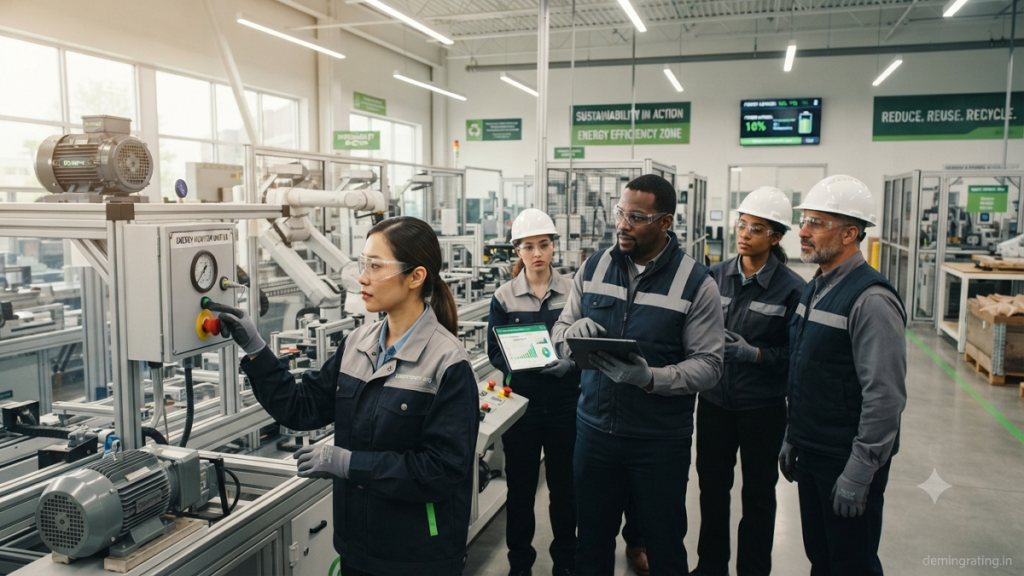
Industry Application of Energy Efficiency Strategies for Awareness Creation and Employee Involvement
Energy efficiency has become an important priority across manufacturing, commercial buildings, healthcare, hospitality, transportation, and other industries. Although organizations increasingly invest in efficient equipment and energy-management technologies, the effectiveness of these measures depends significantly on employee awareness and participation. Employees influence energy consumption through equipment operation, maintenance practices, lighting, heating and cooling, production processes, and daily workplace behavior.
1. Manufacturing Industry
Manufacturing facilities are often highly energy-intensive, making employee involvement particularly important. Organizations can conduct energy-awareness training for operators, maintenance personnel, supervisors, and engineers. Employees can be trained to identify compressed-air leaks, unnecessary machine idling, steam losses, inefficient motors, and poor operating practices.
Energy treasure hunts can be particularly effective in manufacturing because employees can inspect production areas and identify energy-saving opportunities directly. The U.S. Department of Energy has promoted treasure hunts as a practical approach for engaging employees in identifying energy and water efficiency opportunities. (U.S. Department of Energy)
2. Commercial Buildings and Offices
In offices, employee behavior has a significant influence on lighting, air-conditioning, computers, printers, and other electrical equipment. Organizations can introduce awareness campaigns encouraging employees to switch off unused equipment, use natural lighting where appropriate, and follow efficient HVAC practices.
Digital dashboards can display energy consumption and savings, while departmental campaigns can encourage teams to meet energy-reduction targets. Regular communication through emails, posters, induction programs, and staff meetings helps reinforce these behaviors.
3. Healthcare Industry
Hospitals and healthcare facilities operate continuously and have substantial energy requirements. Employee awareness programs can focus on efficient lighting, HVAC operation, medical equipment usage, refrigeration, sterilization processes, and facility management.
Training should be designed around different job functions. Clinical staff, housekeeping teams, facility personnel, and administrative employees may each have different opportunities to reduce energy waste. Energy-saving activities must be designed carefully so that efficiency improvements never compromise patient safety, infection control, or essential medical services.
4. Hospitality Industry
Hotels and resorts can engage employees in energy conservation through housekeeping, kitchen, maintenance, front-office, and facilities teams. Employees can be trained to manage room lighting, air-conditioning, laundry equipment, kitchen appliances, water-heating systems, and other energy-intensive operations efficiently.
Recognition programs can reward departments that demonstrate strong energy-saving performance while maintaining service quality. Employee awareness can also complement guest-facing initiatives, such as responsible energy-use information in hotel rooms.
5. Retail Industry
Retail organizations can involve employees in managing lighting, refrigeration, HVAC systems, display equipment, and back-office electrical consumption. Store teams can conduct routine checks to ensure that unnecessary equipment is switched off and that refrigeration and HVAC systems operate according to defined requirements.
Energy-saving targets can be integrated into store-management reviews, while employees can report equipment faults or unusual energy consumption to facility teams.
6. Transportation and Logistics
Transportation companies can address energy efficiency through employee training focused on fuel-efficient driving, vehicle maintenance, route optimization, idling reduction, and efficient warehouse operations. Drivers and fleet personnel can be encouraged to report vehicle issues that may increase fuel consumption.
For warehouses and logistics centers, employees can also participate in energy audits and identify opportunities involving lighting, material-handling equipment, refrigeration, and building systems.
7. Measuring Industry-Level Employee Involvement
Organizations should measure employee participation rather than relying only on overall energy consumption. Useful indicators include training completion rates, number of employee suggestions, participation in energy campaigns, energy treasure-hunt findings, implemented improvement ideas, and energy savings associated with employee initiatives.
ISO 50001 provides a structured energy-management framework that supports continual improvement of energy performance and organizational awareness. (ISO)
Conclusion
Across industries, employee involvement can transform energy efficiency from a technical initiative into an organizational culture. Manufacturing companies can use energy treasure hunts and process-focused training, offices can emphasize behavioral conservation, healthcare organizations can provide role-specific training, hospitality businesses can involve operational teams, and transportation companies can focus on fuel-efficient practices.
The most effective industry programs combine awareness, training, participation, measurement, communication, and recognition. When employees understand how their actions affect energy consumption and are given practical opportunities to contribute, organizations can achieve more sustainable energy performance while reducing operational costs and supporting environmental objectives.
Ask FAQs
Why is employee involvement important for industrial energy efficiency?
Employee involvement helps organizations turn energy-efficiency policies into everyday practices. Employees operate equipment, manage processes, identify faults, and influence energy consumption, making their participation essential for reducing energy waste.
What industries can benefit from employee energy-efficiency programs?
Manufacturing, healthcare, hospitality, retail, commercial buildings, transportation, logistics, and other energy-intensive industries can benefit. The specific activities should be adapted to the industry’s operational requirements and energy-use patterns.
How can organizations encourage employees to participate in energy conservation?
Organizations can use energy-awareness training, suggestion programs, energy treasure hunts, departmental competitions, regular communication, employee energy committees, and recognition programs to encourage active participation.
How can organizations measure employee involvement in energy efficiency?
Organizations can monitor training completion, participation in energy-saving activities, employee suggestions, implemented ideas, energy audits, behavioral compliance, and measurable savings associated with employee initiatives. These indicators provide a broader view of engagement than energy consumption alone.
What role does ISO 50001 play in employee energy awareness?
ISO 50001 provides a systematic framework for establishing and continually improving an energy-management system. It supports organizational awareness, competence, defined responsibilities, energy performance monitoring, and continual improvement. ISO 50001 – Energy Management Systems
Table of Contents
Disclaimer: This content is for general informational purposes only. Organizations should adapt energy-efficiency strategies to their specific operational, regulatory, safety, and environmental requirements.