
Eco-friendly Commuting Practices
Eco-friendly commuting practices are transportation choices and habits that reduce fuel consumption, greenhouse gas emissions, air pollution, traffic congestion, and the overall environmental impact of daily travel. As cities continue to grow and transportation remains a significant source of emissions, adopting cleaner commuting methods can make an important contribution to sustainable urban development.
One of the most effective approaches is public transportation. Buses, trains, metro systems, and other shared transportation options can move large numbers of people using less energy per passenger than individual private vehicles. Choosing public transit for regular journeys can therefore reduce fuel consumption and help lower emissions.
Walking and cycling are among the most environmentally friendly commuting options. They produce virtually no direct emissions and provide additional health benefits through physical activity. For short-distance journeys, replacing car or motorcycle trips with walking or cycling can be a practical way to reduce environmental impact. Infrastructure such as dedicated cycle lanes, pedestrian pathways, secure bicycle parking, and safe road crossings can encourage more people to adopt these options.
Carpooling and ride-sharing can also make commuting more sustainable. Sharing a vehicle with colleagues, friends, or other passengers reduces the number of vehicles required for the same journey. This can lower fuel consumption, traffic congestion, and emissions per passenger.
For commuters who require private vehicles, electric vehicles (EVs) offer another option. Battery-electric cars, scooters, and other EVs produce no tailpipe emissions and can reduce transportation-related emissions, particularly when charged using electricity generated from renewable sources. The International Energy Agency reports that electric vehicle adoption is expanding rapidly and represents an important part of the transition toward cleaner road transportation.
Another useful practice is combining trips and reducing unnecessary travel. Planning errands efficiently can prevent multiple separate journeys. Remote and hybrid working can also reduce commuting frequency when appropriate, helping employees avoid unnecessary daily transportation.
Employers can support eco-friendly commuting through workplace initiatives such as public-transit benefits, bicycle facilities, EV charging stations, carpool programs, flexible working arrangements, and incentives for low-carbon transportation. Governments can contribute by investing in reliable public transportation, pedestrian infrastructure, cycling networks, Commuting Practices and clean mobility systems.
Ultimately, eco-friendly commuting is not limited to one transportation technology. It involves choosing the most sustainable and practical option for each journey. Walking or cycling can be ideal for short trips, public transportation can work well for longer urban journeys, Commuting Practices and carpooling or EVs may be suitable when private transportation is necessary.
Adopting these practices collectively can help reduce transportation emissions, improve urban air quality, decrease congestion, and create healthier and more sustainable communities.
Relevant External Resources
- International Energy Agency – Global EV Outlook
- United Nations – Sustainable Transport
- U.S. Environmental Protection Agency – Green Transportation
- World Health Organization – Transport and Health
#SustainableMobility
What Are Eco-Friendly Commuting Practices and Why Are They Important for Sustainable Transportation?
Eco-friendly commuting practices are transportation choices that reduce the environmental impact of traveling between home, work, school, and other regular destinations. These practices focus on reducing greenhouse gas emissions, fuel consumption, air pollution, traffic congestion, and unnecessary energy use. Common examples include walking, cycling, using public transportation, carpooling, ride-sharing, using electric vehicles, and combining trips to reduce unnecessary journeys.
The importance of sustainable commuting is closely connected to the environmental impact of transportation. Road vehicles that rely on petrol and diesel contribute to greenhouse gas emissions and local air pollution. According to the International Energy Agency, the transport sector remains a significant source of global carbon dioxide emissions, making the transition to cleaner mobility an important part of climate action.
Common Eco-Friendly Commuting Practices
Walking and cycling are among the cleanest transportation options because they do not require fossil fuels and produce virtually no direct transport emissions. They are particularly effective for short-distance journeys and can also improve physical health.
Public transportation is another important option. Buses, trains, metros, and other shared transportation systems can carry many passengers in a single vehicle, reducing the number of individual cars on roads. Well-designed public transportation can therefore improve energy efficiency Commuting Practices and reduce congestion.
Carpooling and ride-sharing allow multiple people to share one vehicle. This reduces the number of vehicle journeys required and can lower fuel consumption and emissions per passenger.
For journeys where private transportation is necessary, electric vehicles (EVs) can provide a lower-emission alternative to conventional petrol and diesel vehicles. Battery-electric vehicles have no tailpipe emissions, while their overall environmental impact depends partly on how the electricity used for charging is generated. The IEA identifies vehicle electrification as an important pathway for reducing emissions from road transportation.
Why Sustainable Commuting Matters
Eco-friendly commuting can provide environmental, economic, and social benefits. Reducing fuel consumption can lower transportation costs, while fewer private vehicles on the road can help reduce congestion and improve urban mobility. Lower vehicle emissions can also contribute to better air quality.
Sustainable transportation can support healthier communities as well. Walking and cycling increase physical activity, while reduced traffic can contribute to quieter and more pleasant urban environments. The World Health Organization recognizes walking and cycling as important forms of physical activity and sustainable urban mobility.
Employers and governments can further encourage sustainable commuting by providing public transportation incentives, cycling facilities, pedestrian-friendly infrastructure, carpool programs, EV charging stations, and flexible or hybrid working arrangements.
Ultimately, eco-friendly commuting is not about eliminating private vehicles entirely. It is about choosing the most efficient and sustainable transportation option for each journey. By combining public transit, active mobility, shared transportation, electric vehicles, and reduced unnecessary travel, individuals Commuting Practices and organizations can contribute to a cleaner, more efficient, and more resilient transportation system.
Relevant External Resources
- International Energy Agency – Transport
- International Energy Agency – Global EV Outlook
- World Health Organization – Physical Activity
- U.S. Environmental Protection Agency – Green Vehicles
#CyclingToWork
How Can Walking, Cycling, Public Transportation, Carpooling, and Electric Vehicles Reduce Environmental Impacts?
Transportation is an essential part of modern life, but conventional road transport can contribute significantly to greenhouse gas emissions, air pollution, fuel consumption, and traffic congestion. Choosing lower-impact commuting options such as walking, cycling, public transportation, carpooling, and electric vehicles can reduce these environmental pressures. Each option provides benefits in different ways, Commuting Practices and combining them can contribute to a more sustainable transportation system.
Walking and Cycling
Walking and cycling are among the most environmentally friendly forms of transportation because they require little or no fossil-fuel energy for everyday travel. They produce virtually no direct greenhouse gas or tailpipe emissions and require considerably less infrastructure Commuting Practices and energy than private motor vehicles.
For short journeys, replacing car trips with walking or cycling can reduce fuel consumption and local air pollution. These modes can also reduce traffic congestion and support healthier communities by encouraging physical activity. The World Health Organization recognizes walking and cycling as important forms of physical activity and sustainable mobility.
Public Transportation
Public transportation allows many passengers to share the same vehicle or infrastructure. Buses, trains, metros, and other mass-transit systems can therefore reduce the number of individual vehicles required to transport the same number of people.
The environmental benefits depend on factors such as vehicle occupancy, technology, fuel type, route efficiency, and electricity sources. Electrified rail systems and electric buses can further reduce dependence on fossil fuels. The International Energy Agency identifies public transportation, rail, Commuting Practices and other efficient mobility options as important elements of sustainable transport systems.
Carpooling
Carpooling reduces environmental impacts by allowing several people to travel together in one vehicle instead of using separate cars. When occupancy increases, fuel consumption and emissions can be distributed across more passengers.
For example, if four commuters who normally drive separately share one vehicle, the number of vehicle journeys can potentially be reduced substantially. Carpooling can also decrease congestion, parking demand, Commuting Practices and overall road traffic.
Electric Vehicles
Electric vehicles can reduce local air pollution and eliminate tailpipe emissions when compared with conventional internal-combustion vehicles. Their total environmental impact depends on factors such as battery manufacturing, vehicle efficiency, electricity generation, and driving patterns.
As electricity grids incorporate more renewable energy, the emissions associated with charging EVs can also decrease. The IEA reports that electric vehicle deployment is expanding rapidly and can play an important role in reducing road-transport emissions. (IEA)
Combined Environmental Benefits
No single transportation option is suitable for every journey. A sustainable commuting strategy may combine several approaches—for example, walking or cycling to a railway station, taking public transportation for the main journey, and using an electric vehicle or shared mobility service for the final distance.
Collectively, these practices can reduce fossil-fuel consumption, greenhouse gas emissions, air pollution, congestion, and pressure on urban infrastructure. They also encourage cities to invest in cleaner public transportation, safer pedestrian routes, cycling infrastructure, and charging networks.
Ultimately, the environmental impact of commuting depends on factors such as distance, vehicle occupancy, vehicle efficiency, energy sources, and travel frequency. Choosing the lowest-impact practical option for each journey is an effective way for individuals and organizations to contribute to cleaner and more sustainable transportation.
Relevant External Resources
- International Energy Agency – Transport
- International Energy Agency – Global EV Outlook
- World Health Organization – Physical Activity
- U.S. Environmental Protection Agency – Green Vehicles
#Carpooling
What Facilities and Incentives Can Organizations Provide to Encourage Sustainable Commuting?
Organizations can play an important role in encouraging employees to choose sustainable commuting options such as public transportation, cycling, walking, carpooling, ride-sharing, and electric vehicles. A well-designed workplace commuting program should combine practical facilities with financial incentives and flexible work policies. According to the U.S. Environmental Protection Agency (EPA), employer-based transportation programs can reduce single-occupancy vehicle travel, vehicle miles traveled, congestion, Commuting Practices and transportation-related emissions.
Bicycle and Pedestrian Facilities
Organizations can make cycling more convenient by providing secure bicycle parking, bicycle lockers, showers, changing rooms, and lockers. These facilities address common barriers faced by employees who want to cycle to work, particularly for longer journeys. Employers can also provide basic bicycle repair stations or partner with nearby bicycle-service providers.
For employees who walk to work, organizations can provide safe pedestrian access, well-maintained pathways, adequate lighting, and convenient entrances. EPA guidance specifically identifies secure bicycle parking and changing facilities as useful workplace improvements for encouraging cycling.
Public Transportation Support
Companies can encourage public transportation by providing transit passes, fare subsidies, shuttle services, or transportation allowances. A company shuttle connecting the workplace with nearby railway or metro stations can be particularly useful where the final distance between public transit and the workplace is inconvenient.
The U.S. Department of Energy provides an example of an employer transit-subsidy program designed to encourage employees to use public transportation Commuting Practices and reduce commuting-related congestion.
Carpooling and Ride-Sharing Programs
Organizations can establish employee ride-matching platforms that help colleagues with similar routes share vehicles. Priority parking spaces for carpools, vanpool services, and guaranteed emergency rides home can make shared transportation more attractive. EPA identifies ride matching, vanpool services, priority parking, Commuting Practices and emergency ride-home programs among potential employer strategies. (EPA)
Electric Vehicle Facilities
As electric vehicle adoption increases, employers can install EV charging stations in workplace parking areas. Charging access can encourage employees who already own or are considering purchasing electric vehicles. Organizations can also transition company fleets to EVs where operational requirements and infrastructure make this practical.
Financial and Workplace Incentives
Financial incentives can significantly influence commuting choices. Organizations may offer monthly public-transit subsidies, cycling allowances, carpool rewards, EV-charging benefits, or recognition programs for employees who consistently use sustainable transportation.
Flexible working arrangements can provide another effective incentive. Remote work, hybrid schedules, flexible working hours, and compressed workweeks can reduce the number of commuting trips. EPA identifies telecommuting and flexible work schedules as travel-demand-management strategies that can reduce single-occupancy vehicle travel.
Conclusion
The most effective workplace commuting programs provide employees with a choice of convenient, affordable, and accessible alternatives rather than relying on a single incentive. Combining bicycle facilities, transit support, carpool programs, EV charging, financial benefits, and flexible work policies can reduce dependence on single-occupancy vehicles while improving employee convenience Commuting Practices and supporting organizational sustainability goals.
Relevant External Resources
- U.S. EPA – Estimating Emission Reductions from Travel Efficiency Strategies
- U.S. EPA – Employer-Based Incentives and Travel Demand Management
- U.S. Department of Energy – Employee Transit Subsidies
- U.S. EPA – Green Transportation
#ElectricVehicles
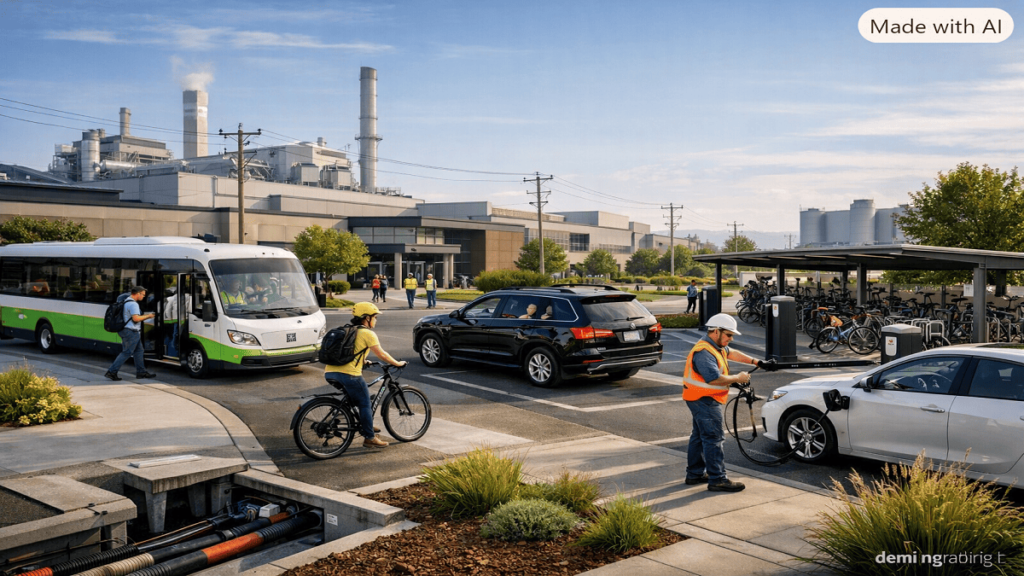
How Can Workplace Policies, Shuttle Services, and Flexible Working Arrangements Reduce Single-Occupancy Vehicle Travel?
Workplace policies, company shuttle services, and flexible working arrangements can significantly reduce single-occupancy vehicle (SOV) travel by giving employees practical alternatives to driving alone. These approaches are part of transportation demand management (TDM), which aims to provide commuters with more choices regarding how, when, and where they travel. The U.S. Environmental Protection Agency (EPA) identifies employer-based transportation programs, transit incentives, telecommuting, flexible working hours, Commuting Practices and ridesharing as strategies that can reduce vehicle miles traveled and transportation-related emissions.
Workplace Transportation Policies
Organizations can influence commuting behavior through policies that make sustainable transportation more convenient and financially attractive. Examples include subsidized public-transit passes, carpool and vanpool incentives, preferential parking for high-occupancy vehicles, parking cash-out programs, and guaranteed emergency rides home.
Employers can also provide secure bicycle parking, changing rooms, and other facilities that make cycling and walking more practical. Such policies reduce the dependence on private cars by addressing common barriers to alternative transportation. The Federal Highway Administration (FHWA) identifies employer-based ridesharing, transit benefits, flexible schedules, and telecommuting as effective TDM strategies.
Company Shuttle Services
Workplace shuttle services can be particularly effective when offices or industrial facilities are located far from public transportation stations. Employers can operate dedicated buses between workplaces and nearby railway stations, metro stations, bus terminals, residential areas, or park-and-ride facilities.
A well-planned shuttle allows employees to complete part or all of their commute without driving their own vehicles. It can be especially useful for large organizations with predictable employee schedules. FHWA identifies employer shuttle services and transit connections as strategies that can reduce traffic volumes when sufficient numbers of employees use the service.
Flexible Working Arrangements
Flexible working arrangements reduce commuting by changing when and where employees work. Teleworking or hybrid work allows employees to work remotely on selected days, eliminating the associated commute altogether. Compressed workweeks can also reduce the number of days employees travel to the workplace.
Flexible working hours allow employees to travel outside peak periods. Although flexible schedules do not necessarily eliminate vehicle trips, they can shift travel away from congested periods and improve the efficiency of transportation networks. FHWA notes that telework and compressed work schedules reduce work-related vehicle trips, while flexible hours can shift travel away from peak periods.
Combining Strategies for Greater Impact
The strongest results typically come from combining multiple measures rather than relying on one program. For example, an organization could provide a shuttle to a nearby railway station, subsidize public transportation, offer carpool incentives, and allow employees to work remotely two days per week.
These measures can reduce SOV travel, lower fuel consumption and emissions, decrease parking demand, and improve employee commuting flexibility. Organizations can monitor commuting patterns through employee surveys, parking data, shuttle usage, and transportation-program participation to measure effectiveness.
Ultimately, workplace transportation policies work best when sustainable choices are convenient, affordable, reliable, and easy to access. By combining practical transportation services with flexible working arrangements and targeted incentives, organizations can reduce dependence on single-occupancy vehicles while supporting broader environmental and sustainability objectives.
Relevant External Resources
- U.S. EPA – Estimating Emission Reductions from Travel Efficiency Strategies
- U.S. EPA – Employer-Based Incentives and Transportation Demand Management
- Federal Highway Administration – Transportation Demand Management
- Federal Highway Administration – Employer-Based Transportation Demand Management
#PublicTransportation
What Are the Environmental, Economic, Health, and Social Benefits of Adopting Eco-Friendly Commuting Practices?
Eco-friendly commuting practices, including walking, cycling, public transportation, carpooling, ride-sharing, and electric vehicle use, can provide benefits that extend well beyond reducing fuel consumption. By reducing dependence on conventional private vehicles, sustainable commuting can support environmental protection, lower transportation costs, improve public health, and create more accessible and livable communities. The World Health Organization (WHO) recognizes sustainable transport as an important opportunity to achieve simultaneous environmental, health, economic, and social benefits.
Environmental Benefits
One of the most significant advantages is the potential reduction in greenhouse gas emissions and air pollution. Walking and cycling produce virtually no direct transportation emissions, while public transportation and carpooling can reduce the number of individual vehicles required for daily travel. Electric vehicles can also reduce tailpipe emissions compared with conventional combustion-engine vehicles.
Reducing private vehicle use can additionally decrease traffic-related noise and congestion. WHO notes that sustainable transport strategies can reduce carbon emissions, air pollution, and noise while supporting healthier urban environments.
Economic Benefits
Eco-friendly commuting can reduce transportation expenses for individuals and organizations. Walking and cycling require little direct expenditure, while public transportation can be less expensive than owning and maintaining a private vehicle. Carpooling allows commuters to share fuel, parking, and other travel costs.
At the broader economic level, sustainable transportation can reduce congestion-related productivity losses and healthcare costs associated with pollution and physical inactivity. Investments in walking and cycling infrastructure can also generate economic value through improved accessibility, healthier populations, and local employment opportunities. WHO’s Health Economic Assessment Tool is specifically designed to estimate the economic value of health benefits associated with walking and cycling.
Health Benefits
Walking and cycling incorporate physical activity into everyday routines, helping people maintain healthier lifestyles. Regular physical activity is associated with lower risks of cardiovascular disease, diabetes, certain cancers, and other noncommunicable diseases. WHO also reports that active commuting can contribute to improved physical and mental well-being.
Cleaner transportation can also reduce exposure to traffic-related air pollution and noise. However, safe infrastructure is essential because pedestrians and cyclists can face greater traffic-injury risks where roads are poorly designed.
Social Benefits
Sustainable commuting can improve mobility and social inclusion, particularly for people who cannot afford or do not have access to private vehicles. Reliable public transportation, safe walking routes, and cycling infrastructure can improve access to employment, education, healthcare, shops, and recreational opportunities. WHO emphasizes that sustainable transport can improve mobility and health equity for lower-income groups, older people, children, women, and people with disabilities.
Reduced traffic can also create quieter and more attractive neighborhoods where people have greater opportunities for walking, social interaction, and community activities.
Conclusion
Eco-friendly commuting practices provide interconnected environmental, economic, health, and social advantages. Reducing unnecessary car travel can lower emissions and congestion, while walking and cycling can improve physical activity and public health. Public transportation and shared mobility can make transportation more affordable and accessible, while electric vehicles can support the transition toward lower-emission road transport.
The greatest benefits occur when sustainable commuting is supported by safe infrastructure, reliable public transportation, workplace incentives, and well-planned urban development. By making low-impact transportation convenient and accessible, governments, organizations, and communities can build cleaner, healthier, more affordable, and more inclusive transportation systems.
Relevant External Resources
- World Health Organization – Sustainable Transport and Health
- WHO – Promoting Walking and Cycling
- WHO – Safe Environments and Mobility
- WHO – Health Economic Assessment Tool for Walking and Cycling
#CleanTransportation
Case Study of Eco-Friendly Commuting Practices
A strong example of eco-friendly commuting can be seen in the Google Bike Commuter Program in California, USA. Google has implemented a broad transportation demand management program that combines commuter shuttles, public-transit support, bicycle programs, vanpools, microtransit, and carpool incentives. The initiative demonstrates how organizations can reduce dependence on single-occupancy vehicles by providing employees with convenient and practical alternatives.
Background of the Case Study
Google’s major office locations in Mountain View and Sunnyvale, California, were originally designed with significant dependence on private vehicles. To encourage more sustainable commuting, the company introduced several transportation programs, including its commuter shuttle service, known as GBus, subsidized public-transit passes, free bicycles, vanpools, microtransit options, and subsidized carpool rides.
Research examining Google’s transportation program found that less than 50% of employees commuted using single-occupancy vehicles, while bicycle commuting accounted for approximately 5–6% of trips. This demonstrates how a combination of transportation options can influence commuting behavior even in locations traditionally designed around automobile travel.
Bicycle and E-Bike Initiative
Google also introduced a bicycle and electric-bicycle lending program to address common barriers to cycling. Research found that employees identified bicycle ownership and concerns about maintenance as important obstacles to cycling. The lending program provided employees with access to high-quality electric-assisted bicycles without requiring them to purchase one themselves.
This approach illustrates an important principle of sustainable commuting: providing infrastructure alone may not be sufficient. Organizations can increase participation by addressing practical barriers such as cost, maintenance, convenience, and access to equipment.
Environmental and Employee Benefits
The program demonstrates how employers can use multiple commuting strategies simultaneously. Shuttle services and public transportation can reduce the number of private vehicle journeys, while cycling and e-bikes provide zero-tailpipe-emission alternatives for suitable trips. Carpooling and vanpools further increase vehicle occupancy and reduce the number of vehicles needed to transport employees.
Beyond environmental benefits, cycling can also contribute to employee well-being. Research on workplace sustainable-mobility initiatives has found that employees can perceive cycling as beneficial for physical and mental well-being. A separate workplace pilot in Lahti, Finland, found that employer-supported commuter tickets and bicycle benefits successfully encouraged more sustainable mobility choices.
Key Lessons
The Google case demonstrates that successful eco-friendly commuting programs should offer multiple convenient alternatives rather than relying on a single solution. Public transportation support can serve longer-distance commuters, shuttles can address first- and last-mile challenges, bicycles and e-bikes can support shorter journeys, and carpooling can reduce vehicle use where public transportation is less practical.
The case also highlights the importance of understanding employee needs. Financial incentives, convenient services, equipment access, and reliable transportation can all influence commuting decisions.
Overall, Google’s approach shows how organizations can reduce single-occupancy vehicle travel by combining transportation infrastructure, financial incentives, shared mobility, and active-transportation programs. Such strategies can help businesses reduce commuting-related environmental impacts while providing employees with more affordable, flexible, and sustainable ways to travel to work.
Relevant External Resources
- Frontiers – Google Bike Commuter Program Case Study
- Frontiers – Workplace Sustainable Mobility Case Study
- European Commission – Smart Commuting Case Study
- International Energy Agency – Transport
#GreenMobility
White Paper on Eco-Friendly Commuting Practices
Executive Summary
Eco-friendly commuting is an important component of sustainable transportation and urban development. It involves choosing transportation methods that reduce fuel consumption, greenhouse gas emissions, air pollution, congestion, and unnecessary energy use. Walking, cycling, public transportation, carpooling, ride-sharing, electric vehicles, and flexible working arrangements can all contribute to more sustainable daily mobility.
The need for cleaner commuting is particularly important in rapidly urbanizing countries such as India. The Bureau of Energy Efficiency reports that transport accounts for approximately 18% of India’s total energy consumption, while road transportation represents a major share of transport-related carbon dioxide emissions.
A successful transition requires more than encouraging individuals to change their travel habits. Governments, employers, transport operators, urban planners, and communities must create infrastructure and policies that make sustainable transportation convenient, safe, affordable, and accessible.
1. Introduction
Conventional commuting based heavily on private petrol and diesel vehicles creates multiple environmental and social challenges. Increasing vehicle ownership can contribute to congestion, fuel consumption, air pollution, noise, and greenhouse gas emissions. It can also increase household transportation costs and place pressure on urban road and parking infrastructure.
Eco-friendly commuting provides an alternative by prioritizing efficient and low-carbon transportation. India’s National Urban Transport Policy emphasizes mobility rather than vehicle movement and promotes public transportation, walking, cycling, and integrated urban transport planning.
The objective is not necessarily to eliminate private vehicles but to create a transportation system in which people can choose the most appropriate low-impact option for each journey.
2. Major Eco-Friendly Commuting Practices
Walking and Cycling
Walking and cycling are among the cleanest forms of transportation. They produce virtually no direct emissions and require substantially less energy than motorized transportation. They also provide physical-activity benefits.
Safe footpaths, protected cycle lanes, bicycle parking, street lighting, and pedestrian-friendly road design are essential for encouraging these modes. India’s Ministry of Housing and Urban Affairs has emphasized the importance of pedestrian and cycling infrastructure for sustainable mobility and last-mile connectivity.
Public Transportation
Buses, metro systems, suburban rail, and other forms of mass transportation can move large numbers of people using fewer vehicles than individual car travel. Efficient public transportation can therefore reduce congestion, fuel consumption, and emissions per passenger.
Integration between public transport and walking or cycling is particularly important. First- and last-mile connectivity can make public transportation substantially more convenient. NITI Aayog recommends improving access to efficient public transit and strengthening connections between public transportation and non-motorized modes.
Carpooling and Shared Mobility
Carpooling and ride-sharing allow multiple passengers to share a vehicle, reducing the number of individual journeys. Shared mobility can be particularly useful where public transportation is unavailable or unsuitable.
Organizations can encourage these practices through ride-matching platforms, preferential parking, financial incentives, and employer-supported transportation programs.
Electric Vehicles
Electric cars, buses, two-wheelers, and three-wheelers can reduce tailpipe emissions and dependence on petroleum fuels. Their overall environmental performance depends on factors including electricity generation, vehicle efficiency, battery production, and charging infrastructure.
India is expanding electric mobility through programs such as PM E-DRIVE and the PM-eBus Sewa initiative. In 2026, the government reported that PM-eBus Sewa was supporting the deployment of 10,000 electric buses across more than 100 cities.
Flexible and Remote Working
Teleworking, hybrid work, flexible schedules, and compressed workweeks can reduce the number of commuting journeys. When employees work remotely for selected days, the associated commute is eliminated altogether. Flexible working hours can also help employees travel outside peak periods, potentially reducing congestion.
3. Infrastructure Requirements
Sustainable commuting depends heavily on infrastructure. Cities need continuous pedestrian pathways, protected cycling networks, reliable public transportation, integrated ticketing, accessible transit stations, and convenient first- and last-mile connections.
Recent government initiatives in India demonstrate increasing investment in these areas. According to a July 2026 government release, 346 Green Mobility projects under AMRUT have supported approximately 474.34 km of walkways and cycle tracks. The same release reported that the PM-eBus Sewa scheme had sanctioned 10,000 electric buses across more than 100 cities.
Infrastructure should also be designed around accessibility and safety, considering the needs of women, children, older people, people with disabilities, and lower-income communities.
4. Environmental Benefits
Eco-friendly commuting can reduce greenhouse gas emissions, air pollution, fuel consumption, and traffic-related noise. Increasing the share of walking, cycling, public transportation, and shared mobility can reduce dependence on individual fossil-fuel vehicles.
Electrification can further reduce direct vehicle emissions, particularly as electricity systems incorporate increasing amounts of renewable energy. Sustainable transport therefore complements wider climate and clean-energy objectives.
5. Economic Benefits
Sustainable commuting can reduce individual transportation costs by lowering fuel, parking, maintenance, and vehicle ownership expenses. Public transportation and shared mobility can provide affordable alternatives to private vehicle ownership.
At the city level, reducing congestion can improve productivity and decrease time lost in traffic. Investment in public transportation, cycling infrastructure, pedestrian facilities, and electric mobility can also support employment and technology development.
For businesses, sustainable commuting programs can reduce parking requirements and improve employee access to workplaces. Employers can provide transit subsidies, shuttle services, bicycle facilities, carpool incentives, and EV charging stations.
6. Health and Social Benefits
Walking and cycling provide regular physical activity as part of daily travel. Reduced vehicle traffic can also contribute to lower exposure to transportation-related air pollution and noise.
Sustainable transportation can improve social inclusion by providing affordable mobility to people who do not own private vehicles. NITI Aayog emphasizes that sustainable urban mobility should address the needs of different social groups and improve access to reliable and affordable transportation.
Better pedestrian environments and public spaces can also contribute to more livable communities.
7. Role of Organizations
Employers can have a significant influence on commuting behavior. Effective workplace programs can combine:
- Public-transit subsidies
- Company shuttle services
- Carpool and vanpool programs
- Secure bicycle parking
- Shower and changing facilities
- EV charging stations
- Bicycle and e-bike programs
- Flexible and hybrid working arrangements
- Parking-management policies
- Employee sustainability incentives
The most successful programs typically provide several alternatives rather than expecting every employee to adopt the same commuting method.
8. Policy and Planning Recommendations
Governments and urban authorities should adopt an integrated approach to sustainable transportation. Priority areas include:
- Expanding reliable and affordable public transportation.
- Developing continuous and safe walking and cycling networks.
- Improving first- and last-mile connectivity.
- Supporting electric buses and other zero-emission vehicles.
- Developing appropriate EV charging infrastructure.
- Encouraging shared mobility and carpooling.
- Integrating land-use and transportation planning.
- Supporting employer-based sustainable commuting programs.
- Using digital technologies for journey planning and integrated mobility.
- Measuring transportation emissions and commuting patterns to evaluate progress.
India’s current urban mobility policies increasingly emphasize integrated, multimodal, and people-centered transportation. Government programs are also supporting pedestrian infrastructure, transit-oriented development, and electric public transportation.
9. Conclusion
Eco-friendly commuting is a practical pathway toward cleaner, healthier, and more efficient transportation systems. Walking, cycling, public transportation, carpooling, shared mobility, electric vehicles, and flexible working arrangements each address different aspects of the environmental impact associated with daily travel.
The transition requires coordinated action from individuals, employers, transport providers, urban planners, and governments. Sustainable choices become much easier when cities provide safe infrastructure, reliable public transportation, convenient shared mobility, and accessible electric transportation.
Ultimately, eco-friendly commuting should be viewed not simply as an individual lifestyle choice but as an important part of sustainable urban planning, energy security, public health, climate action, and inclusive economic development. By designing cities around people rather than private vehicles, communities can create transportation systems that are cleaner, more accessible, resilient, and efficient for the long term.
Relevant External Resources
- NITI Aayog – Sustainable Urban Transport
- Bureau of Energy Efficiency – Electric Mobility
- Press Information Bureau – Pedestrian Infrastructure and Sustainable Urban Mobility
- NITI Aayog – Shared Mobility
- Press Information Bureau – PM-eBus Sewa
#SustainableTransportation

Industry Application of Eco-friendly Commuting Practices
Eco-friendly commuting practices are increasingly becoming an important part of corporate sustainability and transportation management. Organizations across manufacturing, technology, healthcare, retail, logistics, education, hospitality, and other sectors are adopting measures that reduce employees’ dependence on single-occupancy vehicles. These practices can include public transportation support, employee shuttle services, carpooling, cycling facilities, electric vehicle charging, company EV fleets, and flexible working arrangements.
The industrial application of sustainable commuting is particularly important because large organizations can influence the travel behavior of hundreds or thousands of employees. According to the U.S. Environmental Protection Agency (EPA), employer-based transportation strategies can help reduce vehicle miles traveled and emissions while providing employees with additional commuting choices.
Manufacturing Industry
Manufacturing facilities often employ large workforces operating across multiple shifts. This makes employee transportation a significant operational consideration. Companies can provide scheduled shuttle buses connecting factories with residential areas, railway stations, and major public-transit routes.
Carpooling and vanpool programs can also be useful for employees working similar shifts. Secure bicycle parking, changing rooms, and workplace EV charging can further encourage sustainable transportation.
For industrial locations outside major urban centers, employer-operated transportation can be particularly valuable because public transportation may be limited.
Technology and IT Industry
Technology companies are well positioned to implement sustainable commuting programs because many employees may have access to flexible or hybrid working arrangements. Remote work can eliminate commuting trips on selected days, while flexible schedules can allow employees to avoid peak travel periods.
Large technology campuses can also provide employee shuttle networks, bicycle facilities, public-transit subsidies, carpool incentives, and EV charging stations. These programs can reduce parking demand while supporting corporate environmental goals.
Healthcare Industry
Hospitals and healthcare facilities operate around the clock, often requiring employees to travel during early mornings, nights, weekends, and holidays. Dedicated employee shuttle services can provide safer and more sustainable transportation for staff working irregular shifts.
Hospitals can also install bicycle parking and EV charging facilities and develop partnerships with local public transportation providers. Sustainable commuting programs can complement healthcare organizations’ broader environmental and social responsibility objectives.
Education Sector
Universities and educational institutions can serve as strong examples of sustainable commuting because students, faculty, and staff generate significant daily travel demand. Institutions can provide campus shuttle systems, bicycle-sharing programs, pedestrian infrastructure, transit passes, carpool programs, and EV charging stations.
University campuses can also restrict or manage parking to discourage unnecessary single-occupancy vehicle use while making alternative transportation more convenient.
Retail and Hospitality
Retail stores, hotels, restaurants, and hospitality facilities often employ large numbers of workers across different shifts. Shuttle services can help employees reach workplaces when public transportation schedules do not align with working hours.
Employers can also encourage carpooling and provide secure bicycle facilities. Where appropriate, electric delivery vehicles and company EV fleets can complement employee commuting initiatives.
Logistics and Transportation
The logistics sector has a particularly important role in the transition toward cleaner transportation. Companies can introduce electric vans, buses, and other low-emission vehicles for appropriate operations while optimizing routes to reduce unnecessary travel.
Although fleet electrification is different from employee commuting, combining cleaner company transportation with sustainable employee travel can create a broader corporate mobility strategy.
Workplace Infrastructure and Incentives
Across industries, organizations can establish a combination of facilities and incentives, including:
- Employee shuttle services
- Public-transit subsidies
- Carpool and vanpool programs
- Bicycle parking and repair facilities
- Showers and changing rooms
- EV charging stations
- Electric company fleets
- Preferential parking for carpools and EVs
- Flexible and hybrid working arrangements
- Sustainable commuting rewards
The most effective approach is generally a combination of infrastructure, financial incentives, and workplace policies rather than a single initiative.
Business and Environmental Benefits
Eco-friendly commuting can reduce transportation-related emissions, fuel consumption, parking demand, and traffic congestion. Organizations may also benefit from improved employee accessibility, lower parking requirements, stronger sustainability credentials, and potentially greater employee satisfaction.
The International Energy Agency identifies electrification, public transportation, active mobility, and more efficient transport systems as important elements of the transition toward cleaner transportation. (IEA)
Organizations can measure program performance through employee commuting surveys, shuttle utilization, parking occupancy, EV charging data, public-transit participation, and estimated reductions in vehicle kilometers traveled.
Conclusion
Eco-friendly commuting has practical applications across almost every industry. Manufacturing companies can use employee shuttles and carpooling, technology companies can combine hybrid work with shared mobility, hospitals can provide transportation for shift workers, universities can promote cycling and public transportation, and retail and hospitality businesses can develop shift-compatible transportation programs.
The strongest results come from creating a workplace environment in which sustainable transportation is convenient, affordable, safe, and reliable. By integrating commuting programs into broader environmental, social, and corporate sustainability strategies, organizations can reduce transportation impacts while improving employee mobility and supporting long-term sustainability goals.
Relevant External Resources
- U.S. EPA – Travel Efficiency Strategies
- International Energy Agency – Transport
- U.S. EPA – Green Transportation
- U.S. Department of Energy – Alternative Fuels Data Center
#EcoFriendlyCommuting
Ask FAQs
What are eco-friendly commuting practices?
Eco-friendly commuting practices are transportation methods that help reduce fuel consumption, greenhouse gas emissions, air pollution, and traffic congestion. Common examples include walking, cycling, public transportation, carpooling, ride-sharing, electric vehicles, and using employer-provided shuttle services. Flexible or remote working arrangements can also reduce the number of commuting trips.
How does public transportation support sustainable commuting?
Public transportation can transport many passengers using fewer vehicles than individual car travel. Buses, trains, metros, and other shared transportation systems can therefore reduce fuel consumption, congestion, and emissions per passenger. Electrified public transportation, such as electric buses and rail systems, can provide additional environmental benefits when supported by cleaner electricity sources.
How can companies encourage employees to commute sustainably?
Organizations can provide practical facilities and incentives such as employee shuttle services, public-transit subsidies, secure bicycle parking, showers, carpool programs, EV charging stations, and preferential parking for shared vehicles. Flexible and hybrid working arrangements can also reduce commuting frequency. Combining several measures generally gives employees more convenient alternatives to driving alone.
Are electric vehicles an eco-friendly commuting option?
Electric vehicles can be a lower-emission alternative to conventional petrol and diesel vehicles because battery-electric vehicles produce no tailpipe emissions during operation. Their overall environmental impact depends on factors such as electricity generation, battery manufacturing, vehicle efficiency, and charging practices. As electricity grids incorporate more renewable energy, the emissions associated with EV operation can decrease.
What are the main benefits of eco-friendly commuting?
Eco-friendly commuting can provide environmental, economic, health, and social benefits. It can reduce greenhouse gas emissions, air pollution, fuel consumption, and traffic congestion while lowering transportation costs. Walking and cycling can increase physical activity, while public transportation and shared mobility can improve access to affordable transportation. For organizations, sustainable commuting programs can also support corporate sustainability objectives and reduce parking demand.
Table of Contents
Disclaimer: This content is for general informational purposes only. Transportation choices, costs, regulations, and environmental impacts may vary by location and individual circumstances. Readers should consult relevant local authorities and qualified professionals for specific guidance.