
GGBC Non Fossil Fueling Facility for Vehicles
What Are Non-Fossil Fueling Facilities and Why Are They Important for GGBC Projects?
Non-fossil fueling facilities are infrastructure designed to support vehicles that operate without conventional fossil fuels such as petrol and diesel. These facilities can include electric vehicle (EV) charging stations, battery-swapping systems, and other suitable alternative-fuel infrastructure, depending on the vehicle technologies available in a particular region. The objective is to make cleaner transportation options more practical by providing convenient access to the energy or fuel required to operate these vehicles.
For GGBC projects, incorporating non-fossil fueling facilities is an important approach to sustainable transportation planning. Green building is not limited to the energy and water performance of a building; it also considers how a development affects pollution, resource consumption, mobility, and the surrounding environment. The Global Green Building Council describes green buildings as those that aim to reduce environmental impacts through efficient resource use and reduced pollution.
Transportation is a significant source of urban air pollution and greenhouse-gas emissions. Providing infrastructure for non-fossil-fuel vehicles can therefore help projects encourage cleaner mobility among occupants, employees, visitors, and service providers. EV charging facilities, for example, can make it easier for people using electric cars, two-wheelers, and other electric vehicles to choose lower-emission transportation instead of conventional petrol- or diesel-powered vehicles.
From a project-planning perspective, these facilities should be considered during the site-design stage rather than added as an afterthought. The project team can assess the expected vehicle types, parking capacity, charging or refueling demand, available electrical infrastructure, safety requirements, accessibility, and future expansion needs. Comparable green-building criteria for alternative-fuel facilities emphasize assessing present and future vehicle demand and ensuring that the facilities can adequately serve the intended users.
Non-fossil fueling infrastructure can also strengthen the long-term sustainability performance of a GGBC project. As electric mobility expands, buildings equipped with suitable charging infrastructure can remain better prepared for changing transportation patterns. When EV charging is combined with renewable electricity, such as power generated from on-site or off-site solar systems, the potential for reducing transportation-related carbon emissions can be further improved.
Ultimately, non-fossil fueling facilities support the broader goal of creating buildings and developments that are environmentally responsible, future-ready, and supportive of cleaner mobility. For GGBC projects, they represent an important connection between green building design and sustainable transportation, helping reduce dependence on conventional fossil fuels while encouraging the adoption of cleaner vehicle technologies.
What Types of Alternative Vehicle Fueling Facilities Can Be Provided in Green Buildings?
Green buildings can support sustainable transportation by providing infrastructure that enables occupants, visitors, and facility fleets to use vehicles powered by alternatives to conventional petrol and diesel. The type of alternative vehicle fueling facility selected depends on the project location, vehicle demand, available technology, electrical capacity, and the applicable requirements of the GGBC framework.
1. Electric Vehicle Charging Stations
EV charging stations are one of the most practical alternative-fueling facilities for modern green buildings. They can be installed in residential parking areas, commercial buildings, offices, hotels, educational campuses, and mixed-use developments. Charging infrastructure may include slower charging for long-duration parking and faster DC charging where vehicles require quicker turnaround. The U.S. Department of Energy identifies workplace and destination charging as important opportunities for providing drivers with convenient access to charging infrastructure.
2. Battery-Swapping Facilities
Battery-swapping infrastructure allows compatible electric vehicles, particularly two-wheelers and certain commercial vehicles, to exchange depleted batteries for charged ones. This can significantly reduce vehicle waiting time compared with conventional charging. Such facilities may be considered in projects with high usage of electric two-wheelers, delivery vehicles, or fleet vehicles.
3. Hydrogen Fueling Facilities
Hydrogen fueling stations can support fuel-cell electric vehicles (FCEVs). Hydrogen is converted into electricity within the vehicle’s fuel cell to power the electric drivetrain. Although hydrogen infrastructure remains less widespread than EV charging, it may be relevant for specific commercial fleets, transportation hubs, or developments located near established hydrogen networks.
4. Biofuel and Renewable-Fuel Facilities
Depending on project requirements and local availability, facilities can also support fuels such as biodiesel, renewable diesel, or ethanol blends. These options require suitable storage, dispensing equipment, safety provisions, and vehicles capable of using the respective fuels. The U.S. Department of Energy recognizes electricity, biodiesel, ethanol, hydrogen, natural gas, and renewable diesel among alternative transportation fuels.
5. Alternative-Fuel Fleet Facilities
Large green developments with dedicated transportation fleets can consider specialized fueling infrastructure based on the vehicles operated on-site. The facility should be planned around actual fleet requirements rather than installing infrastructure that is unlikely to be used.
For a GGBC project, the most appropriate approach is to evaluate transportation demand during the design stage and select facilities that are practical, accessible, safe, and capable of supporting the project’s long-term mobility objectives. Proper planning can also include metering, signage, accessible parking arrangements, electrical capacity, and provisions for future expansion. The U.S. Department of Energy recommends assessing equipment, supply, storage, operation, and maintenance requirements when developing alternative-fueling infrastructure.
Overall, alternative vehicle fueling facilities allow green buildings to go beyond energy-efficient building design and actively support cleaner, lower-carbon transportation. EV charging is generally the most immediately applicable option, while battery swapping, hydrogen, and renewable-fuel facilities can be considered according to project-specific needs and regional availability.
External references: U.S. Department of Energy – Alternative Fuels Data Center | U.S. EPA – Plug-In Electric Vehicle Charging Basics
How Do EV Charging Stations and Other Clean-Fuel Options Support Sustainable Transportation?
Electric vehicle (EV) charging stations and other clean-fuel facilities play an important role in creating a more sustainable transportation system. For GGBC projects, these facilities can connect green building design with cleaner mobility by providing the infrastructure needed for occupants, visitors, employees, and service vehicles to adopt alternatives to conventional petrol and diesel vehicles.
Reducing Dependence on Fossil Fuels
One of the primary benefits of alternative vehicle fueling facilities is their ability to reduce dependence on conventional fossil fuels. EVs use electricity rather than petrol or diesel, eliminating tailpipe emissions during operation. When the electricity used for charging comes increasingly from renewable sources such as solar and wind, the overall environmental benefits of electric mobility can be strengthened.
India’s Ministry of Power specifically identifies the development of EV charging infrastructure as a means of supporting faster EV adoption, improving energy security, and reducing the country’s emission intensity.
Encouraging the Adoption of Electric Vehicles
Availability of convenient charging infrastructure is an important factor in making electric mobility practical. A building that provides EV charging spaces allows users to charge vehicles while they work, live, shop, study, or access other services. This reduces concerns about charging availability and can encourage more people to consider EVs when replacing conventional vehicles.
India’s 2024 EV charging guidelines apply to private parking areas as well as offices, educational institutions, hospitals, group housing societies, commercial complexes, and other locations. The guidelines also emphasize safe, reliable, and accessible charging infrastructure.
Supporting Renewable Energy Integration
EV charging facilities can also be integrated with renewable energy systems. For example, a green building can combine rooftop solar generation with EV charging infrastructure. Charging during periods of strong solar generation can help align electricity consumption with renewable energy availability. India’s Ministry of Power has specifically included encouraging EV charging during solar hours among the objectives of its 2024 charging-infrastructure guidelines.
Supporting Diverse Clean-Mobility Solutions
Sustainable transportation is not limited to conventional EV charging. Depending on project requirements, buildings and developments may also consider battery-swapping facilities and other alternative-fuel infrastructure. India’s Ministry of Power has recognized battery swapping as an alternative method of powering electric vehicles and has established guidelines for battery-swapping and charging stations.
For GGBC projects, incorporating appropriate non-fossil fueling facilities therefore supports a broader sustainable-transportation strategy. These facilities can reduce fossil-fuel dependence, encourage cleaner vehicle adoption, support renewable-energy use, and prepare buildings for the future of low-carbon mobility. When planned alongside efficient parking, pedestrian facilities, public transportation access, and renewable-energy systems, alternative fueling infrastructure can help create developments that are not only energy-efficient but also better connected to sustainable transportation goals.
External references: Ministry of Power – EV Charging Infrastructure Guidelines | NITI Aayog – e-Amrit EV Standards and Specifications | Ministry of Power – Energy Conservation and Energy Transition
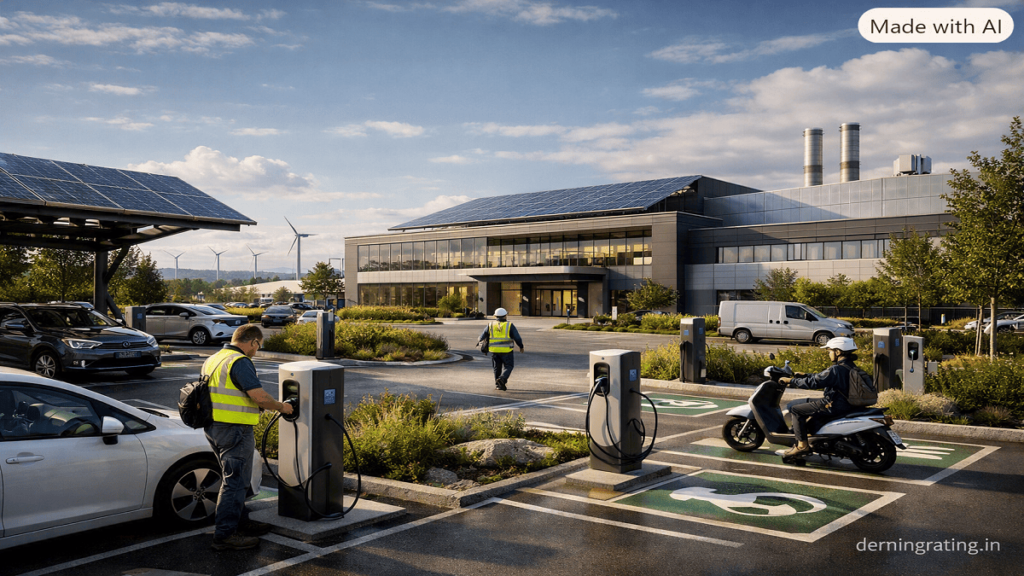
What Infrastructure and Planning Considerations Are Needed for Non-Fossil Vehicle Fueling Facilities?
Non-fossil vehicle fueling facilities require careful planning to ensure that they are safe, accessible, reliable, and capable of meeting both current and future transportation needs. For GGBC projects, the planning of such facilities should be integrated with the overall site, parking, electrical, and sustainability strategy rather than treated as an isolated installation.
1. Assess Vehicle and Charging Demand
The first step is to understand the expected demand. Project teams should consider the number of occupants, visitors, parking spaces, vehicle types, expected EV adoption, and charging duration. This assessment helps determine the appropriate number and type of charging points. India’s Ministry of Power guidelines apply EV charging infrastructure to private parking, offices, educational institutions, hospitals, group housing societies, commercial complexes, and other locations.
2. Plan Electrical Infrastructure
EV charging can create substantial additional electrical demand, particularly when multiple vehicles are charged simultaneously. Designers should evaluate the building’s existing electrical capacity, transformers, distribution boards, cabling, metering, and protection systems. The 2024 Indian guidelines specifically address electricity connections for EV charging stations, including provisions for connections up to 150 kW under low-tension supply.
Future expansion should also be considered. Providing adequate electrical capacity, cable pathways, and distribution infrastructure during initial construction can make it easier to add charging points later without major civil modifications.
3. Select Appropriate Charging Technology
The charging technology should match the expected vehicle type and parking duration. AC chargers may be suitable for workplaces, residences, and locations where vehicles remain parked for several hours, while higher-power DC chargers may be appropriate where faster charging is required. India’s NITI Aayog e-Amrit platform provides specifications covering different charging levels, power ranges, vehicle categories, and connector types.
4. Address Safety and Accessibility
Safety is a fundamental consideration. Charging areas should have suitable electrical protection, proper cabling, appropriate equipment installation, clear signage, adequate ventilation where required, and fire-safety provisions in accordance with applicable regulations and standards. India’s charging-infrastructure guidelines emphasize safe, reliable, and accessible charging infrastructure and include civil, electrical, and safety requirements.
Charging spaces should also be conveniently located and designed to allow vehicles to enter, park, connect, and leave without obstructing normal circulation.
5. Integrate Renewable Energy and Future Technologies
For a GGBC project, charging infrastructure can be integrated with renewable-energy systems such as rooftop solar. Energy management systems can help coordinate building loads and EV charging, while provisions for future battery storage or additional charging points can improve long-term adaptability. The 2024 national guidelines also encourage EV charging during solar hours and recognize the need to prepare the electricity grid for increased charging demand.
Overall, successful non-fossil fueling infrastructure requires demand assessment, electrical planning, appropriate technology selection, safety measures, accessibility, renewable-energy integration, and future expansion planning. When these elements are incorporated from the early design stage, GGBC projects can provide practical clean-mobility infrastructure while supporting broader sustainability objectives.
External references: Ministry of Power – EV Charging Infrastructure Guidelines 2024 | NITI Aayog – e-Amrit Standards and Specifications
What Are the Environmental and Economic Benefits of Providing Non-Fossil Fueling Facilities?
Providing non-fossil vehicle fueling facilities in GGBC projects can deliver both environmental and economic benefits. Infrastructure such as electric vehicle (EV) charging stations and battery-swapping facilities helps buildings support cleaner transportation while preparing them for the growing adoption of alternative-fuel vehicles. When integrated into a project’s overall sustainability strategy, these facilities can contribute to reduced emissions, lower operating costs, energy security, and long-term asset value.
Environmental Benefits
The most significant environmental benefit is the reduction of dependence on petrol and diesel. EVs produce no tailpipe emissions during operation, which can help reduce local air pollution around buildings and urban areas. According to NITI Aayog’s e-Amrit platform, EVs have substantially higher energy efficiency than conventional petrol and diesel vehicles, and their overall carbon impact can be significantly lower depending on the electricity source used for charging.
Non-fossil fueling facilities can also support greenhouse-gas reduction. When EV charging is supplied partly or fully by renewable electricity, such as solar power, the environmental benefits can be further increased. The International Energy Agency estimates that EV deployment globally is already avoiding significant oil consumption and greenhouse-gas emissions.
Another benefit is improved energy security. Greater use of electricity and renewable energy for transportation can reduce reliance on imported petroleum. For India, this can contribute to reduced exposure to fluctuations in international oil prices and support the country’s broader clean-energy and decarbonisation objectives.
Economic Benefits
Non-fossil fueling infrastructure can create long-term economic opportunities for building owners and developers. EV charging can become an additional building service, allowing facilities to generate revenue through charging fees, parking services, or partnerships with charging-network operators. NITI Aayog also identifies charging infrastructure, battery swapping, and energy-related services as emerging areas of opportunity within India’s electric-mobility ecosystem.
For vehicle users, electric mobility can potentially provide lower operating and maintenance costs because EVs generally have fewer moving drivetrain components and electricity can be less expensive per kilometre than conventional fuels, depending on local electricity and fuel prices. NITI Aayog’s EV resources also highlight total-cost-of-ownership considerations when comparing electric and conventional vehicles.
For GGBC projects, these benefits can strengthen long-term sustainability performance and help make buildings more future-ready. Providing non-fossil fueling facilities can also increase the attractiveness of commercial, residential, institutional, and mixed-use developments as demand for clean mobility grows.
Overall, non-fossil fueling facilities are more than transportation amenities. They can help reduce emissions, improve local air quality, lower dependence on fossil fuels, support renewable energy, create new revenue opportunities, and prepare GGBC projects for the transition toward cleaner mobility.
External references: NITI Aayog – Benefits of Electric Vehicles | NITI Aayog – Decarbonising Transport | International Energy Agency – Global EV Outlook 2026
Case Study of GGBC Non-Fossil Fueling Facility for Vehicles
A practical case study of a GGBC non-fossil fueling facility for vehicles can be developed around a green factory project that incorporates electric vehicle charging infrastructure within its parking area. The purpose of such a facility is to encourage the use of vehicles that operate without conventional fossil fuels and thereby reduce pollution associated with automobile use.
Under the relevant green factory criteria, the non-fossil fueling facility is intended to support cleaner transportation by providing infrastructure within the project site. The criteria specify providing facilities capable of catering to at least 5% of the parking capacity. The guidance also recommends assessing the types of non-fossil-fueled vehicles already operating in the area and considering vehicles that may become common in the future. Adequate facilities should be planned according to refueling or charging time so that the required number of vehicles can be serviced during a normal work shift. Safety considerations are also an important part of the planning process.
A useful real-world example is the Grundfos Pumps Factory in Chennai, which incorporated a non-fossil fueling facility for approximately 6% of its total parking capacity as part of its green-building initiatives. The project also included other sustainability measures, including rainwater harvesting, energy-efficient lighting, wastewater treatment and reuse, and measures to reduce heat-island effects. The non-fossil fueling provision was intended to promote the use of alternative and low-emission vehicles.
For a similar GGBC project, the facility could consist of dedicated parking spaces equipped with EV charging points for two-wheelers and four-wheelers. The project team would first calculate the total parking capacity and determine the number of spaces required for non-fossil vehicle infrastructure. For example, if a development has 200 parking spaces, a 5% provision would require facilities capable of serving at least 10 parking spaces. The final design should also consider vehicle turnover, charging duration, electrical capacity, safety systems, signage, accessibility, and opportunities for future expansion.
Documentation is another important component. A project seeking recognition for this provision should maintain parking plans identifying the designated charging or fueling locations, calculations demonstrating compliance with the required percentage, equipment specifications, installation records, and photographs of the completed facilities. Documentation examples for green-building projects have included site plans, photographs, and invoices for electric charging sockets.
This case demonstrates that a non-fossil fueling facility is not simply an additional parking amenity. When properly planned, it becomes part of the project’s sustainable transportation strategy. By providing convenient charging infrastructure, a GGBC project can encourage cleaner vehicle adoption, reduce dependence on conventional fuels, and improve its long-term readiness for the transition toward low-emission mobility.
External references: Global Green Building Council – Energy Management in India | Ministry of Power – EV Charging Infrastructure Guidelines
White Paper on GGBC Non-Fossil Fueling Facility for Vehicles
Executive Summary
The transition toward cleaner transportation is an important component of sustainable development. Buildings and industrial facilities can contribute to this transition by providing infrastructure that supports vehicles powered by alternatives to conventional fossil fuels. For GGBC projects, the Non-Fossil Fueling Facility for Vehicles provision provides a practical mechanism for encouraging cleaner mobility and reducing pollution associated with automobile use.
The GGBC Green Factory Building criteria identify the provision of a non-fossil fueling facility as a site-selection and planning measure. The published criterion states that the facility should be provided within the project site to cater to at least 5% of the parking capacity. It also recommends evaluating the types of non-fossil-fueled vehicles currently operating in the surrounding area and those that may become prevalent in the future. The facility should have sufficient capacity to service the required number of vehicles within one work shift, while appropriate safety measures should be incorporated into its design.
Introduction
Transportation is closely connected with the environmental performance of a development. Conventional petrol- and diesel-powered vehicles contribute to air pollution, greenhouse-gas emissions, and fossil-fuel consumption. Providing infrastructure for cleaner vehicle technologies can help reduce these impacts while making sustainable transportation more accessible to building users.
Non-fossil fueling infrastructure may include facilities for electric vehicles, battery-operated vehicles, and other appropriate low-emission transportation technologies. The exact solution should be selected according to local vehicle demand, available infrastructure, operational requirements, and applicable regulations.
GGBC Requirement and Planning Approach
A key consideration for a GGBC project is the relationship between parking capacity and the proposed fueling infrastructure. The published Green Factory Building criterion requires facilities capable of catering to at least 5% of the project’s parking capacity. For example, a project with 200 parking spaces would need to plan facilities capable of serving at least 10 vehicles under the applicable calculation.
However, simply installing charging points is not sufficient for effective planning. The project team should assess vehicle categories, charging or refueling duration, expected demand, electrical capacity, parking circulation, safety provisions, accessibility, and future expansion requirements. The GGBC guidance specifically recommends considering refueling time so that at least 5% of parked vehicles can be serviced within one work shift.
Infrastructure Considerations
For an EV-focused facility, planning should include suitable charging equipment, electrical distribution capacity, protection systems, cabling, metering, signage, and designated parking spaces. The facility should be positioned so that vehicles can enter and exit safely without disrupting normal traffic circulation.
Where renewable-energy systems are available, EV charging can also be coordinated with on-site solar generation or other renewable-energy sources. This can further strengthen the environmental value of the transportation strategy.
Environmental and Economic Benefits
Non-fossil fueling facilities can help reduce dependence on conventional petroleum fuels and encourage the adoption of cleaner vehicles. EVs, for example, have no tailpipe emissions during operation, while their overall emissions depend partly on how the electricity used for charging is generated.
For building owners and developers, the infrastructure can also improve the long-term attractiveness and future-readiness of a project. As electric mobility expands, buildings with appropriate charging infrastructure may be better positioned to meet changing occupant and fleet requirements.
Documentation and Verification
Proper documentation is essential when demonstrating compliance. The GGBC criterion identifies parking plans and calculations showing that the proposed facilities meet the required capacity as key documentation. Project teams should additionally maintain equipment specifications, electrical drawings, installation records, photographs, and relevant safety documentation where applicable.
Conclusion
The GGBC Non-Fossil Fueling Facility for Vehicles provision represents an important connection between green-building design and sustainable mobility. By providing infrastructure for cleaner vehicles, projects can encourage reduced fossil-fuel dependence while preparing their sites for evolving transportation technologies. Effective implementation requires more than installing charging equipment; it requires demand assessment, capacity planning, safe design, appropriate documentation, and consideration of future mobility needs.
For GGBC projects, integrating non-fossil vehicle infrastructure at the planning stage can therefore transform parking areas from passive vehicle-storage spaces into active components of a broader sustainable transportation strategy.
External references: GGBC Green Factory Building – Non-Fossil Fueling Facility Criteria | Ministry of Power – EV Charging Infrastructure Guidelines | NITI Aayog – e-Amrit EV Platform
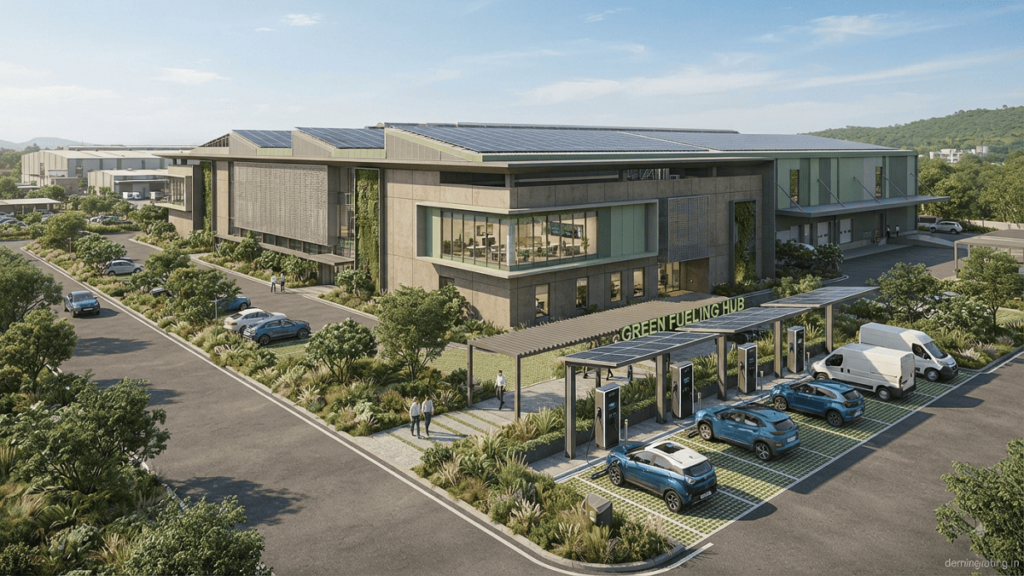
Industry Application of GGBC Non-Fossil Fueling Facility for Vehicles
The GGBC Non-Fossil Fueling Facility for Vehicles provision has significant practical applications across industrial and manufacturing developments. Its primary objective is to encourage the use of vehicles that operate without conventional fossil fuels and thereby reduce pollution associated with automobile use. In an industrial setting, this provision can be implemented as part of the site’s parking, employee transportation, logistics, and sustainability infrastructure.
The GGBC Green Factory Building criteria specify providing a non-fossil fueling facility within the project site to cater to at least 5% of the parking capacity. The guidance also recommends surveying the types of non-fossil-fueled vehicles currently operating in the surrounding area and anticipating future vehicle technologies. The facility should have adequate capacity to service the required number of vehicles within one work shift, while appropriate safety measures must be incorporated.
Application in Manufacturing Facilities
Manufacturing plants, factories, warehouses, and industrial campuses can provide EV charging stations in employee and visitor parking areas. For example, an industrial facility with 300 parking spaces could plan charging or alternative-fueling infrastructure for at least 15 spaces based on the 5% GGBC criterion. The final infrastructure should be determined by actual vehicle demand, charging duration, and operational requirements.
Charging infrastructure can support electric cars, two-wheelers, commercial vehicles, and company-owned electric fleets. India’s Ministry of Power’s 2024 guidelines specifically cover EV charging infrastructure in private parking spaces and semi-restricted locations such as offices, educational institutions, hospitals, group housing societies, and e-bus depots.
Application in Industrial Fleets and Logistics
Industries with internal transportation fleets can use non-fossil fueling infrastructure for electric delivery vehicles, employee shuttle vehicles, utility vehicles, and other site-operated vehicles. Charging facilities can be positioned near fleet parking or loading areas to allow vehicles to charge during scheduled downtime.
This approach can be particularly useful for facilities operating multiple shifts. Charging schedules can be coordinated with vehicle movement and production operations to avoid excessive electrical demand during peak periods.
Integration with Renewable Energy
Industrial facilities can further strengthen the sustainability benefits by integrating EV charging with rooftop solar photovoltaic systems or other renewable-energy sources. Smart charging and energy-management systems can help coordinate vehicle charging with electricity availability. India’s 2024 EV charging guidelines specifically encourage charging during solar hours and highlight the need to prepare the electricity grid for increased EV charging demand.
Planning for Future Mobility
A major industry application of the GGBC provision is future-readiness. Industrial projects have long operating lifecycles, so infrastructure should allow additional chargers to be installed as EV adoption increases. This may involve providing spare electrical capacity, cable pathways, designated parking spaces, and suitable distribution infrastructure during the initial project design.
NITI Aayog’s e-Amrit platform provides technical information on different charging levels and compatible vehicle categories, helping project teams select suitable charging technologies based on operational requirements.
Overall, the GGBC Non-Fossil Fueling Facility for Vehicles can be applied across manufacturing plants, warehouses, industrial parks, corporate campuses, logistics facilities, and other large developments. When properly designed, it supports cleaner employee and fleet mobility, reduces dependence on conventional fuels, encourages EV adoption, and contributes to the project’s broader environmental objectives. More importantly, integrating the facility at the planning stage enables industries to create transportation infrastructure that can adapt to the rapidly evolving clean-mobility landscape.
External references: Ministry of Power – Guidelines for Installation and Operation of Electric Vehicle Charging Infrastructure 2024 | NITI Aayog – e-Amrit Standards and Specifications | GGBC Green Factory Building – Non-Fossil Fueling Facility Criteria
Ask FAQs
What is a non-fossil fueling facility under GGBC?
A non-fossil fueling facility is infrastructure provided within a project to support vehicles that operate without conventional fossil fuels such as petrol and diesel. In practice, this can include EV charging stations, battery-swapping facilities, or other suitable alternative-fueling systems. For GGBC projects, the facility is intended to encourage cleaner transportation and reduce dependence on conventional vehicle fuels. The GGBC Green Factory Building criteria specify providing facilities capable of catering to at least 5% of the parking capacity. Project teams should also consider current and future vehicle technologies when determining the appropriate facility.
What types of vehicles can use non-fossil fueling facilities?
The most common application is electric vehicles, including electric cars, two-wheelers, commercial vehicles, and fleet vehicles. Depending on the project and local requirements, infrastructure may also support battery-swapping systems or other alternative-fuel technologies. The appropriate solution should be selected after assessing the vehicle types commonly used by employees, visitors, contractors, and facility operators. India’s NITI Aayog e-Amrit platform provides information on EV charging standards, specifications, vehicle categories, and charging technologies.
How is the 5% parking requirement calculated?
The requirement is based on the project’s total parking capacity. For example, if a facility has 400 parking spaces, 5% of the capacity would equal 20 spaces that should be catered to by the non-fossil fueling facility. However, the project should also consider charging or refueling time and vehicle turnover to ensure that the facility can adequately serve the required number of vehicles during the relevant operating period. The GGBC criteria emphasize assessing refueling time when planning the facility.
What infrastructure is required for EV charging in a GGBC project?
An EV charging facility generally requires appropriate charging equipment, electrical connections, distribution infrastructure, cabling, protection systems, designated parking spaces, signage, and suitable safety measures. Projects should assess existing electrical capacity and future charging demand before selecting equipment. India’s Ministry of Power provides national guidelines covering the installation and operation of EV charging infrastructure, including requirements related to electrical connections and charging facilities.
What are the main benefits of providing this facility?
Non-fossil fueling facilities can help GGBC projects reduce dependence on petrol and diesel, encourage cleaner vehicle adoption, and support sustainable transportation. EV infrastructure can also make a project more future-ready as electric mobility expands. When charging stations are integrated with renewable electricity, such as rooftop solar, the environmental benefits can be further enhanced. For industrial and commercial developments, providing charging infrastructure can also improve the project’s sustainability profile and provide a practical service for employees, visitors, and fleet operators.
Table of Contents
Disclaimer: The information provided is for general informational purposes only. GGBC requirements, standards, and applicable regulations may change over time. Project teams should verify the latest official guidelines and consult qualified professionals before making design, compliance, or implementation decisions.