
GGBC Access to Public Transport / Shuttle Services
GGBC Access to public transport and shuttle services is an important component of sustainable building planning. Green-building approaches encourage projects to reduce dependence on private vehicles by providing convenient, safe, and accessible transportation options for occupants, employees, visitors, and other users. Well-connected buildings can help reduce traffic congestion, fuel consumption, transportation-related emissions, and the environmental impact associated with daily commuting.
GGBC requirements related to public transport or shuttle services generally focus on improving connectivity between a building and available transportation networks. Depending on the applicable certification framework, projects may consider proximity to bus stops, railway stations, metro systems, or other public transportation facilities. Where regular public transport is limited, dedicated shuttle services can provide an alternative connection between the building, GGBC nearby transit hubs, residential areas, or major transportation points.
Effective transportation planning should begin during the early stages of site selection and building design. Developers can evaluate the distance to public transport facilities, pedestrian access, road safety, availability of sidewalks, accessibility for people with disabilities, and the frequency and reliability of transportation services. Providing sheltered waiting areas, safe pedestrian routes, bicycle facilities, GGBC and clear wayfinding can further improve the overall accessibility of the site.
Shuttle services can be particularly useful for large office campuses, industrial facilities, educational institutions, hospitals, technology parks, and business districts located away from major public transport networks. Well-planned shuttle systems can encourage employees and visitors to use shared transportation instead of individual cars.
The sustainability benefits can extend beyond transportation convenience. Increased use of public and shared transport can contribute to lower fuel consumption and transportation emissions while supporting more efficient land use and reducing parking demand. It can also improve mobility for people who do not own or cannot regularly use private vehicles.
Ultimately, GGBC access-to-transport considerations are part of a broader sustainable-site strategy. A building should not only perform efficiently once occupants enter the facility; its location and transportation connections should also support lower-impact travel. Integrating public transport access, shuttle services, pedestrian infrastructure, and other sustainable mobility options can help create buildings that are more accessible, environmentally responsible, and convenient for their users.
#SmartMobility
Why Is Access to Public Transport Important for GGBC-Certified Buildings?
Access to public transport is an important consideration for GGBC-certified buildings because transportation can have a significant influence on a building’s overall environmental impact. A sustainable building is not limited to energy-efficient equipment, water conservation, or environmentally responsible materials; its location and connectivity can also influence how occupants travel to and from the site.
One of the primary benefits of public transport access is reduced dependence on private vehicles. Convenient access to buses, trains, metro systems, and other shared transportation options can encourage occupants to use alternatives to individual cars and motorcycles. Fewer private vehicle trips can help reduce fuel consumption, traffic congestion, and transportation-related greenhouse-gas emissions.
Public transportation can also contribute to better site sustainability. Buildings located close to reliable transit networks can require less land for extensive parking facilities. The space that might otherwise be dedicated primarily to vehicle storage can potentially be used for landscaping, pedestrian areas, bicycle facilities, or other community-oriented purposes.
Another important consideration is accessibility and mobility. Public transportation can provide mobility for employees, visitors, students, patients, customers, and other building users who do not own private vehicles or prefer not to drive. Convenient transit connections can make buildings more accessible to a wider range of people, including those who depend on public transportation for regular commuting.
For buildings located away from major transit networks, dedicated shuttle services can provide an effective alternative. Offices, industrial campuses, hospitals, educational institutions, and technology parks can operate scheduled shuttles connecting their facilities with nearby railway stations, metro stations, bus terminals, or other transportation hubs. These services can make shared transportation more practical while reducing the need for individual vehicle journeys.
Public transport accessibility can also support employee satisfaction and organizational sustainability goals. Convenient commuting options can reduce the stress and cost associated with daily travel while helping organizations demonstrate their commitment to environmental responsibility.
From a green-building perspective, transportation planning should therefore be considered alongside other sustainable-site strategies. Projects can evaluate the distance to public transport stops, service frequency, pedestrian connectivity, bicycle infrastructure, accessibility features, and shuttle availability. The U.S. Environmental Protection Agency recognizes the relationship between transportation planning, environmental performance, and sustainable community development.
Ultimately, access to public transport helps extend the sustainability benefits of a building beyond its physical boundaries. By encouraging shared and lower-emission transportation, GGBC-certified buildings can support reduced environmental impacts, improved accessibility, GGBC and more sustainable patterns of urban development.
#SustainableTransportation
What Public Transportation Options Can Support Sustainable Building Connectivity?
Public transportation plays an important role in connecting sustainable buildings with surrounding communities. For GGBC-oriented projects, providing convenient access to shared transportation can encourage occupants to reduce private vehicle use, lower transportation-related emissions, GGBC and improve accessibility. The most appropriate transportation options depend on the project’s location, population, existing infrastructure, and local mobility patterns.
1. Bus Services
Local and regional bus networks are among the most widely available public transportation options. Buildings can improve connectivity by providing safe pedestrian routes to nearby bus stops, covered waiting areas, clear signage, and accessible pathways. Large developments may also coordinate with transport authorities to establish or improve bus stops close to the property.
2. Metro and Rapid Transit
Metro, light-rail, and other rapid-transit systems can provide efficient connections between major residential, commercial, and employment areas. Buildings located near stations can benefit from reduced dependence on private vehicles. Where stations are located farther away, shuttle services can provide the connection between the building, GGBC and the transit network.
3. Rail Services
Suburban, regional, and commuter rail services can be particularly valuable for large office campuses, industrial facilities, educational institutions, and mixed-use developments. A project can improve rail connectivity through pedestrian infrastructure, bicycle facilities, wayfinding, and scheduled shuttle services to nearby stations.
4. Shuttle Services
Dedicated shuttles can be an effective solution when conventional public transport does not directly serve a building. Companies, universities, hospitals, technology parks, and industrial campuses can operate scheduled shuttles between the facility and nearby transit hubs. Shuttle programs can also be designed around employee commuting patterns and peak operating hours.
5. Bicycle and Micromobility Connections
Although bicycles and shared micromobility services are not conventional public transportation in every jurisdiction, they can complement public transit by providing first- and last-mile connectivity. Bicycle parking, secure storage, safe cycling routes, and connections to shared mobility systems can make transit more practical for building occupants.
6. Accessible and Shared Mobility Services
Transportation planning should also consider the needs of people with disabilities, older adults, and users who may require accessible transportation. Accessible buses, trains, shuttle vehicles, pedestrian routes, ramps, lifts, GGBC and appropriate signage can improve inclusive mobility.
The U.S. Environmental Protection Agency highlights the relationship between transportation planning, environmental sustainability, and community connectivity.
Conclusion
A strong sustainable-transportation strategy can combine buses, metro systems, railways, shuttle services, cycling infrastructure, and other shared-mobility options. The objective is to create a convenient transportation network in which occupants can reach the building without relying exclusively on private vehicles. For GGBC-oriented projects, evaluating existing transit access and providing practical first- GGBC and last-mile connections can strengthen both sustainability performance and user accessibility.
#TransitAccessibility
How Can Shuttle Services Improve Access to Public Transport for Building Occupants?
Shuttle services can significantly improve public transport accessibility by connecting buildings with nearby transit hubs that may otherwise be difficult or inconvenient to reach. This is particularly valuable for office campuses, industrial facilities, hospitals, universities, technology parks, GGBC and large commercial developments located away from major bus, railway, or metro stations.
One of the main benefits of a shuttle service is first- and last-mile connectivity. Public transport may bring an employee close to a building without providing a direct connection to the final destination. A dedicated shuttle can bridge this gap by transporting occupants between the building and nearby bus stops, railway stations, metro stations, or transit terminals. This makes public transportation a more practical alternative to private vehicles.
Shuttle services can also improve commuting convenience. Fixed routes and scheduled departures allow occupants to plan their journeys more easily. Services can be coordinated with peak commuting periods, GGBC and public transportation timetables, reducing waiting times and making transfers more predictable.
Another advantage is reduced dependence on private vehicles. When employees and visitors have a convenient shared transportation option, they may be less likely to drive individually. This can reduce the number of vehicles travelling to the building, potentially lowering traffic congestion, parking demand, fuel consumption, GGBC and transportation-related emissions.
Shuttle programs can also improve accessibility and inclusion. Buildings can provide vehicles and routes designed to accommodate people with mobility limitations, while accessible boarding areas, GGBC and pedestrian connections can make the overall journey easier. This is especially important for large facilities where walking from the nearest public transport stop may not be practical for every occupant.
For organizations pursuing sustainable-building objectives, shuttle services can also support broader transportation-management strategies. Companies can use occupancy data, travel surveys, and transit schedules to determine appropriate routes and frequencies. Digital booking systems, real-time vehicle tracking, GGBC and passenger information can further improve the user experience.
Effective shuttle planning requires more than simply providing a vehicle. The service should be reliable, safe, appropriately scheduled, accessible, and connected to actual public transportation demand. Routes should ideally link major transit points with building entrances, GGBC and provide safe pedestrian access at both ends of the journey.
The U.S. Environmental Protection Agency recognizes transportation planning as an important element of sustainable community development.
Overall, shuttle services can transform public transportation from a theoretically available option into a genuinely convenient commuting solution. By addressing first- and last-mile challenges, they can help building occupants access public transit more easily while supporting lower-emission travel, reduced private vehicle dependence, GGBC and broader sustainable-building goals.
#GreenBuildingCertification
What Factors Should Be Considered When Planning Shuttle Routes and Services?
Planning an effective shuttle service for a GGBC-oriented building requires more than selecting a route between two locations. The service should be designed around occupant needs, existing public transportation networks, safety requirements, operating costs, accessibility, GGBC and sustainability objectives. A well-planned shuttle can improve first- and last-mile connectivity while encouraging occupants to use shared transportation instead of private vehicles.
1. Location of Transit Hubs
The first consideration is the location of nearby bus stops, railway stations, metro stations, and other major transportation hubs. Shuttle routes should connect the building with transit points that are frequently used by employees, visitors, GGBC and other occupants. Routes should be evaluated based on distance, travel time, road conditions, and accessibility.
2. Occupant Travel Patterns
Understanding where occupants live, GGBC and how they travel is essential. Travel surveys, employee feedback, transportation data, and peak-hour analysis can help identify the most useful routes and service periods. A shuttle that reflects actual commuting patterns is more likely to achieve high utilization.
3. Service Frequency and Timetable
Frequency should be coordinated with building operating hours and public transportation schedules. Services may need to operate more frequently during morning and evening peak periods. Timetables should allow sufficient time for transfers between the shuttle and public transport services while minimizing unnecessary waiting.
4. Accessibility and Safety
Routes and vehicles should accommodate people with different mobility needs. Accessible vehicles, appropriate boarding areas, safe pedestrian paths, adequate lighting, and clear signage can improve usability. Driver training, vehicle maintenance, traffic management, GGBC and emergency procedures should also be considered.
5. Vehicle Capacity and Technology
Vehicle size should correspond to expected passenger demand. Smaller vehicles may be appropriate for low-demand routes, while larger buses may be required for major commuting periods. Organizations can also consider electric or other lower-emission vehicles where infrastructure and operating conditions permit.
6. Operating Costs
Fuel or electricity costs, drivers, vehicle maintenance, insurance, parking, administration, and replacement costs should be included in the operating budget. Cost analysis can help determine whether routes should be operated directly, contracted to a transportation provider, or coordinated with existing public services.
7. Environmental Performance
Sustainability should remain a central consideration. Efficient route planning can reduce unnecessary mileage, while shared transportation can reduce the number of individual vehicle trips. The U.S. Environmental Protection Agency highlights the connection between transportation planning and sustainable development.
Conclusion
An effective shuttle service should be accessible, reliable, safe, financially practical, and environmentally responsible. By analyzing transit locations, occupant demand, service schedules, accessibility, vehicle capacity, operating costs, and environmental impacts, building owners can create shuttle networks that genuinely improve public transport connectivity, GGBC and support sustainable mobility objectives.
#GreenBuilding
What Are the Environmental, Social, and Economic Benefits of Public Transport and Shuttle Services?
Public transport and shuttle services can play an important role in sustainable building strategies by providing practical alternatives to private vehicle travel. For GGBC-oriented projects, these services can improve connectivity while delivering environmental, social, and economic benefits. When properly planned, shared transportation can support both building sustainability objectives and broader community development.
Environmental Benefits
The primary environmental benefit is the potential to reduce private vehicle use. When multiple passengers travel together by bus, train, metro, or shuttle, the number of individual vehicle trips can decrease. This can reduce fuel consumption, traffic-related emissions, and greenhouse-gas emissions, particularly when public transportation replaces conventional car journeys.
Public transportation can also contribute to better land-use efficiency. Buildings that are well connected to transit may require less parking capacity, allowing more land to be allocated to landscaping, pedestrian areas, bicycle infrastructure, or other productive uses.
Shuttle services can strengthen these benefits by solving first- and last-mile connectivity problems. Where a building is located far from a railway or metro station, a dedicated shuttle can connect occupants to the existing transit network. The U.S. Environmental Protection Agency recognizes transportation planning as an important consideration in sustainable development.
Social Benefits
Public transport can improve mobility and accessibility for people who do not own private vehicles or prefer not to drive. This can include employees, students, visitors, older adults, and people with mobility limitations.
Reliable shuttle services can make commuting more convenient by providing predictable connections between workplaces or other facilities and major transportation hubs. Comfortable and accessible transportation can also reduce the stress associated with driving and searching for parking.
Public transportation can further support social inclusion by providing affordable mobility options and connecting people with employment, education, healthcare, shopping, and community services.
Economic Benefits
Shared transportation can provide economic advantages for both organizations and individuals. For building occupants, using public transport or shuttle services can reduce expenses associated with fuel, vehicle maintenance, insurance, tolls, and parking.
For building owners and organizations, effective transportation programs can reduce parking demand and associated infrastructure costs. A well-used shuttle system can also improve employee access to workplaces and potentially support recruitment and retention.
At a wider economic level, efficient public transportation can improve access to employment and commercial areas while reducing productivity losses associated with traffic congestion. Investment in transportation infrastructure and services can also create employment in vehicle operations, maintenance, infrastructure development, and related industries.
Conclusion
Public transport and shuttle services offer interconnected environmental, social, and economic advantages. They can reduce private vehicle dependence and transportation emissions, improve accessibility and commuting convenience, and potentially lower travel and parking costs. For GGBC-oriented buildings, integrating reliable public transport access and well-designed shuttle services can therefore strengthen sustainable mobility while creating practical benefits for occupants and the surrounding community.
#SustainableMobility
Case Study of GGBC Access to Public Transport / Shuttle Services
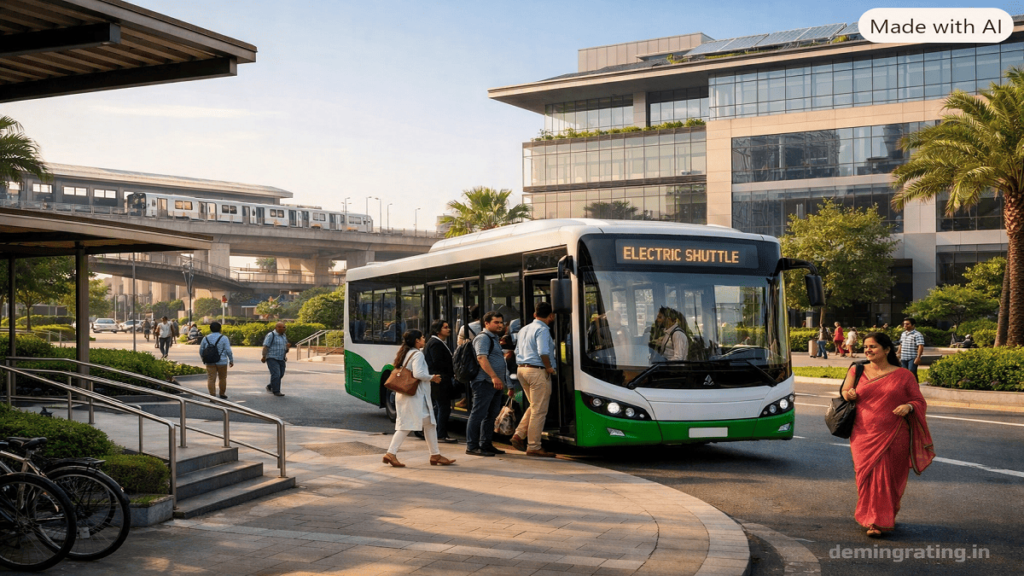
A large business campus in an urban Indian setting provides a useful example of how public transport access and shuttle services can be incorporated into a green-building strategy. The project is designed around the principle that sustainable buildings should address not only energy and water efficiency but also the transportation needs of occupants.
Project Context
The campus accommodates a large number of employees and visitors and is located within an established urban area with access to buses and rail-based public transportation. However, the distance between the main building entrances and nearby transit stations creates a first- and last-mile challenge.
Rather than relying entirely on private cars, the project team develops a transportation strategy that connects the campus with nearby public transport facilities. The approach combines pedestrian infrastructure, dedicated shuttle services, bicycle facilities, and organized transportation information.
Shuttle Service Strategy
A dedicated shuttle network is introduced to connect the campus with major nearby transit points during peak commuting periods. Routes are selected based on employee travel patterns, transit availability, road conditions, and expected passenger demand.
Shuttle schedules are coordinated with public transport timetables wherever practical. This allows employees to travel by public transportation for the majority of their journey while using the shuttle for the final connection to the workplace.
The service can also incorporate accessible vehicles, designated boarding areas, clear signage, and safe pedestrian routes. These features help ensure that the transportation system is convenient for a broad range of users.
Integration With Green-Building Objectives
The transportation strategy supports green-building objectives by encouraging shared mobility and reducing dependence on individual private vehicles. The project can monitor shuttle utilization, passenger numbers, route efficiency, and changes in commuting patterns to evaluate the effectiveness of the program.
The campus can also provide secure bicycle parking and pedestrian connections to nearby transit facilities. Where feasible, electric shuttle vehicles can further reduce local vehicle emissions, provided suitable charging infrastructure and operational conditions are available.
The U.S. Environmental Protection Agency identifies transportation planning as an important component of sustainable development and highlights the environmental value of integrating transportation considerations into development planning.
Key Benefits
The integrated transportation strategy can provide several benefits:
- Improved access to public transportation
- Reduced dependence on private vehicles
- Better first- and last-mile connectivity
- Lower parking demand
- Improved commuting convenience
- Greater accessibility for building occupants
- Potential reduction in transportation-related emissions
- Support for corporate sustainability objectives
Lessons for GGBC-Oriented Projects
The case demonstrates that access to public transportation should be considered during site planning rather than treated as a separate operational issue. A building located near public transport can maximize this advantage through safe pedestrian connections, bicycle infrastructure, clear wayfinding, and convenient shuttle services.
Where direct transit access is limited, a dedicated shuttle can provide an effective connection between the building and existing transportation networks. However, the service should be based on actual occupant demand and regularly reviewed to ensure that routes, schedules, vehicle capacity, and operating costs remain appropriate.
Ultimately, public transport and shuttle planning can extend the sustainability benefits of a green building beyond its physical structure. By supporting shared mobility and reducing reliance on private vehicles, a well-designed transportation strategy can contribute to environmental performance, occupant convenience, accessibility, and the broader sustainability objectives of the development.
#ShuttleServices
White Paper: GGBC Access to Public Transport / Shuttle Services
Executive Summary
Sustainable buildings should address more than energy consumption, water efficiency, and material selection. Transportation is also an important part of a building’s overall environmental and social impact. Providing convenient access to public transportation and shuttle services can help reduce dependence on private vehicles, improve mobility, reduce parking demand, and support more sustainable patterns of development.
For GGBC-oriented projects, access to public transport and shuttle services can be incorporated into a broader sustainable-site and transportation strategy. The exact requirements and scoring criteria depend on the specific GGBC certification framework being used and should be verified against its current technical standard.
This white paper examines the role of public transportation and shuttle services, key planning considerations, benefits, implementation strategies, challenges, and opportunities for sustainable building projects.
1. Introduction
Transportation is closely connected to building location, accessibility, land use, energy consumption, and environmental performance. A highly efficient building can still contribute to significant transportation impacts if occupants have limited alternatives to private vehicles.
Green-building approaches therefore increasingly consider how buildings connect with surrounding transportation networks. Public buses, metro systems, railways, shared mobility, cycling infrastructure, pedestrian routes, and dedicated shuttle services can provide alternatives to individual vehicle travel.
For GGBC-oriented developments, transportation planning should begin during site selection and continue through building design and operation.
2. Importance of Public Transport Access
Public transportation provides shared mobility that can reduce the number of individual vehicle journeys associated with a building. When employees, residents, visitors, and customers can conveniently reach a facility by bus, rail, or metro, dependence on private cars and motorcycles can potentially decline.
Public transport access can also improve social inclusion. People who do not own private vehicles can access employment, education, healthcare, commercial facilities, and other services more easily when reliable transportation is available.
The U.S. Environmental Protection Agency recognizes the connection between transportation planning, sustainable development, and community environmental outcomes.
3. Shuttle Services and First- and Last-Mile Connectivity
A common limitation of public transportation is the first- and last-mile gap. A transit station may be relatively close to a building but still inconvenient to reach because of distance, unsafe pedestrian routes, poor connectivity, or limited transportation frequency.
Dedicated shuttle services can address this challenge by connecting buildings with nearby:
- Metro stations
- Railway stations
- Bus terminals
- Major bus stops
- Transportation hubs
- Residential areas
- Parking facilities
Shuttles are particularly useful for large office campuses, industrial facilities, hospitals, universities, technology parks, and developments located outside major transit corridors.
4. Planning an Effective Shuttle Network
A successful shuttle program should be based on actual transportation demand rather than assumptions.
Route Planning
Routes should connect the building with strategically important transit hubs and locations used by a significant proportion of occupants. Travel time, road conditions, traffic congestion, safety, and accessibility should be evaluated.
Scheduling
Service frequency should correspond with building operating hours and peak commuting periods. Coordinating shuttle schedules with public transportation timetables can reduce transfer and waiting times.
Vehicle Selection
Vehicle capacity should reflect expected demand. Organizations can also consider lower-emission or electric shuttle vehicles where appropriate infrastructure is available.
Accessibility
Vehicles, boarding points, pedestrian routes, and information systems should accommodate users with different mobility requirements. Accessible transportation can improve inclusivity and overall user experience.
5. Sustainable Mobility Infrastructure
Public transport access is most effective when supported by appropriate site infrastructure.
Projects can consider:
- Safe pedestrian pathways
- Covered transit waiting areas
- Bicycle parking
- Cycling connections
- Accessible ramps
- Wayfinding signs
- Lighting
- Shuttle boarding zones
- Real-time transportation information
- Secure mobility facilities
These features can make public and shared transportation more convenient and attractive.
6. Environmental Benefits
Public transport and shuttle services can contribute to lower transportation-related environmental impacts by reducing individual vehicle dependence.
Potential environmental benefits include:
- Reduced private vehicle trips
- Lower fuel consumption
- Reduced transportation emissions
- Lower parking demand
- More efficient use of land
- Improved integration between buildings and public infrastructure
The scale of these benefits depends on factors such as vehicle occupancy, route efficiency, transportation mode, travel distance, and the energy source used by vehicles.
7. Social Benefits
Transportation planning also has important social benefits.
Reliable public transport and shuttle services can improve access for employees, visitors, students, patients, customers, and other building users. They can be particularly valuable for people who cannot drive or who prefer not to use private vehicles.
Convenient shared transportation can also reduce commuting stress, simplify transfers, and provide more predictable access to workplaces and services.
8. Economic Benefits
Sustainable transportation can create economic advantages for both building owners and occupants.
Occupants may reduce spending on fuel, vehicle maintenance, parking, tolls, and other private-vehicle costs. Organizations may benefit from reduced demand for parking infrastructure and improved employee access.
Well-planned transportation programs can also support employee recruitment and retention by making workplaces easier to reach.
9. Compliance and Documentation
For projects seeking green-building certification, transportation-related measures should be documented from the design stage.
Potential evidence may include:
- Site location plans
- Distance to public transportation facilities
- Transit schedules
- Route maps
- Shuttle operating plans
- Vehicle specifications
- Passenger-capacity information
- Photographs
- Pedestrian-access plans
- Bicycle-facility documentation
- Accessibility information
- Transportation surveys
- Shuttle utilization records
The exact evidence required should be confirmed against the applicable GGBC certification standard.
10. Key Challenges
Despite the benefits, public transport and shuttle programs face several challenges.
Limited transit availability can make connectivity difficult in suburban or developing areas.
Operating costs can be significant because shuttle services require vehicles, drivers, maintenance, insurance, fuel or electricity, and administration.
Demand fluctuations can make it difficult to maintain efficient routes throughout the day.
Traffic congestion can affect reliability and make scheduled journey times difficult to maintain.
Infrastructure limitations may restrict the ability to provide safe pedestrian access or dedicated shuttle stopping areas.
Addressing these challenges requires ongoing monitoring and adjustment rather than treating transportation planning as a one-time exercise.
11. Recommended Implementation Framework
A practical implementation strategy can follow eight steps:
- Assess the location and identify nearby public transport facilities.
- Analyze occupant travel patterns using surveys and available transportation data.
- Identify first- and last-mile gaps between transit facilities and the building.
- Design shuttle routes based on demand, safety, and travel efficiency.
- Coordinate schedules with public transportation services.
- Provide supporting infrastructure such as pedestrian paths, bicycle facilities, and accessible boarding areas.
- Monitor performance through passenger counts, utilization rates, travel times, and user feedback.
- Review and improve the service periodically based on changing demand.
12. Future Opportunities
The future of sustainable building transportation will increasingly involve integrated mobility systems.
Electric shuttle buses, real-time vehicle tracking, mobile transportation applications, digital ticketing, smart parking systems, and data-driven route optimization can improve service efficiency.
Buildings can also integrate shuttle services with metro, railway, bus, bicycle-sharing, and other shared-mobility networks to create seamless transportation options.
As cities become more focused on reducing emissions and improving mobility, buildings with strong public transport connections may gain additional environmental and economic advantages.
Conclusion
Access to public transportation and shuttle services can significantly strengthen the sustainability strategy of a GGBC-oriented building. By connecting occupants to buses, railways, metro systems, and other shared transportation options, projects can reduce private vehicle dependence while improving accessibility and commuting convenience.
A successful approach requires more than simply locating a building near a transit stop. Projects should consider pedestrian connectivity, first- and last-mile access, shuttle routes, service frequency, accessibility, vehicle efficiency, operating costs, and user demand.
#PublicTransport
Industry Applications of GGBC Access to Public Transport / Shuttle Services
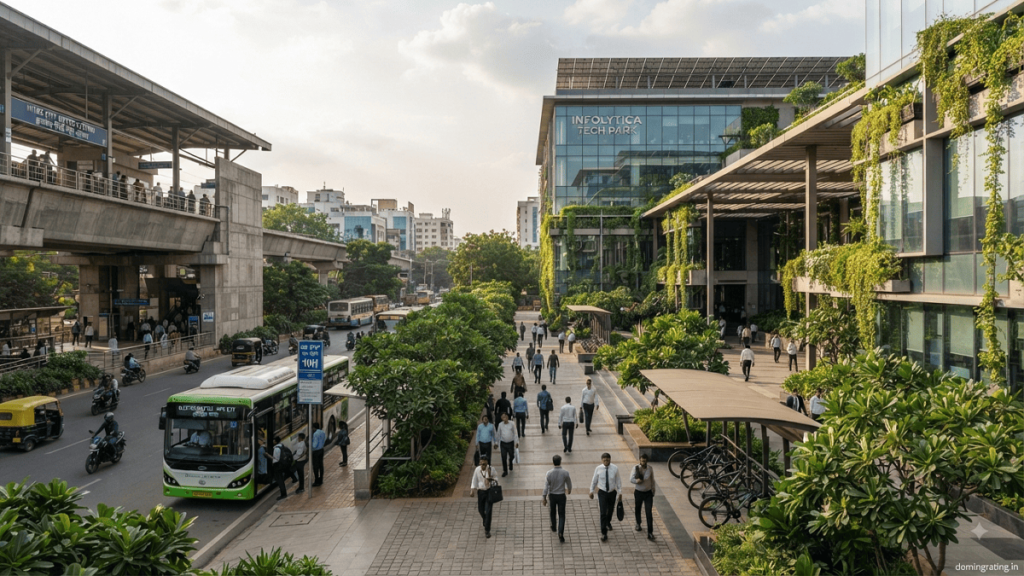
Access to public transport and shuttle services has applications across many industries where sustainable buildings need to provide convenient, efficient, and lower-impact mobility options. For GGBC-oriented projects, transportation planning can help reduce private vehicle dependence, improve accessibility, manage parking demand, and support broader environmental and social sustainability goals.
1. Corporate Offices and Business Parks
Large corporate offices and business parks often have significant daily commuting requirements. Connecting these facilities with metro stations, railway stations, bus stops, and other transit hubs can make public transportation more practical for employees.
Dedicated company shuttles can provide first- and last-mile connections, particularly during peak commuting hours. Organizations can also use employee travel surveys to optimize routes and schedules.
2. Manufacturing and Industrial Facilities
Industrial facilities may operate multiple shifts, including early-morning, evening, and overnight schedules when public transportation may be less frequent. Shuttle services can provide reliable connections between industrial sites and nearby residential areas or transit stations.
This approach can improve employee accessibility while potentially reducing private vehicle use and parking requirements. Transportation planning should also consider worker safety, vehicle capacity, shift patterns, and appropriate pickup locations.
3. Healthcare Facilities
Hospitals and healthcare campuses require transportation options for employees, patients, visitors, and service providers. Public transport access can improve accessibility, while dedicated shuttles can connect hospitals to railway stations, metro stops, parking areas, and nearby healthcare facilities.
Accessible vehicles and safe pedestrian routes are particularly important because some users may have mobility limitations or medical needs.
4. Educational Institutions
Universities, colleges, schools, and research campuses can use public transportation and shuttle services to connect students, faculty, staff, and visitors with surrounding communities.
Campus shuttle networks can connect multiple buildings, residential areas, parking facilities, and public transport hubs. Bicycle facilities and pedestrian infrastructure can further support sustainable mobility.
5. Hospitality and Tourism
Hotels, resorts, convention centres, and tourism facilities can use shuttle services to connect guests with airports, railway stations, metro systems, and tourist destinations. Convenient transportation can improve guest experience while reducing dependence on individual rental cars and taxis.
Electric or other lower-emission shuttle vehicles may provide additional sustainability benefits where suitable infrastructure is available.
6. Retail and Mixed-Use Developments
Shopping centres and mixed-use developments can benefit from strong connections to public transportation because they serve large numbers of customers and employees. Convenient bus, metro, and rail access can reduce parking pressure and improve visitor accessibility.
Developers can also provide safe pedestrian connections, bicycle parking, clear wayfinding, and dedicated shuttle stops.
7. Technology Parks and Data Centres
Technology parks often accommodate large employee populations and may be located in suburban areas where public transport connections are limited. Shuttle networks can connect technology campuses with nearby metro stations and residential areas.
Data centres generally have fewer occupants but may still benefit from shared transportation for employees, contractors, and maintenance teams.
8. Residential and Large-Scale Developments
Residential communities can integrate public transport access, internal shuttle services, bicycle facilities, and pedestrian infrastructure into their planning. Shuttle services can connect residents with nearby stations, commercial areas, schools, and major transportation hubs.
Such facilities can improve mobility while reducing dependence on private vehicles for everyday journeys.
Conclusion
GGBC-oriented transportation strategies can be applied across corporate, industrial, healthcare, educational, hospitality, retail, technology, and residential sectors. The specific solution depends on the site’s location, occupant profile, existing public transportation network, and travel demand.
The U.S. Environmental Protection Agency highlights the connection between transportation planning and sustainable development. By combining public transit access with well-designed shuttle services, pedestrian routes, cycling facilities, and accessible infrastructure, organizations can create more connected and sustainable buildings while improving convenience for occupants and reducing reliance on private vehicles.
#GGBC
Ask FAQs
Why is public transport access important for GGBC-oriented buildings?
Public transport access can reduce dependence on private vehicles, support lower-emission travel, improve accessibility, and reduce transportation-related environmental impacts. It can also help reduce parking demand and improve connectivity for employees, visitors, residents, and other building users.
What transportation options can support GGBC objectives?
Depending on location, projects can consider buses, metro systems, railways, public transit hubs, dedicated shuttle services, cycling infrastructure, and pedestrian connections. The most appropriate combination depends on the site’s location, available transportation network, occupant needs, and applicable certification requirements.
How do shuttle services support sustainable building connectivity?
Shuttle services can address first- and last-mile transportation gaps by connecting buildings with nearby metro stations, railway stations, bus stops, and other transit hubs. Reliable shuttle routes can make public transportation more convenient and encourage occupants to reduce private vehicle use.
What factors should be considered when planning a building shuttle service?
Important factors include transit-hub locations, occupant travel patterns, route distance, traffic conditions, service frequency, vehicle capacity, accessibility, safety, operating costs, and environmental performance. Shuttle schedules should also be coordinated with building operating hours and public transport timetables.
What are the main benefits of public transport and shuttle services?
Key benefits include reduced private vehicle dependence, lower transportation-related emissions, improved accessibility, reduced parking demand, greater commuting convenience, and potential cost savings for organizations and occupants. Well-designed transportation programs can also support broader sustainability and corporate environmental goals.
Table of Contents
Disclaimer: This content is for general informational purposes only. GGBC criteria and public transport requirements may vary by certification framework and location. Project teams should verify applicable requirements with the relevant certification body and local authorities.