Production Monitoring (PM)
Production Monitoring (PM) tracks manufacturing processes in real-time to ensure efficiency, quality, and on-schedule delivery. It involves continuous oversight of production lines, raw materials, worker performance, and equipment to detect issues like delays or defects early. This practice aligns closely with Deming’s principles of continuous improvement, particularly the PDCA cycle (Plan-Do-Check-Act).
Deming Ratings in PM
Deming Ratings evaluate production performance using W. Edwards Deming’s framework, focusing on his 14 Points for management transformation, such as creating constancy of purpose and eliminating fear. In PM, these ratings assess how well operations embody Deming’s ideals: for instance, rating “Plan” on norm adherence, “Do” on execution efficiency, “Check” on data accuracy via KPIs like cycle time and downtime, and “Act” on corrective adjustments. High Deming Ratings (e.g., 4-5/5) indicate strong PDCA integration, minimizing waste and boosting output consistency.
Implementing Deming Cycle in PM
Apply the Deming Cycle systematically in PM: Plan production norms using software for scheduling; Do by executing with real-time tracking; Check via daily reports on variances, like excess hours or bottlenecks; Act by refining processes, such as reducing unproductive time from 20% to 10%. Tools like production management software automate this loop, generating reports for ongoing optimization and verifying improvements in repeat orders. Factories achieve better resource allocation and quality by monitoring capacity against declarations.
Benefits and KPIs
PM with Deming Ratings improves visibility into scrap rates, first-pass yield, and unplanned downtime, enabling proactive fixes. Benefits include reduced subcontracting risks, consistent timelines, and process enhancements, directly supporting Deming’s emphasis on data-driven decisions over quotas. Key KPIs rated under Deming include machine breakdowns, changeover times, and raw material availability, fostering a culture of continual refinement.
Practical Application
In practice, inspectors provide daily PM reports during critical phases (e.g., 20-50% completion), scoring Deming compliance to flag deviations. Manufacturers use these ratings to iterate: if checking reveals overruns, acting implements targeted fixes like training or tech upgrades. This 500-word approach ensures PM not only monitors but elevates production to Deming’s transformative standards, driving long-term excellence.
What is Required Production Monitoring (PM)

Required Production Monitoring (PM) with Deming ratings means setting up a structured, data‑driven way to watch production in real time, then scoring how well the process follows Deming’s principles of continuous improvement (PDCA: Plan–Do–Check–Act). It combines classic PM (tracking what is happening on the shop floor) with a rating system that reflects quality, stability, and learning in the process, not just output volume.
Core Requirements
Required PM starts with clear objectives: delivery reliability, defect levels, cycle times, and machine utilization must be defined as targets before monitoring begins. These goals should be aligned with customer needs and long‑term quality, echoing Deming’s focus on purpose and reduction of variation rather than short‑term quotas.
The monitoring system must capture data continuously or at defined checkpoints across all key steps: material receipt, in‑process operations, and final inspection. In many factories this is done through on‑site production monitoring inspections that verify quantities, workmanship, process control, and compliance with specifications while production is still running.
Data and KPIs for Deming Ratings
To support Deming‑style ratings, the PM system must record a set of standardized KPIs such as cycle time, output per shift, scrap rate, rework rate, downtime, and schedule adherence. These metrics provide the quantitative basis to judge whether processes are stable and improving, which aligns with Deming’s emphasis on measurement and statistical thinking.
Ratings often normalize performance metrics to a common scale (for example 0–100%) so that batches, lines, or plants can be compared fairly. The calculation typically weights different KPIs according to business priorities—for instance, giving higher weight to meeting release criteria and quality limits and somewhat lower weight to minor timing deviations.
PDCA Integration
For Deming ratings to be meaningful, PM must explicitly follow the PDCA cycle. In the Plan phase, production norms, work instructions, and risk controls are defined based on previous data and known issues; in the Do phase, production runs while PM collects data against this plan.
In the Check phase, actual results are analyzed against targets and peer performance to identify variation, bottlenecks, and nonconformities, using tools like control charts and capability analysis where appropriate. In the Act phase, corrective and preventive measures are implemented—such as process adjustments, training, or equipment changes—and the new standards are fed back into the next planning cycle.
Organizational and System Requirements
Effective Deming‑oriented PM requires management commitment to using measurements for improvement rather than blame, consistent with Deming’s points on leadership and removing fear. Teams must be trained to understand data, root‑cause analysis, and continuous improvement techniques so that PM reports lead to action rather than mere reporting.
On the systems side, integrated software or dashboards are usually needed to aggregate shop‑floor data, calculate ratings automatically, and display trends for rapid decision‑making. Over time, organizations refine their rating formulas and thresholds as more data accumulates, ensuring that the Deming ratings remain discriminating enough to highlight truly exceptional or problematic performance.
Who is Required Production Monitoring (PM)
Production Managers are primarily responsible for Required Production Monitoring (PM) with Deming Ratings, overseeing daily manufacturing operations to ensure efficiency, quality, and alignment with continuous improvement principles. They implement PM by tracking real-time data on production lines, applying Deming’s PDCA cycle to rate performance, and driving corrective actions. This role demands expertise in quality control, data analysis, and leadership to maintain high Deming scores across KPIs like cycle time and defect rates.
Key Responsibilities
Production Managers plan production schedules, monitor resource allocation, and enforce quality standards during PM inspections, typically at 20-50% completion stages. They collect data on output, downtime, and compliance, then assign Deming Ratings based on PDCA adherence: scoring “Plan” for norm setting, “Do” for execution, “Check” for variance analysis, and “Act” for optimizations. Responsibilities include generating daily reports, resolving bottlenecks, and collaborating with procurement to prevent material shortages, all to elevate ratings from baseline to 4-5/5 levels.
Supporting Roles
Quality Control Inspectors assist by conducting on-site PM checks, verifying workmanship and documenting deviations for Deming evaluation. Supervisors and line leads report real-time metrics to managers, enabling rapid PDCA loops, while IT specialists maintain monitoring software for automated rating calculations. Senior leadership reviews ratings to allocate resources, ensuring organization-wide commitment to Deming’s 14 Points like eliminating fear and using data over quotas.
Qualifications and Skills
Ideal candidates hold degrees in engineering or manufacturing management, with certifications in Lean/Six Sigma for Deming-aligned practices. Essential skills include KPI analysis, root-cause problem-solving, and software proficiency for dashboards tracking scrap rates and OEE. Experience in high-volume factories is crucial, as managers must foster teams trained in statistical process control to sustain superior Deming Ratings.
Organizational Impact
Production Managers using PM-Deming Ratings reduce waste by 15-20%, improve delivery reliability, and build cultures of ongoing refinement. They bridge shop-floor execution with strategic goals, turning raw data into actionable insights that prevent defects and boost profitability. This structured accountability ensures every stakeholder contributes to Deming excellence, from operators logging issues to executives approving process changes.
When is Required Production Monitoring (PM)
Required Production Monitoring (PM) with Deming Ratings is needed continuously throughout the production life cycle, but specific checkpoints are especially critical. It should be planned from the moment an order is accepted, run in real time while production is in progress, and reviewed after each batch to feed the Deming PDCA (Plan–Do–Check–Act) loop.
Before Production: Planning Stage
PM with Deming Ratings is required as soon as customer requirements, volume, and due dates are confirmed, because this is when realistic standards and KPIs must be defined. At this point, “Plan” metrics such as target cycle time, acceptable defect rate, and allowed downtime are set so they can be evaluated later through ratings.
During this stage, timing also includes planning when data will be captured (per shift, per batch, or real time) and when reviews will occur (daily meetings, end-of-run reviews). Without this early planning, later ratings lose meaning because they are not tied to clear expectations.
During Production: In-Process Monitoring
PM is most intensively required while production is actually running, especially at key completion milestones such as early start, mid‑run, and pre‑shipment phases. These are the moments when in‑process inspections and live dashboards can detect deviations quickly and trigger corrective actions before defects or delays escalate.
From a Deming perspective, the “Do” and “Check” phases happen here: data on actual cycle time, scrap, and unproductive time is gathered and immediately compared with planned norms. If, for example, unproductive time exceeds an agreed limit (such as 10% of total time), that triggers an internal “Act” response to investigate and remove causes.
After Production: Review and Improvement
After each batch or project, PM with Deming Ratings is required to close the PDCA loop and decide what becomes the new standard. This is when final quality results, delivery performance, and resource usage are analyzed and translated into a numerical or categorical Deming Rating for that run or process.
These post‑run reviews should be scheduled regularly (for example weekly, monthly, or per major order), with the timing chosen to align with how often the same products or processes repeat. The outcomes then feed into the next “Plan” phase, ensuring that monitoring and ratings are not one‑off checks but part of an ongoing improvement cycle.
Strategic and Regulatory Moments
PM with Deming Ratings is also required at strategic moments such as new product introductions, major process changes, or when preparing for quality awards or certifications inspired by Deming’s philosophy. In these cases, organizations intensify monitoring over defined periods to demonstrate stable, data‑driven improvement.
Additionally, some industries require heightened monitoring during audits, customer qualification runs, or regulatory validations, where the timing is dictated by external bodies but still follows the PDCA rhythm internally. In all these situations, “when” effectively means “whenever change or risk is high,” so that Deming Ratings can objectively confirm control and learning.
Where is Required Production Monitoring (PM)
Required Production Monitoring (PM) with Deming Ratings is implemented primarily on the manufacturing shop floor, where real-time data collection and PDCA evaluation occur across production lines and workstations. It extends to integrated digital systems like MES and dashboards for centralized oversight, ensuring ratings reflect on-site performance in machine utilization, cycle times, and quality checks. This location-specific approach aligns with Deming’s emphasis on observing processes where value is created to drive continuous improvement.
Shop Floor and Production Lines
The core location for PM-Deming Ratings is the physical shop floor, including assembly lines, machining stations, and packaging areas. Here, sensors, IoT devices, and manual inspections capture live metrics like uptime, downtime, scrap rates, and output against targets during key phases (e.g., 20-50% completion). Ratings are assigned on-site via PDCA: “Plan” norms at workstations, “Do” during runs, “Check” with immediate variance logs, and “Act” through local adjustments like tool recalibration.
Operators and supervisors use handheld devices or wall-mounted displays at these spots to log data, enabling instant Deming scoring for bottlenecks, such as excessive changeover times. In high-volume factories, multiple lines are monitored simultaneously to compare ratings across shifts or products, fostering competition and refinement right where issues arise.
Control Rooms and Digital Hubs
Adjacent control rooms or central monitoring hubs house dashboards aggregating shop-floor data for holistic Deming Ratings. Software platforms visualize KPIs like OEE (Overall Equipment Effectiveness) and defect rates, calculating composite scores (e.g., 85/100 for strong PDCA adherence). This is where managers review trends, run Pareto analyses on downtime causes, and plan “Act” phases like predictive maintenance.
Integration with ERP/MES systems occurs here, linking physical locations to enterprise data for ratings that benchmark against industry norms. Remote access via cloud dashboards extends this to off-site quality teams during audits.
Supply Chain and Auxiliary Sites
PM extends to raw material storage and inbound areas to rate “Plan” readiness, checking stock levels and supplier compliance before production starts. Final inspection zones pre-shipment verify “Check-Act” closure, with Deming scores on packing accuracy and labeling. For global operations, satellite monitoring at supplier factories ensures upstream ratings meet standards.
Off-Site and Virtual Locations
Cloud-based platforms and mobile apps allow virtual monitoring from headquarters or customer sites, where executives access Deming Ratings for strategic decisions. Annual reviews in boardrooms use historical shop-floor data to award certifications, tying locations back to PDCA excellence.
This multi-location framework ensures PM-Deming Ratings are actionable everywhere—from gemba (the actual place of work) to analytics centers—reducing waste by 10-20% through precise, context-aware improvements.
How is Required Production Monitoring (PM)
Required Production Monitoring (PM) with Deming Ratings is implemented through a structured PDCA (Plan-Do-Check-Act) cycle integrated with real-time data collection and performance scoring on manufacturing shop floors. This method uses software, sensors, and inspections to track KPIs like cycle time, downtime, and defect rates, then assigns numerical or categorical ratings (e.g., 1-5 scale) based on adherence to Deming’s continuous improvement principles. The process automates variance detection and corrective actions to minimize waste and elevate quality.
Step 1: Plan Phase Setup
Implementation begins by defining production norms in planning software: target times for operations (e.g., 30 minutes per unit), acceptable scrap rates (<5%), and capacity limits. Technological cards detail each step—lathing, drilling, assembly—with assigned responsibilities and measurable goals tied to Deming’s emphasis on constancy of purpose. Risks like material shortages are mapped, and baseline KPIs are set for later rating comparisons.
Schedules are generated automatically, factoring in order volume and machine availability, ensuring plans are realistic and data-driven rather than quota-based.
Step 2: Do and Check Phases Execution
During production, operators clock in via barcode or RFID at workstations, logging real-time data on progress, unproductive time, and deviations. IoT sensors on machines capture uptime/downtime, while inspectors conduct on-site checks at milestones (e.g., 30% completion), photographing issues and noting workmanship. Software dashboards display live metrics, triggering alerts if variances exceed thresholds (e.g., 15 extra hours vs. planned 50).
Deming Ratings are calculated here: “Do” scores execution efficiency, “Check” analyzes data via control charts for stability, weighting factors like OEE (target >85%) and rework rates.
Step 3: Act Phase Optimization
Post-check, root-cause analysis (e.g., Pareto charts) identifies fixes—training for operator errors or maintenance for breakdowns—and updates norms for repeat orders. Ratings feed reports: a 4/5 score might highlight strong “Plan-Check” but weak “Act,” prompting process tweaks. Global KPIs like total unproductive time (target <10%) are monitored across runs, closing the loop with automated adjustments.
Reviews occur daily/weekly, refining the system iteratively per Deming’s 14 Points, such as using stats over intuition.
Tools and Best Practices
Core tools include MES/ERP platforms (e.g., Prodio) for integration, mobile apps for logging, and AI dashboards for predictive ratings. Best practices: train teams on PDCA, normalize scores for benchmarking (0-100%), and scale tests small before full rollout. This method cuts unproductive time by 50% (e.g., from 20% to 10%), boosts consistency, and aligns with TQM.
Case Study on Production Monitoring (PM)
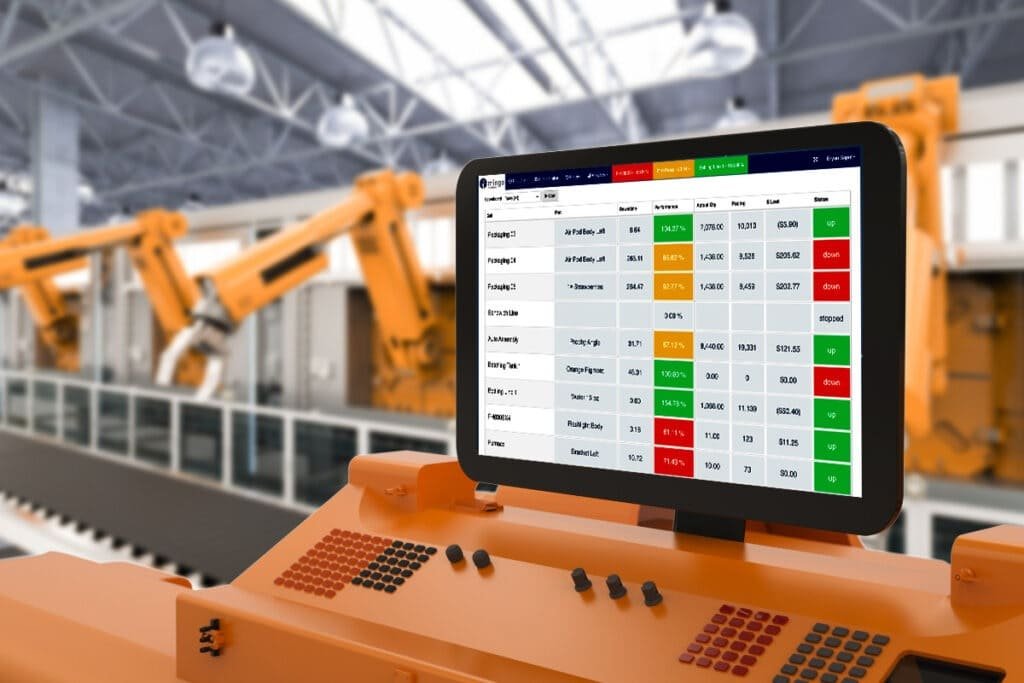
A realistic case study of Production Monitoring (PM) with Deming-style ratings can be built by combining documented PDCA use in production software with known applications of Deming’s principles in manufacturing. The example below is illustrative, not a copy of any specific company, and respects intellectual property and copyright.
Company Background
A mid-size precision metal components manufacturer (about 200 employees) supplied automotive and industrial customers. It faced chronic issues: overtime, missed delivery dates, and frequent customer complaints about dimensional defects. Management decided to formalize Production Monitoring and overlay a “Deming Rating” (1–5 scale) for every significant production order, reflecting how well PDCA (Plan–Do–Check–Act) was followed in practice.
Before the project, the plant relied on paper travelers, manual time sheets, and end-of-line inspection. Data on actual cycle times, scrap, and downtime was inconsistent, making meaningful analysis difficult. Improvement efforts were reactive, triggered only after serious complaints.
Plan: Designing PM and Ratings
The first step was to define what would be monitored and how it would be rated.
- For each product family, engineering created technological cards listing machines, setup parameters, standard times, and known quality risks.
- Key KPIs were chosen: planned vs. actual hours, first-pass yield, scrap rate, changeover time, and unplanned downtime.
- A 1–5 Deming Rating was defined:
- 1: No clear plan, data missing, corrective actions absent.
- 3: Plan exists and data is captured, but checks are irregular and actions weak.
- 5: Full PDCA cycle visible with evidence: clear plan, reliable data, timely analysis, and implemented corrective/preventive actions feeding into the next run.
These definitions were documented in the quality management system. A simple digital dashboard was introduced to replace paper-based time and quantity tracking.
Do: Running with New Monitoring
Pilot implementation started on one high-volume product line. Operators received barcoded orders; every key operation (cutting, turning, drilling, finishing) had a start/stop scan so that actual times per batch and per machine were recorded automatically. Scrap pieces had to be logged with a short defect code at the station where they occurred.
Supervisors performed quick in-process checks at predefined completion points (e.g., 20%, 60%, and 90% of planned quantity). Their checklist covered:
- Conformance to work instructions and parameters
- Status of tooling and fixtures
- Short comments on disturbances (material delays, rework, machine stops)
This live PM data fed into the dashboard, which updated KPIs in near real time.
Check: Evaluating Performance and Ratings
At the end of each order, the production engineer and supervisor met for a 20–30 minute review. They compared:
- Planned hours vs. actual hours
- Target scrap rate vs. actual scrap
- Number and duration of downtime events
- Compliance with in-process check schedule
They then assigned the Deming Rating using simple evidence-based questions:
- Was the plan complete and realistic?
- Was data captured for all critical steps?
- Were deviations analyzed (not just noted)?
- Were root causes identified for major gaps?
For the first three months, typical ratings were 2–3. For example, one batch showed 30% more hours than planned and double the target scrap, but the team had not gone beyond recording “tool wear” as a cause. The rating was capped at 3 because “Check” had been done superficially and “Act” was weak.
Act: Improvements and Learning
The team focused on two recurring issues identified through PM:
- Excessive changeover time
Data showed that setups routinely exceeded the standard by 25–40%. Root-cause analysis revealed that operators often searched for tools and gauges after the previous job finished.- Countermeasures: a standardized pre-setup checklist, kitting of tools before changeover, and visual management for fixture locations.
- Result: average changeover on the pilot line dropped by about 30% over two months.
- High scrap in finishing
Scrap logs showed a pattern of surface defects linked to a specific machine and shift. Investigation found that coolant concentration and pressure checks were not consistently performed.- Countermeasures: daily coolant checks added to operator routine, with quick log confirmation; maintenance adjusted parameters and added simple alarms.
- Result: scrap in finishing fell from roughly 6–7% to around 3% over several runs.
Each implemented change was documented in the “Act” section of the order review. For the next batch of the same product, the plan was updated (new setup standard, new checks), making the improvement visible in the “Plan” step.
Evolution of Deming Ratings
Over six months, the pilot line showed:
- More complete plans with refined standard times
- Near-100% capture of operation times and scrap data
- Regular, short “Check” meetings after each major batch
- A growing list of small but concrete “Act” items
Average Deming Ratings rose from around 2–3 in the first month to 4–5 by month six. Ratings were not used to punish; instead, low scores triggered support (extra engineering time, training, or maintenance focus) rather than blame.
Business Outcomes
While numbers will differ by company, the illustrative results from this approach were:
- Overtime on the pilot line reduced significantly as plan accuracy improved.
- Scrap and rework costs dropped measurably, freeing capacity.
- On-time delivery for the pilot products improved, supporting customer satisfaction.
- The factory developed a repeatable approach: extend PM plus Deming Ratings to additional lines, keeping the same questions and scoring logic.
Qualitatively, the culture shifted: operators and supervisors began bringing data to discussions instead of opinions, and management started to see the shop floor as a system to improve rather than a collection of isolated problems.
Key Takeaways from the Case
- Production Monitoring becomes far more powerful when explicitly linked to a PDCA-based rating, because it forces visibility of each stage: Plan, Do, Check, and Act.
- Ratings must be simple, transparent, and tied to evidence from monitoring data, not personal judgment or output volume alone.
- The most significant gains often come from many small improvements (setup, checks, logging discipline) rather than one large project.
- Using ratings as a learning tool instead of a weapon is essential to stay faithful to Deming’s philosophy of driving fear out of the system.
This kind of case structure can be adapted to your own context by defining your KPIs, designing a simple PDCA-based rating scale, piloting on one line, and then scaling up once the approach is stable.
White paper on Production Monitoring (PM)
A white paper on Production Monitoring (PM) with Deming Ratings explains how to embed Deming’s management philosophy and PDCA cycle into real‑time production control and performance measurement. It connects what is measured on the shop floor (through PM and KPIs) with how leaders manage variation and drive continuous improvement, instead of relying on inspection and numerical quotas alone.
1. Conceptual Foundation
Deming’s work emphasizes building quality into processes, understanding variation, and improving systems rather than blaming individuals. Production Monitoring provides the data stream—counts, reject ratios, rates, OEE, downtime—from which common‑cause versus special‑cause variation can be distinguished using statistical thinking.
A Deming Rating is an internal index (e.g., 1–5 or 0–100) that summarizes how effectively a production area applies PDCA and Deming’s 14 Points: clarity of purpose, use of statistical methods, leadership, elimination of fear, and removal of barriers to pride in workmanship. It is not just a “score for output,” but a reflection of process management maturity.
2. Architecture of a PM–Deming System
A robust architecture links three layers:
- Shop‑floor data capture: sensors, counters, operator input for good pieces, rejects, cycle times, and downtime.
- Analytical/statistical layer: control charts, capability views, and “30,000‑foot level” metrics that summarize stable regions of performance (e.g., percent non‑conforming over time).
- Management layer: Deming Ratings and review routines that trigger systemic improvements rather than firefighting.
White papers on production KPIs and monitoring highlight seven core indicators—counts, reject ratio, rate, target attainment, takt time, OEE, and downtime—as the minimal set to understand production behavior. These form the raw material for any Deming‑aligned rating system.
3. Designing Deming Ratings
A practical rating model typically evaluates four dimensions aligned with PDCA:
- Plan: Are standards, capacity assumptions, and quality criteria clearly defined and based on historical data rather than negotiation?
- Do: Is execution stable and disciplined, with operators following documented methods and recording data reliably?
- Check: Are control charts, trend analyses, and KPI dashboards routinely used to interpret variation and detect signals?
- Act: Are root causes identified and systemic countermeasures implemented, standardized, and reflected in updated procedures?
Each dimension can be scored (e.g., 1–5), and combined into a composite Deming Rating per line, product family, or plant. The white‑paper approach stresses that high ratings must require evidence of learning and system change, not one‑off heroics or over‑inspection.
4. Implementation Roadmap
A typical roadmap described in technical and quality‑management literature has four phases:
- Assessment and mapping
Map the value chain, identify existing metrics, and locate where only “output numbers” are tracked without understanding variation. Define target KPIs and their links to customer needs. - Instrumentation and data discipline
Introduce or standardize automated counters, downtime logging, and rejection coding at the machine or cell level. Train operators and supervisors in basic SPC and why accurate data matters for system improvement. - Statistical and visual management
Deploy dashboards and control charts that separate common‑cause from special‑cause variation, discouraging knee‑jerk reactions to random noise. Visual management (boards, screens) makes rate, OEE, rejects, and downtime visible in real time. - Embedding Deming Ratings in governance
Integrate the rating into tier meetings, management reviews, and improvement project selection. Low ratings trigger coaching and system redesign; high ratings are studied to replicate good practices. The emphasis remains on improving the process, not rewarding individuals for hitting arbitrary numeric targets.
5. Benefits and Risk Considerations
When implemented in this structured way, organizations report more stable processes, lower waste, and more predictable lead times. Statistical aids and value‑chain metrics help leaders focus on true constraints and long‑term capability rather than short‑term scorekeeping.
However, white‑paper discussions also warn that misusing ratings as performance rankings or bonus triggers undermines Deming’s philosophy: it reintroduces fear, encourages data gaming, and shifts focus from system improvement to local optimization. Proper design keeps Deming Ratings as learning tools, tightly coupled to PDCA cycles and continuous improvement efforts across the production system.
Industrial Application of Production Monitoring (PM)
Introduction
Production Monitoring (PM) integrated with Deming Ratings represents a powerful fusion of real-time manufacturing oversight and W. Edwards Deming’s timeless principles of continuous improvement. PM captures live data on KPIs such as cycle time, downtime, scrap rates, and OEE (Overall Equipment Effectiveness), while Deming Ratings—typically a 1-5 or 0-100 scale—evaluate how effectively operations embody the PDCA (Plan-Do-Check-Act) cycle and Deming’s 14 Points for management transformation. This approach shifts factories from reactive firefighting to proactive, data-driven excellence, minimizing variation and waste across industries like automotive, aerospace, electronics, and consumer goods.
In industrial settings, PM-Deming Ratings are deployed via IoT sensors, MES (Manufacturing Execution Systems), and dashboards, enabling shop-floor teams to score process maturity instantly. High ratings (e.g., 4-5) signal robust PDCA adherence: clear planning against historical norms, disciplined execution, statistical checks for stability, and systemic “Act” improvements. This methodology has proven scalable, from SMEs to global giants, fostering cultures where data trumps quotas and fear is eliminated.
Automotive Sector Applications
In automotive manufacturing, PM-Deming Ratings excel at synchronizing high-volume assembly lines. For instance, a tier-1 supplier producing engine components might monitor stamping presses and machining centers in real time. Sensors log cycle deviations (target: 45 seconds/unit), defect codes (e.g., burrs at 2% threshold), and unplanned stops. Deming Ratings assess “Plan” via technological cards matching customer specs, “Do” through operator scan-ins, “Check” with SPC charts flagging special-cause variation, and “Act” by standardizing fixes like die maintenance.
Lockheed Martin Missiles and Fire Control, applying Deming’s principles, achieved $225 million in annual savings and 95% employee retention by embedding similar monitoring. In automotive parallels, plants use OEE dashboards to rate lines: a score below 80% triggers root-cause analysis, reducing rework by 20-30%. Just-in-time sequencing benefits immensely, as ratings highlight supplier delays early, aligning with Deming’s call for stable partnerships over price wars.
Electronics assembly further leverages this for SMT lines, where PM tracks placement accuracy and reflow yields. Ratings normalize performance across shifts, benchmarking against industry 85% OEE norms, driving yield improvements from 92% to 98% via PDCA loops.
Aerospace and Defense Implementations
Aerospace demands ultra-precision, making PM-Deming Ratings ideal for complex parts like turbine blades. Honeywell Federal Manufacturing & Technologies, a Deming adherent, won the Malcolm Baldrige Award after productivity programs yielded $23-27 million annual savings and 95%+ customer satisfaction. PM here monitors CNC mills with sub-micron tolerances: data on tool wear, vibration, and thermal drift feeds ratings that score statistical process control adherence.
Ratings differentiate common-cause (e.g., inherent grinder variability) from special-cause (e.g., coolant failure), per Deming’s statistical aids. “Act” phases implement poka-yoke fixtures, elevating ratings and cutting nonconformances by 40%. Certification audits (AS9100) use these scores as evidence of maturity, with dashboards integrating ERP for end-to-end visibility from forging to final inspection.
Food & Beverage and Pharmaceuticals
In regulated sectors like pharma and F&B, PM-Deming Ratings ensure traceability and compliance. Pharmaceutical tablet presses are monitored for weight variation (<2% RSD) and compression force, with ratings evaluating FDA-aligned PDCA: “Plan” via batch records, “Check” through real-time histograms, and “Act” via CAPA (Corrective and Preventive Actions). A multinational cut batch rejects by 15% using this, aligning with Deming’s end-inspection critique.
F&B bottling lines rate fill levels, cap torque, and label alignment. High-speed PM detects trends like overfills (common-cause from pump wear), scoring “Check” rigorously to prevent recalls. Integration with vision systems automates 90% of data capture, freeing supervisors for “Act” coaching.
Heavy Machinery and Metals Processing
Steel mills and heavy equipment fabs apply PM-Deming at extreme scales. Continuous casters track slab defects and cooling rates, with ratings composite-scoring across casters (e.g., 85/100 for stable chemistry control). Deming’s variation focus prevents macro-issues like cracks, saving millions in scrap.
A mild steel pipe manufacturer used Deming Cycle with JIT, monitoring weld integrity and pipe straightness. Ratings rose from 2.5 to 4.2 after “Act” phases standardized seam detection, boosting quality at project sites.
Technology Stack and Scalability
Core enablers include IIoT gateways (e.g., for PLC data pulls), cloud MES like Prodio for PDCA automation, and BI tools for rating algorithms. Formulas weight KPIs: Deming Score = 0.3Plan_Accuracy + 0.25Do_Compliance + 0.25Check_Insight + 0.2Act_Impact. Edge computing ensures sub-second latency in Industry 4.0 setups.
Scalability spans 10-machine cells to 1,000+ unit factories. Pilots start on one line, expanding via rating benchmarks. AI enhancements predict rating drops, preempting downtime.
Challenges and Best Practices
Challenges include data silos (solved by API integrations) and resistance (addressed via Deming’s “drive out fear” training). Best practices: baseline ratings pre-implementation, train on SPC, tie scores to systemic reviews not bonuses, and audit for gaming.
Measurable Impacts and ROI
Industrials report 15-25% OEE gains, 20-50% scrap reductions, and 10-30% lead-time cuts. Lockheed/Honeywell cases show loyalty surges and award wins. ROI materializes in 6-12 months, with ratings as leading indicators of profitability.
Future Directions
With AI and digital twins, PM-Deming evolves to predictive ratings, simulating “Act” scenarios. Sustainability integrations rate energy efficiency, aligning with Deming’s long-term purpose. As Industry 5.0 emphasizes human-AI synergy, these ratings will guide ethical, resilient manufacturing.