
GGBC Green Home – Energy Efficiency
Energy efficiency is one of the most important aspects of a green home because it directly influences operating costs, occupant comfort, resource consumption, and environmental impact. A well-designed energy-efficient home reduces the amount of electricity required for cooling, lighting, appliances, and other household functions without compromising comfort or functionality.
In India, residential buildings represent a significant opportunity for energy conservation. The Bureau of Energy Efficiency notes that residential buildings account for a substantial share of building-sector electricity consumption, with cooling demand becoming an increasingly important contributor to household energy use.
Climate-Responsive Building Design
Energy efficiency begins with the design of the building rather than with appliances installed after construction. A green home should respond to its local climate through appropriate orientation, building form, window placement, shading, insulation, and ventilation.
The building envelope plays a particularly important role. Walls, roofs, windows, doors, and shading elements should be designed to minimise unwanted heat gain while supporting daylight and natural ventilation. India’s residential energy-efficiency framework, Eco Niwas Samhita, specifically addresses building-envelope performance, heat gain, heat loss, natural ventilation, and daylighting potential.
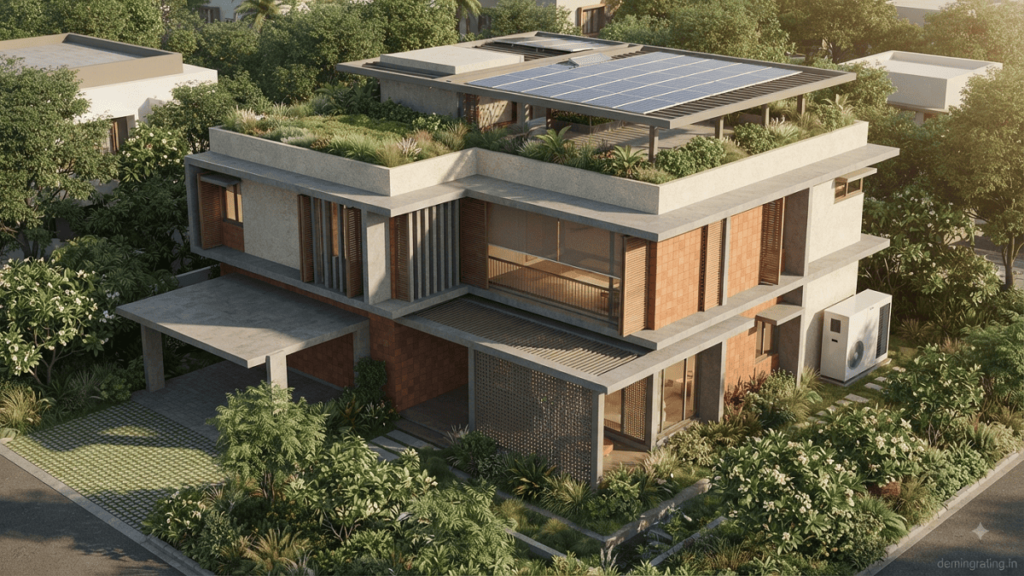
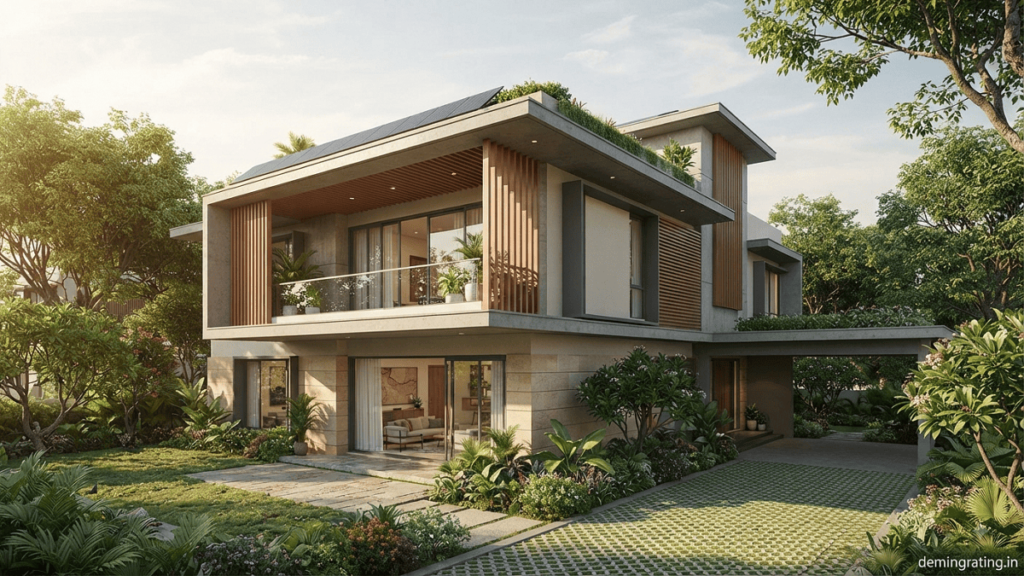
External shading devices such as overhangs, fins, balconies, and appropriately positioned vegetation can reduce direct solar heat entering the home. High-performance glazing, suitable window-to-wall ratios, and thermally appropriate wall and roof assemblies can further improve indoor thermal conditions.
Efficient Cooling, Lighting and Appliances
Mechanical systems should be selected according to the actual requirements of the home. High-efficiency air conditioners, ceiling fans, refrigerators, pumps, and other appliances can significantly reduce electricity consumption over their operating life. Efficient LED lighting should be combined with daylight-responsive design so that artificial lighting is used only when necessary.
Controls can further improve performance. Occupancy sensors, timers, thermostats, smart controls, and zoning allow energy-consuming equipment to operate according to actual requirements rather than continuously.
Renewable Energy Integration
Once energy demand has been reduced through passive and efficient design, renewable energy can be considered. Rooftop solar photovoltaic systems can generate electricity on-site and reduce dependence on grid electricity, subject to site conditions, system design, and applicable regulations.
The Bureau of Energy Efficiency’s residential guidance also identifies clean energy, including solar power, as an important component of energy-conscious residential development.
Measuring Performance
An energy-efficient home should be evaluated through measurable performance rather than relying only on individual green features. Energy consumption, equipment efficiency, thermal performance, daylight availability, and renewable-energy generation can be monitored to identify opportunities for improvement.
For homeowners, developers, and design professionals, the Bureau of Energy Efficiency provides resources including residential energy-efficiency guidance, design tools, and information on energy-efficient homes.
Useful external resources: Bureau of Energy Efficiency – Energy Efficiency in Buildings | Eco Niwas Samhita – Residential Energy Efficiency | Handbook of Replicable Designs for Energy Efficient Residential Buildings
Overall, energy efficiency in a green home should be approached as an integrated design strategy. Combining climate-responsive architecture, a high-performing building envelope, efficient systems and appliances, intelligent controls, and renewable energy can create homes that are more comfortable, economical to operate, and environmentally responsible throughout their lifecycle.
#EnergyConservation
What Is Energy Efficiency in a GGBC Green Home and Why Is It Important?
Energy efficiency in a GGBC Green Home refers to designing, constructing, and operating a residential building in a way that provides the required level of comfort and functionality while using as little energy as reasonably possible. It is not simply about installing energy-efficient appliances. Instead, it involves an integrated approach that considers the building’s orientation, envelope, windows, shading, ventilation, lighting, appliances, cooling systems, controls, and renewable-energy options.
For a green home, energy efficiency should ideally begin at the design stage. The building can be planned to respond to local climatic conditions, reduce unnecessary heat gain, make effective use of daylight and natural ventilation, and minimise dependence on mechanical cooling and artificial lighting. India’s Bureau of Energy Efficiency identifies building-envelope performance, natural ventilation, daylighting, and limiting heat gain or heat loss as important elements of residential energy efficiency.
Key Elements of Energy Efficiency
An energy-efficient green home can incorporate several strategies. A well-designed building envelope helps control heat transfer through roofs, walls, windows, and doors. Appropriate insulation, reflective or thermally suitable materials, shading devices, and efficient glazing can reduce unwanted solar heat entering the home.
Natural ventilation and daylight can also reduce energy demand when they are appropriately integrated into the design. Windows and openings should be positioned according to the site’s climate and orientation rather than simply for appearance. External shading through overhangs, balconies, fins, screens, and landscaping can further reduce direct solar exposure.
Efficient electrical systems are another important component. LED lighting, energy-efficient fans, refrigerators, air conditioners, pumps, and other appliances can deliver the same essential services with lower electricity consumption. Smart controls, timers, occupancy sensors, and appropriate temperature settings can further prevent unnecessary energy use.
Renewable energy can complement efficiency measures. For example, a suitably designed rooftop solar photovoltaic system can generate electricity on-site. However, reducing the home’s underlying energy demand should generally come first; renewable generation becomes more effective when the building itself has already been designed for efficient operation.
Why Is Energy Efficiency Important?
Energy efficiency matters because residential electricity consumption is increasing rapidly in India. The Bureau of Energy Efficiency states that residential buildings account for approximately 75% of electricity consumed within the building sector, making homes an important area for energy conservation.
For homeowners, lower energy consumption can translate into reduced electricity bills and lower operating costs over the life of the building. Efficient homes can also provide better thermal comfort by reducing excessive indoor heat gain and maintaining more stable indoor conditions.
From an environmental perspective, reducing electricity demand can help lower the emissions associated with energy generation, particularly where electricity is produced from fossil fuels. Energy-efficient homes therefore contribute to broader resource-conservation and sustainability objectives.
Energy efficiency also improves long-term resilience. As cooling demand and household electricity consumption increase, homes that require less energy to maintain comfortable conditions can be better positioned to manage rising energy costs and demand.
A Long-Term Approach to Green Home Design
Energy efficiency should therefore be viewed as a whole-building strategy rather than a collection of individual products. The most effective approach combines climate-responsive design, a high-performing building envelope, efficient equipment, responsible energy-use practices, and, where appropriate, renewable energy.
#GreenArchitecture
What Building Design Strategies Can Reduce Energy Consumption in a Green Home?
Building design has a major influence on how much energy a home consumes throughout its life. An energy-efficient green home should be designed to respond to its local climate, reduce unnecessary heat gain and heat loss, maximise useful daylight and natural ventilation, and minimise dependence on mechanical cooling and artificial lighting. These strategies are most effective when considered during the early planning and design stages rather than added after construction.
1. Climate-Responsive Orientation
The orientation of a home should be planned according to the local climate and the movement of the sun and prevailing winds. Proper orientation can reduce direct solar heat entering the building while improving opportunities for daylight and natural ventilation. In warm climates, reducing excessive exposure to intense solar radiation can significantly lower indoor cooling requirements.
2. High-Performance Building Envelope
The roof, walls, windows, doors, and other components forming the building envelope influence the transfer of heat between indoors and outdoors. Appropriate insulation, reflective roof treatments, suitable wall assemblies, and well-designed openings can help maintain more stable indoor temperatures.
India’s residential energy-efficiency guidance highlights the importance of building-envelope measures for controlling heat gain and heat loss. The Bureau of Energy Efficiency provides guidance on residential building energy performance.
3. External Shading
Windows can provide valuable daylight and ventilation, but poorly shaded windows can also introduce significant solar heat. External shading devices such as roof overhangs, balconies, horizontal projections, vertical fins, louvers, and screens can reduce direct solar radiation before it reaches the glazing.
Vegetation can complement architectural shading. Trees and appropriately selected landscape elements can provide shade around exposed walls, windows, and outdoor areas.
4. Natural Ventilation
A green home should take advantage of natural air movement whenever outdoor conditions are suitable. Strategically positioned windows, ventilators, courtyards, and other openings can encourage cross-ventilation and remove accumulated heat.
The Eco Niwas Samhita resources from the Bureau of Energy Efficiency address natural ventilation and related residential building-envelope considerations.
5. Daylighting
Effective daylighting can reduce dependence on artificial lighting during daytime hours. Window placement, room depth, skylights where appropriate, light shelves, reflective interior surfaces, and shading should be considered together. The objective is not simply to increase the amount of glass but to provide useful daylight while controlling glare and unwanted heat gain.
6. Efficient Windows and Glazing
Window design should consider orientation, size, glazing performance, frame characteristics, shading, and air leakage. Selecting glazing appropriate to the local climate can help balance daylight, thermal performance, ventilation, and visual comfort.
7. Efficient Building Form
A compact and appropriately proportioned building form can reduce the amount of exposed surface through which heat is transferred. However, the optimal form depends on the local climate, site conditions, orientation, and requirements for daylight and ventilation. Design decisions should therefore be based on the specific location rather than applying a single building shape universally.
8. Roof Design
In many Indian climates, roofs receive substantial solar exposure. Insulation, reflective surfaces, appropriate roof assemblies, shading, and other passive strategies can reduce heat entering the occupied spaces below. Where suitable, green roofs or rooftop installations may also contribute to overall environmental performance, provided they are properly designed for the local climate and structural requirements.
9. Efficient Systems and Renewable Energy
Passive design should be complemented by efficient mechanical and electrical systems. High-efficiency air conditioners, fans, pumps, lighting, and appliances can reduce energy demand when mechanical systems are necessary. Once demand has been reduced, rooftop solar photovoltaic systems can help supply a portion of the home’s electricity requirements.
The Bureau of Energy Efficiency’s building resources provide additional information on energy-efficient building approaches.
Conclusion
The most effective green-home strategy is to combine several measures rather than depend on a single technology. Climate-responsive orientation, a well-designed envelope, external shading, natural ventilation, daylighting, efficient glazing, appropriate roof design, efficient equipment, and renewable energy can work together to reduce energy consumption while improving indoor comfort.
#SustainableConstruction
How Can Efficient Lighting, Appliances, HVAC Systems, and Controls Improve Home Energy Performance?
Efficient lighting, appliances, heating, ventilation, and air-conditioning (HVAC) systems, together with effective controls, play an important role in improving the energy performance of a green home. While passive design strategies can reduce the amount of energy a home requires, efficient equipment ensures that the remaining energy demand is met with as little electricity as reasonably possible. Selecting and operating these systems correctly can reduce utility costs, improve comfort, and support long-term environmental performance.
Efficient Lighting
Lighting is one of the easiest areas in which a home can reduce electricity consumption. LED lighting generally uses substantially less electricity than conventional incandescent lighting and has a longer service life. However, efficient fixtures alone are not enough. Lighting should be combined with good daylighting so that artificial lights are used only when necessary.
Task lighting, occupancy sensors, daylight sensors, timers, and dimming controls can further reduce unnecessary operation. Lighting zones can also allow occupants to illuminate only the areas being used rather than an entire floor or room.
Energy-Efficient Appliances
Household appliances such as refrigerators, washing machines, televisions, dishwashers, and other equipment can contribute significantly to annual electricity consumption. Selecting high-efficiency products helps reduce this demand without reducing the essential service provided by the appliance.
In India, consumers can use the Bureau of Energy Efficiency’s Standards & Labelling programme to compare the energy performance of covered appliances. Choosing products with strong energy-efficiency ratings can reduce operating costs over the product’s lifetime.
Appliances should also be correctly sized. An oversized refrigerator, water heater, pump, or other system can consume unnecessary energy, while inappropriate sizing can reduce performance and comfort.
Efficient HVAC Systems
Cooling can represent a major portion of household electricity consumption, particularly in India’s warmer regions. High-efficiency air conditioners and properly sized HVAC systems can deliver required cooling with less electricity.
The effectiveness of an HVAC system also depends on installation and maintenance. Correct refrigerant charge, clean filters, properly designed ducts, adequate insulation, and appropriate airflow can help the system operate efficiently.
Thermostat settings are equally important. Avoiding excessive cooling and using temperature settings appropriate to occupant comfort can reduce unnecessary electricity use. The Bureau of Energy Efficiency provides resources related to energy-efficient building systems and equipment.
Smart Controls and Automation
Controls connect efficient equipment with actual household requirements. Occupancy sensors can switch lighting or equipment off when spaces are unoccupied. Timers can prevent systems from operating unnecessarily, while programmable or smart thermostats can adjust cooling according to schedules and occupancy.
Energy monitoring systems can provide information about electricity consumption and help homeowners identify high-energy loads. When residents can see how and when energy is being used, they are better positioned to modify operating habits and identify equipment that may require attention.
Integrated Energy Performance
The greatest benefit comes from combining efficient systems rather than treating each one separately. For example, good daylighting reduces lighting demand, which can also reduce internal heat gains. Effective shading and insulation reduce cooling loads, allowing HVAC systems to be smaller or operate for fewer hours. Efficient appliances further reduce electricity consumption, while controls ensure that systems operate only when required.
This integrated approach is consistent with the broader principles of residential energy efficiency described in the Eco Niwas Samhita resources.
Conclusion
Efficient lighting, appliances, HVAC systems, and controls can significantly improve a home’s energy performance when they are selected, sized, installed, and operated appropriately. The objective is not simply to purchase efficient equipment but to create a coordinated system in which the building design, equipment, controls, and occupant behaviour work together.
#EnergyEfficientHomes
How Can Passive Design, Insulation, Shading, and Natural Ventilation Reduce the Need for Mechanical Cooling and Heating?
Passive design strategies can significantly reduce the amount of energy a green home requires for maintaining comfortable indoor temperatures. Instead of relying primarily on air conditioners, heaters, and other mechanical systems, passive design uses the building’s orientation, materials, openings, shading, insulation, and natural airflow to respond to local climatic conditions. When these measures are properly integrated, they can reduce cooling and heating loads while improving indoor comfort and lowering operating costs.
Passive Design and Climate-Responsive Planning
Passive design begins with understanding the site’s climate, solar exposure, prevailing winds, and seasonal temperature patterns. Building orientation, form, window placement, and room arrangement can then be planned to reduce unwanted heat gain during hot periods and make better use of beneficial solar heat when heating is required.
In warm climates, limiting direct solar exposure and encouraging air movement can reduce indoor temperatures. In cooler climates, appropriate solar access and a well-insulated building envelope can help retain useful heat. The Bureau of Energy Efficiency identifies building-envelope performance, natural ventilation, daylighting, and management of heat gain and heat loss as important aspects of residential energy efficiency.
The Role of Insulation
Insulation slows the transfer of heat between the interior and exterior of a building. During hot weather, an adequately insulated roof and walls can reduce the rate at which outdoor heat enters the home. During cooler periods, insulation helps retain indoor heat and reduces heat loss.
The roof is particularly important in many Indian climates because it can receive substantial solar radiation. A properly designed roof assembly incorporating suitable insulation and reflective or other climate-appropriate measures can reduce heat entering occupied spaces.
Good insulation works best when combined with proper construction detailing. Gaps, thermal bridges, and uncontrolled air leakage can reduce the effectiveness of an otherwise well-insulated envelope.
External Shading
Shading prevents solar radiation from reaching windows and other exposed building surfaces. This is especially valuable during hot weather because solar heat entering through windows can increase indoor temperatures and subsequently increase air-conditioning demand.
Architectural features such as roof overhangs, balconies, horizontal projections, vertical fins, louvers, and screens can be designed according to the orientation of each opening. Trees and appropriate landscape elements can provide additional shade.
External shading is generally more effective at preventing solar heat gain than relying solely on internal curtains or blinds because it can block or reduce solar radiation before it passes through the glazing.
Natural Ventilation
Natural ventilation uses outdoor air movement to provide fresh air and remove accumulated heat when outdoor conditions are suitable. Cross-ventilation can be encouraged by positioning openings on different sides of a room or building to take advantage of pressure differences and prevailing winds.
Other approaches include courtyards, ventilated corridors, high-level openings, and strategically positioned windows. Warm air can rise and escape through higher openings, helping draw cooler air into lower parts of the building under suitable conditions.
However, natural ventilation should be used selectively. During periods of extreme outdoor heat, high humidity, poor outdoor air quality, or unfavourable weather, opening windows may increase rather than reduce cooling requirements.
Reducing Mechanical Cooling and Heating Loads
These strategies work together. Shading reduces solar heat gain, insulation slows heat transfer, and natural ventilation can remove heat when outdoor conditions permit. Appropriate orientation and building form can further reduce unwanted heat gain or heat loss.
As a result, mechanical cooling or heating systems may need to operate for fewer hours and at lower loads. Efficient passive design can therefore reduce electricity consumption while maintaining comfortable indoor conditions.
The Eco Niwas Samhita resources provide additional information on residential building-envelope considerations, including heat transfer, ventilation, and daylighting.
Conclusion
Passive design, insulation, shading, and natural ventilation should be considered fundamental components of an energy-efficient green home. Their greatest advantage is that they reduce energy demand through the building itself rather than depending entirely on mechanical equipment.
When these measures are carefully adapted to the local climate and combined with efficient HVAC systems, they can reduce cooling and heating requirements, lower household energy bills, improve thermal comfort, and support more sustainable residential development. The most effective approach is therefore to reduce the building’s thermal load first and use mechanical systems to meet the remaining demand efficiently.
#GreenBuilding
What Are the Environmental, Economic, and Occupant-Comfort Benefits of Improving Energy Efficiency in a Green Home?
Improving energy efficiency in a green home provides benefits that extend beyond reducing electricity consumption. A well-designed and efficiently operated home can lower environmental impacts, reduce long-term household expenses, and create a more comfortable indoor environment. These benefits are closely connected because reducing unnecessary energy demand can simultaneously reduce operating costs and the environmental impacts associated with energy generation.
Environmental Benefits
The most direct environmental benefit of energy efficiency is reduced energy consumption. When a home requires less electricity for cooling, lighting, appliances, and other services, the associated demand for energy generation can also decrease. This can help reduce greenhouse gas emissions and the home’s overall carbon footprint, particularly where electricity generation relies on fossil fuels.
Energy-efficient residential design is increasingly important in India because residential buildings account for approximately 75% of electricity consumption within the building sector, according to the Bureau of Energy Efficiency. The organisation also highlights the importance of limiting heat gain and heat loss while supporting natural ventilation and daylighting in residential buildings.
Energy efficiency can also support more responsible use of natural resources. Lower electricity demand reduces pressure on energy infrastructure and can complement the integration of renewable energy systems such as rooftop solar.
Economic Benefits
For homeowners, one of the most visible advantages is the potential reduction in monthly electricity bills. Efficient lighting, appliances, HVAC equipment, insulation, shading, and building-envelope measures can reduce the amount of energy needed to maintain comfortable indoor conditions.
Although some energy-efficiency measures may involve higher initial investment, they can provide financial benefits over their operating life through lower energy consumption and, in some cases, reduced maintenance requirements. The U.S. Department of Energy notes that measures such as insulation, air sealing, efficient windows, and high-efficiency systems can improve comfort while reducing household energy costs. (The Department of Energy’s Energy.gov)
Energy-efficient homes can also be more resilient to future increases in energy prices because their operating costs are less dependent on high levels of electricity consumption.
Occupant Comfort and Well-Being
Energy efficiency should not come at the expense of comfort. Properly designed measures can actually improve indoor living conditions. Insulation and effective building envelopes help maintain more stable indoor temperatures, while shading can reduce excessive solar heat gain. Natural ventilation and appropriately designed openings can improve airflow when outdoor conditions are suitable.
Efficient HVAC systems can provide more consistent temperature control, while appropriate lighting design can improve visual comfort. The Department of Energy also identifies insulation, air sealing, ventilation, and other home-performance measures as contributing to healthier and more comfortable indoor environments. (The Department of Energy’s Energy.gov)
A Balanced Approach to Green Home Performance
The greatest benefits occur when environmental performance, economics, and occupant comfort are considered together. Passive design can reduce heating and cooling demand, efficient equipment can minimise the energy required for remaining loads, and intelligent controls can prevent unnecessary energy use.
The Bureau of Energy Efficiency’s residential energy-efficiency resources provide further guidance on building-envelope performance, natural ventilation, and daylighting.
Overall, improving energy efficiency in a green home creates a practical combination of environmental responsibility, lower operating costs, and improved occupant comfort. Rather than treating energy efficiency as a single feature, homeowners and designers should approach it as an integrated strategy covering building design, materials, equipment, controls, and everyday operation.
#SustainableHomes
Case Study of a GGBC Green Home – Energy Efficiency
A green home can demonstrate that energy efficiency is most effective when building design, efficient equipment, and renewable energy are treated as one integrated strategy. The following case study presents a representative residential example based on the energy-efficiency principles used in green-home development. It is intended to illustrate how these measures can work together rather than describe the performance of a specific named property.
Project Overview
Consider a two-storey family home located in a warm Indian climate, where cooling represents a significant portion of annual household electricity consumption. During the design stage, the project team identified cooling, lighting, appliances, and water heating as the primary energy loads.
Instead of depending entirely on air-conditioning and artificial lighting, the design focused first on reducing the home’s energy demand. Building orientation was selected to limit excessive solar exposure, while appropriately positioned windows were provided to support daylight and cross-ventilation.
The approach is consistent with residential energy-efficiency principles that emphasise building-envelope performance, natural ventilation, daylighting, and control of heat gain and heat loss.
Passive Design Measures
The home incorporates external shading through roof overhangs, balconies, and strategically positioned shading elements. These features reduce direct solar radiation reaching windows and occupied spaces.
The roof and external walls use suitable insulation to slow heat transfer. Efficient glazing is used at selected openings, balancing daylight and ventilation requirements with the need to control unwanted heat gain.
During periods when outdoor conditions are favourable, windows can be opened to encourage cross-ventilation. This reduces the need for mechanical cooling during suitable hours.
Efficient Building Systems
After reducing the building’s passive cooling load, the project specifies efficient LED lighting and energy-efficient household appliances. Lighting is divided into zones so occupants can illuminate only the areas being used.
High-efficiency air-conditioning equipment is selected for spaces where mechanical cooling remains necessary. Proper sizing, installation, maintenance, and temperature controls help prevent unnecessary electricity consumption.
Occupancy sensors, timers, and programmable controls are also incorporated where practical. These systems ensure that lighting and cooling equipment do not operate unnecessarily when rooms are vacant.
Renewable Energy
A rooftop solar photovoltaic system can be integrated to generate electricity on-site. Solar generation is particularly valuable after passive and equipment-efficiency measures have reduced the home’s overall electricity demand.
This demonstrates an important principle: energy efficiency should reduce demand first, while renewable energy can then help meet the remaining demand.
Measured and Expected Benefits
The performance of green buildings can vary significantly according to climate, design, occupancy, equipment, and operational practices. Published green-building information reports that certified green buildings in India can achieve substantial energy savings compared with conventional buildings, although individual projects should be evaluated using their own measured data. (globalgbc.org)
For this representative home, the key benefits would include lower cooling demand, reduced electricity consumption, lower operating costs, improved thermal comfort, and reduced environmental impact.
The Bureau of Energy Efficiency provides additional resources on residential energy efficiency, including building-envelope performance and passive design considerations.
Key Lessons from the Case Study
This case demonstrates that an energy-efficient green home does not depend on one technology. Its performance comes from combining passive design, insulation, shading, natural ventilation, efficient lighting, appliances, HVAC systems, controls, and renewable energy.
The most important lesson is to reduce energy demand at the building-design level before adding technological solutions. When these strategies are integrated from the beginning, a green home can provide comfortable living conditions while consuming less energy and reducing long-term operating costs.
#GreenHome
White Paper on GGBC Green Home – Energy Efficiency
Executive Summary
Energy efficiency is a fundamental component of a high-performance green home. It focuses on reducing the amount of energy required to provide essential services such as lighting, cooling, ventilation, hot water, and appliance operation while maintaining occupant comfort and functionality. For residential buildings in India, this is increasingly important as electricity consumption and cooling demand continue to grow. The Bureau of Energy Efficiency reports that residential buildings account for approximately 75% of electricity consumption within the building sector.
A GGBC Green Home should therefore approach energy performance as an integrated building-design objective rather than relying on individual energy-efficient products. Building orientation, envelope performance, insulation, shading, daylighting, natural ventilation, efficient equipment, controls, and renewable energy can work together to reduce energy demand throughout the building’s operational life.
1. Energy Efficiency as a Green Home Strategy
Energy efficiency begins with reducing unnecessary energy demand. The building should respond to its local climate through appropriate orientation, form, window placement, shading, materials, and ventilation strategies.
India’s current residential energy-efficiency framework, the Energy Conservation & Sustainable Building Code 2024, addresses building-envelope performance and sustainable energy practices for residential buildings. Its objectives include limiting heat gains in cooling-dominated climates, limiting heat loss in heating-dominated climates, and supporting adequate natural ventilation and daylighting.
This approach is particularly relevant to green homes because reducing the building’s thermal load can reduce the size and operating time of mechanical cooling systems.
2. Passive Design and Building Envelope
A high-performing green home should use passive design measures before depending extensively on mechanical systems. Proper orientation can reduce unwanted solar exposure, while external shading can prevent excessive heat from entering through windows.
The roof and walls should be designed with appropriate thermal properties and insulation. Efficient glazing and carefully planned window areas can balance daylight, ventilation, views, and thermal performance.
The Eco Niwas Samhita framework provides flexibility in selecting wall types, window sizes, glazing, and external shading while maintaining required envelope performance.
3. Efficient Lighting and Equipment
Energy-efficient lighting and appliances can substantially reduce household electricity consumption. LED lighting, efficient fans, refrigerators, pumps, water-heating equipment, and appropriately sized air-conditioning systems should be selected based on actual household requirements.
Controls can further improve performance. Occupancy sensors, timers, thermostats, daylight-responsive controls, and energy-monitoring systems can prevent equipment from operating unnecessarily.
The Bureau of Energy Efficiency provides residential energy-efficiency resources, including design tools, energy-efficient residential building designs, and information on energy-efficient building materials.
4. HVAC and Thermal Comfort
Cooling can represent a significant residential energy load, particularly in India’s warmer climates. Reducing solar heat gain through orientation, shading, insulation, and efficient glazing can lower cooling requirements before air-conditioning is considered.
Where mechanical cooling is necessary, high-efficiency equipment should be correctly sized and properly maintained. Appropriate thermostat settings, clean filters, effective airflow, and good installation practices can help maintain performance.
Natural ventilation can supplement mechanical cooling when outdoor temperature, humidity, and air quality are suitable.
5. Renewable Energy Integration
Once energy demand has been reduced, renewable energy can help meet the remaining electricity requirement. Rooftop solar photovoltaic systems are particularly relevant to residential projects with adequate roof area and suitable solar exposure.
The 2024 residential energy-efficiency framework also identifies clean energy, including solar energy, as part of a broader approach to sustainable residential development.
The key principle is to reduce demand first and then use renewable generation to address the remaining demand. This generally produces a more effective energy strategy than attempting to offset excessive consumption solely through renewable generation.
6. Monitoring and Performance Evaluation
Energy efficiency should be measurable. A green home can use electricity meters, sub-metering, smart controls, and monitoring systems to understand how energy is being consumed.
Performance indicators may include annual electricity consumption, energy use intensity, cooling demand, renewable-energy generation, and reductions achieved through efficiency measures.
India’s residential energy-efficiency initiatives also include tools for building-performance analysis and residential energy labelling, supporting greater transparency in home energy performance.
7. Environmental and Economic Value
Improved energy efficiency can reduce electricity consumption, lower operating costs, and reduce emissions associated with energy generation. It can also improve thermal comfort by maintaining more stable indoor conditions and reducing excessive heat gain.
From a long-term perspective, investing in the building envelope and efficient systems can help homeowners manage future energy costs while improving the home’s overall performance and resilience.
Conclusion
Energy efficiency in a GGBC Green Home should be treated as a whole-building strategy encompassing passive design, building-envelope performance, insulation, shading, daylighting, natural ventilation, efficient HVAC systems, appliances, lighting, controls, and renewable energy.
The strongest results are achieved when these measures are coordinated from the earliest stages of planning and design. India’s residential energy-efficiency framework provides an important technical reference for this approach, while resources from the Bureau of Energy Efficiency offer additional guidance for architects, developers, engineers, and homeowners. (Bureau of Energy Efficiency)
Relevant external resources:
- Bureau of Energy Efficiency – Residential Energy Efficiency
- Eco Niwas Samhita – Residential Energy Efficiency Information Tool
- Eco Niwas Samhita 2024 – Official Code
- Bureau of Energy Efficiency – Energy Efficiency in Buildings
- NEEV – Simplified Guidelines for an Energy-Efficient Home
#EnergyEfficiency
Industry Application of GGBC Green Home – Energy Efficiency
Energy efficiency principles used in a GGBC Green Home have applications far beyond individual residences. They can influence the wider construction, real-estate, building-materials, HVAC, electrical, renewable-energy, and smart-home industries. As India’s building stock continues to expand, applying efficient residential design and technologies at scale can reduce energy demand while improving occupant comfort and lowering operating costs. The Bureau of Energy Efficiency states that India’s building sector accounts for more than 30% of total electricity consumption, highlighting the importance of improving building energy performance.
Application in Real Estate and Residential Construction
Real-estate developers can incorporate energy-efficiency principles into apartment projects, villas, townships, and affordable housing developments. Climate-responsive orientation, efficient building envelopes, insulation, shading, daylighting, and natural ventilation can be incorporated during the planning stage.
This approach can reduce dependence on mechanical cooling and artificial lighting while creating homes with lower operating requirements. The Bureau of Energy Efficiency’s residential framework specifically addresses building-envelope performance, heat gain, heat loss, natural ventilation, and daylighting.
Building Materials Industry
Energy-efficient homes create demand for products that improve thermal performance, including insulation materials, high-performance glazing, reflective roofing systems, efficient windows, shading devices, and energy-conscious construction materials.
Manufacturers can develop products specifically suited to India’s different climatic conditions. This creates opportunities for innovation in materials that reduce heat transfer while maintaining durability, affordability, and ease of installation.
HVAC and Electrical Industry
The HVAC sector has a major role in residential energy efficiency because cooling demand can be a significant household electricity load. High-efficiency air conditioners, fans, ventilation equipment, pumps, and smart thermostatic controls can help reduce electricity consumption.
Similarly, the electrical industry can support green homes through efficient LED lighting, energy-efficient appliances, occupancy sensors, smart switches, energy meters, and home-automation systems. BEE also operates standards and labelling initiatives that help consumers identify efficient appliances and equipment.
Renewable Energy Industry
Energy-efficient homes provide an important market for rooftop solar photovoltaic systems and other distributed renewable-energy technologies. Reducing household demand first can allow renewable systems to cover a greater proportion of the remaining electricity requirement.
This creates opportunities for solar developers, installers, energy-management companies, battery-storage providers, and smart-energy technology manufacturers.
Smart Home and Energy Management
Digital technologies can further improve the performance of green homes. Smart meters, automated lighting, occupancy sensors, intelligent thermostats, and energy-monitoring platforms can help homeowners understand and control energy consumption.
Real-time monitoring can identify unusually high consumption and allow systems to be adjusted according to occupancy, weather, and household schedules. This moves residential energy management from simple equipment efficiency toward active performance optimisation.
Application in Policy, Design and Professional Services
Energy efficiency also creates opportunities for architects, engineers, energy auditors, consultants, developers, contractors, and building-performance specialists. These professionals can use energy modelling, performance analysis, audits, and compliance tools to identify opportunities for reducing energy demand.
BEE provides resources including the Eco Niwas Samhita, residential energy-efficiency design tools, energy-efficient building material information, and guidance for energy-efficient homes.
Economic and Environmental Industry Impact
At an industry level, energy-efficient residential construction can stimulate demand for efficient technologies while reducing operating expenses for homeowners. It can also contribute to lower energy demand and associated emissions.
BEE’s recent analysis indicates that green-rated buildings incorporating both passive and technology-based strategies could offer significant energy-saving potential compared with conventional buildings.
Conclusion
The industry application of GGBC Green Home energy-efficiency principles extends across the entire residential construction ecosystem. Developers can integrate efficient design, manufacturers can provide better-performing materials and equipment, HVAC and electrical companies can deliver efficient systems, renewable-energy providers can support on-site generation, and technology companies can enable intelligent energy management.
The result is a broader market transformation in which energy efficiency becomes an integral part of residential design and construction rather than an optional feature. With India’s residential building stock continuing to grow, applying these principles consistently can support more comfortable, economical, and environmentally responsible homes.
Relevant external resources:
- Bureau of Energy Efficiency – Energy Efficiency in Buildings
- Bureau of Energy Efficiency – Residential Energy Efficiency / Eco Niwas Samhita
- Bureau of Energy Efficiency – Buildings Background
- BEE Reports and Studies – Energy-Efficient Homes and Buildings
#GGBCGreenHome
Ask FAQs
What is energy efficiency in a GGBC Green Home?
Energy efficiency means designing and operating a home to provide comfort and essential services while using less energy. It can involve passive design, insulation, shading, natural ventilation, efficient lighting and appliances, high-efficiency HVAC systems, smart controls, and renewable energy.
How can building design improve energy efficiency in a green home?
Climate-responsive orientation, appropriate window placement, external shading, insulation, efficient glazing, daylighting, and natural ventilation can reduce unwanted heat gain and improve indoor comfort. These measures can lower the home’s dependence on air-conditioning, heating, and artificial lighting.
What role do energy-efficient appliances and HVAC systems play?
Efficient appliances, LED lighting, fans, pumps, and appropriately sized HVAC systems can reduce electricity consumption while delivering the same essential services. Regular maintenance and smart controls can further improve system performance.
Can energy efficiency reduce household operating costs?
Yes. Lower electricity consumption can reduce monthly energy bills. Although some efficiency measures may require an initial investment, they can provide long-term financial benefits through reduced operating costs and improved equipment performance.
How does energy efficiency benefit the environment and occupants?
Lower energy consumption can reduce the environmental impacts associated with electricity generation. At the same time, insulation, shading, ventilation, efficient HVAC systems, and effective lighting can contribute to improved thermal, visual, and overall indoor comfort.
Table of Contents
Disclaimer: This content is for general informational purposes only. Energy performance may vary based on location, design, materials, climate, occupancy, and operating conditions. Always consult qualified professionals for project-specific advice.