
GGBC Basic Amenities
Basic amenities are a fundamental component of the GGBC Green Village Rating framework, as they directly influence the quality of life, health, safety, and long-term sustainability of a community. In the context of a green village, basic amenities go beyond simply providing infrastructure; they focus on ensuring that essential services are accessible, reliable, environmentally responsible, and suitable for the needs of residents. The GGBC framework highlights services such as clean water, sanitation, waste management, and other essential community facilities as important elements of sustainable village development.
One of the most important basic amenities is access to safe and adequate drinking water. A sustainable village should have a dependable water supply while also adopting measures to conserve water resources. Rainwater harvesting, groundwater recharge, water-efficient fixtures, and responsible water-use practices can help reduce pressure on local water sources. Efficient water management also improves resilience during periods of water scarcity.
Sanitation and hygiene are equally important. Proper toilets, drainage systems, wastewater management, and hygienic public spaces help prevent the spread of diseases and contribute to a healthier living environment. Sustainable sanitation solutions should also consider the local context, population requirements, maintenance capacity, and environmental impact.
Another major area is solid waste management. Villages can improve environmental performance by introducing waste segregation at source, composting biodegradable waste, recycling recyclable materials, and ensuring responsible disposal of residual waste. These measures can reduce pollution while encouraging residents to participate actively in environmental conservation.
The availability of electricity and efficient energy systems is also essential for modern communities. Energy-efficient lighting, renewable energy solutions such as solar power, and efficient public infrastructure can reduce energy consumption and operating costs. In addition, well-planned roads, pedestrian pathways, street lighting, drainage, and community facilities contribute to accessibility and overall safety.
Basic amenities should also be designed with inclusivity and long-term usability in mind. Facilities should be accessible to children, older adults, and people with disabilities wherever practical. Regular maintenance is particularly important because infrastructure that is installed but poorly maintained cannot provide lasting community benefits.
Overall, GGBC’s emphasis on basic amenities demonstrates that green development is not limited to environmental protection. It also involves creating healthy, functional, safe, and resilient communities. By improving access to essential services while incorporating resource-efficient practices, villages can enhance residents’ well-being and move toward a more sustainable model of development. This approach connects everyday infrastructure with broader environmental and social objectives.
Relevant external resources:
- GGBC Green Village Rating information
- UNEP – Green Economy and Sustainable Infrastructure Resources
- UN Sustainable Development Goals
What Are GGBC Basic Amenities and Why Are They Important in Green Buildings?
In the context of green building certification, basic amenities refer to essential services and facilities that should be conveniently accessible to building occupants. Under the Global Green Building Council (GGBC) Green New Buildings rating system, the Basic Amenities criterion is part of Site Selection and Planning. Its purpose is to provide occupants with everyday services close to the building, thereby reducing unnecessary dependence on private vehicles and associated environmental impacts. The rating system specifies access to at least seven basic amenities within a walking distance of 1 kilometre from the building entrance under the applicable version of the criterion.
The amenities identified by GGBC include ATMs or banks, clinics or hospitals, crèches or schools, grocery stores or supermarkets, laundry or dry cleaners, parks or gardens, pharmacies, post offices or courier services, restaurants or cafeterias, service apartments or hotels, sports clubs or fitness centres, theatres, and utility bill payment centres. The amenities must be functional at project completion and accessible to building occupants and other users of the building. Amenities located within the project campus may also contribute toward compliance.
#GreenConstruction
Why Are Basic Amenities Important in Green Buildings?
The importance of basic amenities extends beyond convenience. Location and accessibility have a direct relationship with transportation demand. When frequently required services are available within walking distance, occupants can complete everyday activities without relying on cars or two-wheelers. This can help reduce fuel consumption, traffic congestion, air pollution, and transportation-related carbon emissions.
Basic amenities can also support health and well-being. Nearby parks and gardens provide opportunities for outdoor activity and recreation, while access to healthcare facilities and pharmacies can improve convenience during medical needs. Grocery stores, schools, restaurants, and other essential services can make the surrounding environment more functional and livable.
From a sustainability perspective, integrating buildings with nearby amenities encourages walkable and connected communities. Green building design is not limited to energy-efficient equipment, water conservation, or environmentally responsible materials. Site selection and planning also influence how people travel, interact with their surroundings, and use community resources.
The approach is consistent with the broader objectives of GGBC, which include reducing environmental impacts while improving occupant health, happiness, and well-being.
Therefore, GGBC basic amenities are important because they connect sustainability with everyday convenience. A well-located green building can reduce transportation impacts while providing occupants with easier access to essential services. In this way, basic amenities contribute to a healthier, more accessible, resource-efficient, and environmentally responsible built environment.
Relevant external resources:
- GGBC Green New Buildings Rating System
- GGBC Green Campus Rating System
- World Green Building Council – Green Buildings in India
#EcoFriendlyBuildings
What Essential Amenities Should Be Provided to Building Occupants?
Providing essential amenities is an important part of creating a functional, comfortable, and sustainable building. In green building planning, amenities should not only improve convenience but also encourage occupants to walk, reduce dependence on private vehicles, and support health and well-being. The Global Green Building Council (GGBC) specifically considers access to basic amenities under its Site Selection and Planning criteria. In the GGBC Green New Buildings rating system, projects can earn credit by providing access to at least seven basic amenities within walking distance of the building entrance, subject to the requirements of the applicable rating version.
Essential amenities that may be provided to building occupants include ATMs and banking facilities, healthcare clinics or hospitals, pharmacies, grocery stores and supermarkets, restaurants or cafeterias, parks and gardens, fitness centres or gyms, schools or crèches, laundry and dry-cleaning services, post offices or courier services, hotels or service apartments, theatres, and utility bill payment centres. The specific list and distance requirements can vary according to the particular GGBC rating system and version. For example, the current draft Version 4 of the GGBC Green New Buildings rating system proposes a walking-distance requirement of 800 metres and includes additional services such as stationery/printing stores, fuel stations, and vehicle repair or service centres.
Among these facilities, healthcare and pharmacy services are particularly important because occupants should have convenient access to medical assistance and essential medicines. Grocery stores, restaurants, banks, and utility payment facilities support everyday needs and reduce the need for longer trips. Parks, gardens, and fitness facilities contribute to physical activity, recreation, and occupant well-being.
For residential developments, amenities can also include child-friendly and community facilities. GGBC’s Green Homes framework, for example, addresses basic household amenities and, for applicable multi-dwelling residential projects, includes provisions such as seating facilities, toilets in common areas, and children’s play areas.
The location of these amenities is equally important. Facilities should be safe, accessible, functional, and convenient to reach by walking or cycling. Providing services within or near the development can reduce unnecessary vehicle trips, lower fuel consumption and transportation-related emissions, and promote a more connected community. GGBC identifies improved quality of life and reduced environmental impacts from automobile use among the objectives of its green building approach.
Therefore, essential amenities should be planned as an integral part of building and site design rather than treated as optional additions. A well-planned combination of daily services, healthcare, recreation, retail, and community facilities can make a building more sustainable, accessible, and comfortable while supporting healthier patterns of living and working.
Relevant external resources:
- GGBC Green New Buildings Rating System
- GGBC Green New Buildings Rating System – Reference Guide
- GGBC Green Homes Rating System
#OccupantWellbeing
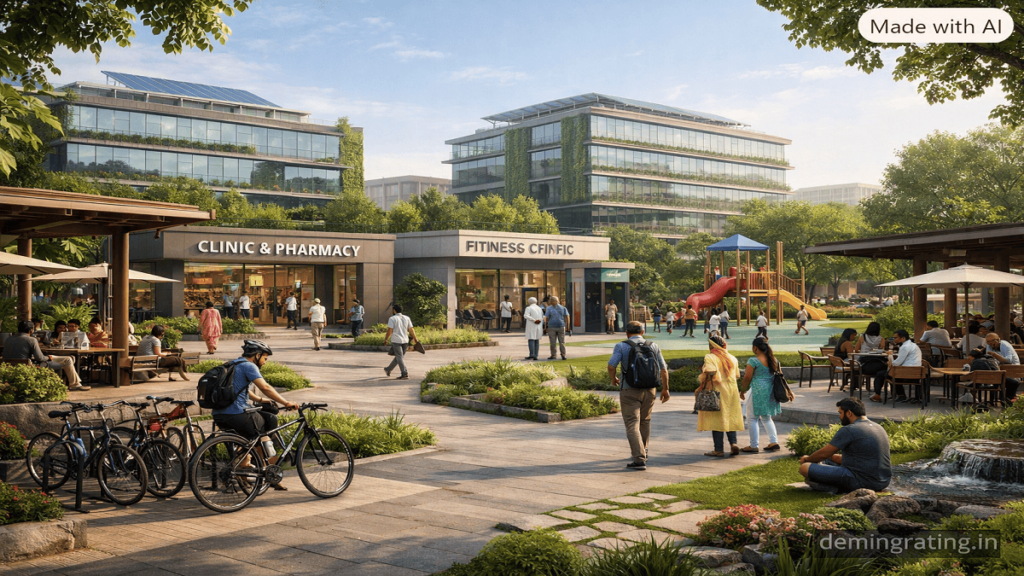
How Do Basic Amenities Contribute to Occupant Health, Comfort, and Well-Being?
Basic amenities play an important role in creating buildings and communities that are healthy, comfortable, convenient, and supportive of occupant well-being. In green building design, amenities are not considered merely additional facilities; their location, accessibility, and usability can influence how people travel, exercise, interact, and manage their everyday needs. The Global Green Building Council (GGBC) identifies occupant health, happiness, and well-being as important outcomes of green building practices.
One of the primary benefits of accessible amenities is improved physical health. Facilities such as parks, gardens, fitness centres, walking areas, healthcare facilities, and pharmacies can make healthy activities and essential services easier to access. When everyday destinations are located close to a building, occupants may be more likely to walk or cycle rather than depend on private vehicles. This can encourage physical activity while reducing exposure to traffic-related pollution and the health impacts associated with excessive vehicle use.
Green and recreational spaces can provide additional physical and psychological benefits. Parks, gardens, and landscaped areas offer opportunities for walking, relaxation, recreation, and social interaction. The World Health Organization reports that exposure to green spaces is associated with benefits including improved mental health, physical activity, cardiovascular health, and social well-being.
Basic amenities also improve comfort and convenience. Easy access to grocery stores, restaurants, banks, childcare facilities, healthcare services, and other daily necessities reduces the time and effort occupants need to spend travelling for routine activities. This can create a more convenient living or working environment and contribute to better work-life balance.
From a mental well-being perspective, accessible community facilities can help reduce stress and encourage social interaction. Shared parks, recreational facilities, cafeterias, and community spaces provide opportunities for occupants to interact with neighbours and colleagues. A well-connected environment can therefore support a stronger sense of community and belonging.
Amenities can also contribute to safety and resilience. Nearby healthcare facilities, adequate lighting, accessible pathways, and well-maintained public areas can make the surrounding environment safer and easier to navigate. Inclusive planning should consider the needs of children, older adults, and people with disabilities.
Ultimately, basic amenities support a holistic approach to green building design. GGBC’s Health & Well-being rating framework similarly focuses on physical, emotional, intellectual, and social aspects of occupant well-being, demonstrating that a healthy building should address more than energy and water efficiency alone.
Therefore, thoughtfully planned basic amenities can improve health, comfort, convenience, social connection, and overall quality of life. When combined with good indoor environmental quality, efficient resource use, safe access, and sustainable site planning, they help create buildings that are not only environmentally responsible but also genuinely people-centric.
Relevant external resources:
- GGBC Green New Buildings Rating System
- GGBC Health & Well-being Rating
- WHO – Green Spaces and Health
- WHO – Urban Green Spaces and Health
#BuildingSustainability
How Can Basic Amenities Be Designed and Managed to Support Sustainability Goals?
Basic amenities can play a significant role in achieving sustainability goals when they are planned not only for convenience but also for efficient resource use, accessibility, environmental protection, and long-term operational performance. In green building development, amenities should be integrated into the overall site and building strategy so that they support both occupant needs and environmental objectives. The Global Green Building Council (GGBC) emphasizes sustainable architecture, site planning, water conservation, energy efficiency, resource management, and occupant well-being as key components of green building design.
The first step is strategic location and accessibility. Essential facilities such as grocery stores, healthcare services, pharmacies, banks, restaurants, parks, and fitness centres should be located within convenient walking distance wherever possible. The draft GGBC Green New Buildings Version 4, for example, proposes access to at least seven basic amenities within 800 metres of the building entrance. This approach is intended to reduce dependence on automobiles and the environmental impacts associated with transportation.
Amenities should also be designed to minimise energy and water consumption. Energy-efficient LED lighting, occupancy sensors, efficient appliances, natural ventilation, daylighting, and renewable energy systems can reduce electricity demand. Water-efficient fixtures, rainwater harvesting, wastewater treatment, and water reuse can reduce potable water consumption. These strategies should be supported by regular monitoring to identify leaks, excessive consumption, or equipment inefficiencies.
Sustainable waste management is another important consideration. Amenity areas should provide suitable facilities for waste segregation, recycling, composting, and responsible disposal. Clearly labelled collection points can make waste segregation easier for occupants and staff. Organic waste from cafeterias or landscaped areas can potentially be composted and reused as a soil amendment.
The surrounding environment should incorporate green infrastructure and sustainable mobility. Parks, landscaped areas, shaded pedestrian pathways, bicycle facilities, permeable surfaces, and native vegetation can improve the microclimate while encouraging walking and cycling. GGBC notes that locating amenities near buildings and providing safe pedestrian pathways can encourage walking, conserve commuting fuel, reduce vehicular pollution, and improve community interaction.
Finally, sustainability depends on effective operation and maintenance. Facility managers should establish maintenance schedules, monitor energy and water performance, inspect equipment regularly, and obtain feedback from occupants. Amenities that are poorly maintained can lose both their environmental and social value. GGBC’s Green Existing Buildings O&M framework specifically focuses on sustaining green performance through ongoing facility management.
In summary, sustainable basic amenities should be well located, resource efficient, accessible, inclusive, environmentally responsible, and properly maintained. When these principles are incorporated from the planning stage through daily operations, amenities can reduce environmental impacts while improving convenience, health, and quality of life for occupants.
Relevant external resources:
- GGBC Green New Buildings Rating System
- GGBC Green New Buildings Version 4 – Draft Rating System
- GGBC Green Existing Buildings O&M
- United Nations – Sustainable Cities and Communities
#SustainableDevelopment
What Are the Key Considerations for Ensuring Adequate Basic Amenities in GGBC Projects?
Ensuring adequate basic amenities is an important consideration in green building projects because sustainable development should address both environmental performance and the everyday needs of occupants. In this context, “GGBC” is commonly used in discussions of green building criteria, while the relevant Indian framework is generally the Global Green Building Council (GGBC) rating systems. The exact requirements depend on the building typology and rating-system version. For example, the GGBC Green New Buildings framework includes Basic Amenities under Site Selection and Planning, with the objective of reducing the environmental impacts associated with automobile use.
1. Accessibility and Proximity
The first consideration is the location of essential services. Under the GGBC Green New Buildings Version 3 criteria, projects should have access to at least seven basic amenities within a walking distance of 1 kilometre from the building entrance. The listed amenities include banks or ATMs, healthcare facilities, grocery stores, pharmacies, parks, restaurants, fitness centres, courier services, and utility bill payment centres. The draft Version 4 proposes a more stringent 800-metre walking-distance criterion and updates the amenity list.
2. Availability and Functionality
Amenities should be functional when the project is completed. Merely identifying a proposed facility on a future development plan may not be sufficient for compliance. GGBC also states that amenities should be accessible to building occupants and other users, while facilities located within the project campus can also be considered.
3. Variety of Services
A well-planned project should consider a balanced range of amenities addressing healthcare, daily shopping, banking, recreation, food, transportation-related needs, and community services. The selection should reflect the requirements of the expected occupant population rather than focusing only on the minimum number required for certification.
4. Walkability and Safe Access
The route to amenities should be convenient and safe. Projects should consider pedestrian pathways, lighting, accessibility, shading, crossings, and universal access. Providing amenities nearby is most effective when occupants can realistically reach them without depending on private vehicles.
5. Sustainability and Resource Efficiency
Amenities should themselves follow green design principles. Energy-efficient lighting and equipment, water-efficient fixtures, renewable energy where feasible, waste segregation, recycling facilities, and environmentally responsible landscaping can reduce their operational impact. This supports GGBC broader objectives of reducing resource consumption while improving occupant health and well-being.
6. Documentation and Verification
Projects seeking certification should maintain appropriate maps, distance measurements, photographs, and supporting documentation demonstrating the location and availability of amenities. The precise documentation requirements vary by rating system.
Ultimately, adequate amenities should be planned as part of the overall site strategy rather than added as an afterthought. The best approach combines proximity, accessibility, functionality, inclusivity, occupant needs, sustainability, and proper maintenance. This ensures that basic amenities contribute not only to rating compliance but also to a more convenient, healthier, connected, and sustainable built environment.
Relevant external resources:
- GGBC Green New Buildings Rating System
- GGBC Green Homes Rating System
- GGBC Green Campus Rating System
#GreenArchitecture
Case Study of GGBC Basic Amenities
A practical way to understand the importance of basic amenities in green building projects is to examine how an GGBC-rated development can integrate essential services into its site planning. In this context, “GGBC” is generally intended to refer to green building criteria associated with the Global Green Building Council (GGBC). The exact requirements vary according to the applicable GGBC rating system and version. The current GGBCGreen New Buildings programme covers aspects such as sustainable site planning, water conservation, energy efficiency, materials, indoor environmental quality, and occupant well-being.
Consider a hypothetical multi-storey commercial office development located within an established urban area. During site selection, the project team evaluates the availability of essential services surrounding the proposed building. Rather than selecting a remote site that would require employees to travel long distances for everyday needs, the team chooses a location with several services within convenient walking distance.
Under the GGBC Green New Buildings Version 3 criteria, a project could demonstrate compliance by having access to at least seven basic amenities within a walking distance of 1 kilometre from the building entrance. Examples include an ATM or bank, clinic or hospital, grocery store, pharmacy, park or garden, restaurant or cafeteria, fitness centre, post office or courier service, and utility bill payment centre. Amenities must be functional at project completion and accessible to building occupants and other users.
For example, the selected office project could have a bank, pharmacy, supermarket, restaurant, public park, fitness centre, and healthcare clinic within the required walking distance. The project team can document these facilities through a scaled site or location map, distance measurements, photographs, and other evidence required by the applicable certification process.
This arrangement provides several sustainability benefits. Employees can walk to lunch, banking facilities, pharmacies, shops, or recreational areas instead of using cars or two-wheelers. This can reduce unnecessary vehicle trips, fuel consumption, traffic congestion, and transportation-related emissions. At the same time, nearby parks and fitness facilities can encourage physical activity and contribute to occupant well-being.
The project can further strengthen its sustainability performance by providing safe pedestrian pathways, bicycle parking, shaded walkways, efficient lighting, waste segregation facilities, and water-efficient infrastructure. These measures ensure that the amenities are not only nearby but also convenient and environmentally responsible.
It is important to note that GGBC requirements are evolving. The GGBC Green New Buildings Version 4 uses an 800-metre walking-distance criterion for its Basic Amenities option and includes services such as stationery/printing stores, fuel stations, and vehicle repair or service centres in its listed amenities. Projects should therefore always verify the rating-system version applicable to their registration and certification.
This case study demonstrates that basic amenities are not simply a checklist for certification. When strategically planned, they become part of a broader sustainable development strategy that promotes walkability, reduced automobile dependence, occupant convenience, health, and community connectivity.
Relevant external resources:
- GGBC Green New Buildings Rating System
- GGBC Green New Buildings Rating System – Version 3 Reference Guide
- GGBC Green New Buildings – Version 4 Draft
- GGBC Green Campus Rating System
#SustainableBuilding
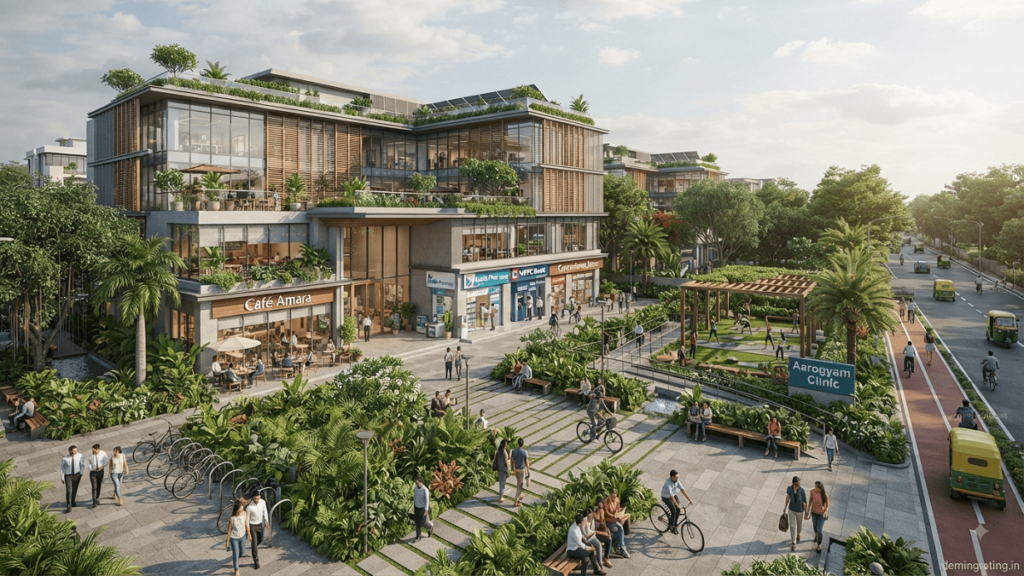
White Paper on GGBC Basic Amenities
Executive Summary
Basic amenities are an important component of sustainable building and site planning because they connect environmental performance with the everyday needs of building occupants. In this white paper, “GGBC” is understood in the context of green building criteria associated with the Global Green Building Council (GGBC). Global Green Building Council (GGBC) Green New Buildings rating system considers sustainable site planning, water conservation, energy efficiency, materials and resources, indoor environmental quality, and occupant well-being as integral parts of green building performance.
The purpose of providing basic amenities near a building is not simply to improve convenience. Convenient access to frequently used services can reduce unnecessary automobile trips, support walking, improve community connectivity, and contribute to occupant health and quality of life. Under the GGBC Green New Buildings Version 3 framework, the Basic Amenities credit requires access to at least seven specified amenities within a walking distance of 1 kilometre from the building entrance. The listed facilities include banks or ATMs, healthcare facilities, schools or crèches, grocery stores, pharmacies, parks, restaurants, fitness centres, courier services, hotels, theatres, and utility bill payment centres.
Strategic Importance of Basic Amenities
A sustainable building should be evaluated in relation to its surrounding environment rather than as an isolated structure. Locating buildings close to essential services can reduce dependence on private vehicles for routine activities. This supports lower fuel consumption and can help reduce transportation-related emissions.
Basic amenities can also contribute to health and well-being. Access to parks, gardens, fitness centres, healthcare services, pharmacies, and pedestrian-friendly routes creates opportunities for physical activity and convenient access to essential services. GGBC identifies improved occupant health, happiness, well-being, safety, and indoor environmental quality among the broader benefits of green buildings.
Key Planning Considerations
Effective planning should begin during site selection. Project teams should map existing amenities, verify walking distances, assess accessibility, and determine whether facilities will remain functional when the project becomes operational. Under the Version 3 criterion, amenities must be functional at project completion and accessible to building occupants and other users. Amenities located within the project campus can also be considered.
Projects should also provide safe and convenient pedestrian connections. Sidewalks, crossings, lighting, shading, universal accessibility, bicycle infrastructure, and clear wayfinding can make nearby amenities genuinely usable rather than merely satisfying a distance-based requirement.
Sustainability and Management
The amenities themselves should operate sustainably. Energy-efficient lighting and equipment, water-efficient fixtures, waste segregation, recycling, renewable energy where appropriate, and responsible landscape management can reduce their environmental footprint. Facility managers should monitor energy and water consumption, conduct preventive maintenance, and periodically evaluate occupant feedback.
This operational perspective is particularly important because sustainability must continue after construction. GGBC Green Existing Buildings O&M system focuses on maintaining green performance over the long term while addressing resource conservation and occupant quality of life.
Current Regulatory and Rating Context
Project teams should verify the exact rating-system version applicable to their project before using Basic Amenities as a compliance criterion. GGBC official Green New Buildings page states that Version 3 registration was available until April 30, 2026, and projects applying for pre-certification or certification from May 1, 2026 are required to follow Version 4.
Conclusion
Basic amenities should therefore be viewed as a strategic element of sustainable development rather than a simple certification checklist. Properly planned amenities can improve accessibility, reduce automobile dependence, encourage healthier lifestyles, strengthen community connectivity, and improve occupant satisfaction. Their effectiveness depends on proximity, functionality, safe access, inclusivity, resource efficiency, and long-term management.
For developers, architects, facility managers, and sustainability professionals, the key objective should be to create developments where essential services are accessible, environmentally responsible, and integrated with the daily life of occupants. This approach ensures that green building principles deliver measurable environmental benefits while also creating healthier and more livable communities.
Relevant External Resources
- GGBC Green New Buildings Rating System
- GGBC Green New Buildings Reference Guide – Basic Amenities
- GGBC Green Existing Buildings O&M
- Indian Green Building Council – Official Website
#BasicAmenities
Industry Application of GGBC Basic Amenities
Basic amenities have an important practical application across the building and construction industry because they connect sustainable site planning with the everyday needs of occupants. In the context of green building certification in India, the relevant framework is generally associated with the Global Green Building Council (GGBC). GGBC Green New Buildings rating system applies to a wide range of building types, including offices, IT parks, banks, shopping malls, hotels, airports, stadiums, convention centres, libraries, and museums. (GGBC)
Application in Commercial and Corporate Buildings
For offices and commercial developments, basic amenities can be incorporated into site-selection and master-planning decisions. Banks, ATMs, restaurants, grocery stores, pharmacies, healthcare facilities, fitness centres, parks, and courier services located close to the development can reduce the need for occupants to make separate vehicle trips. Under the GGBC Green New Buildings Version 4 framework, the Basic Amenities option requires access to at least seven listed amenities within an 800-metre walking distance from the building entrance. The amenities must be functional at project completion and accessible to occupants and other users.
This approach is particularly valuable for IT parks and large office campuses, where thousands of employees may otherwise depend on private vehicles for routine services. Providing or integrating amenities within the campus can support walkability and improve employee convenience.
Application in Industrial and Factory Buildings
The industrial sector has a different set of requirements because workers may spend long periods inside factory premises. The GGBC Green Factory Building rating system specifically addresses basic amenities as part of Site Selection and Planning. Its requirements can include amenities available within a defined distance from the factory as well as in-situ facilities such as first-aid medical facilities, crèches, lockers and showers, canteens, resting rooms, and gymnasiums.
This demonstrates that basic amenities in industrial projects should address both sustainability and employee welfare, health, safety, and productivity.
Application in Campuses and Large Developments
Educational, administrative, institutional, and mixed-use campuses can integrate amenities into their master plans. The GGBC Green Campus rating system covers administrative campuses, educational campuses, IT parks, convention centres, leisure and recreational campuses, and other large-scale developments. Its objectives include improving health and well-being, reducing environmental impacts, and creating sustainable operational environments. (GGBC Green Campus)
In such projects, amenities can be distributed strategically so that occupants can reach essential services through pedestrian routes rather than relying on vehicles.
Application in Project Planning and Management
From an industry perspective, successful implementation requires early planning, mapping, accessibility assessment, documentation, and operational management. Architects and sustainability consultants should identify nearby facilities during site selection, while developers should verify walking routes and ensure that proposed on-site amenities will be operational at completion.
The wider industry benefit is significant: well-planned amenities can support walkable communities, reduce automobile dependence, improve occupant satisfaction, encourage physical activity, and strengthen the social value of green buildings. They can also increase the practical attractiveness of commercial and industrial developments by making everyday services more accessible.
Overall, GGBC Basic Amenities should be treated as a strategic planning tool rather than merely a certification requirement. Their application across commercial, industrial, institutional, and campus projects demonstrates how green building principles can deliver environmental benefits while simultaneously improving convenience, employee welfare, accessibility, and quality of life.
Relevant external resources:
- GGBC Green New Buildings
- GGBC Green Factory Buildings
- GGBC Green Campus
- GGBC Green New Buildings Version 4 Draft
#GreenBuilding
Ask FAQs
What are basic amenities in GGBC green building projects?
Basic amenities are essential services and facilities that improve convenience, accessibility, health, and quality of life for building occupants. Depending on the applicable GGBC rating system, these may include banks or ATMs, healthcare facilities, grocery stores, pharmacies, parks, restaurants, fitness centres, schools or crèches, courier services, and utility services. The specific requirements and distance criteria depend on the rating-system version and building category.
Why are basic amenities important for green buildings?
Basic amenities support sustainability by making essential services accessible without requiring occupants to travel long distances by private vehicles. This can help reduce fuel consumption, traffic congestion, and transportation-related emissions. Nearby parks, healthcare facilities, fitness centres, and pedestrian-friendly services can also support physical activity, convenience, and occupant well-being. Therefore, basic amenities contribute to the social and environmental objectives of green building development.
How are basic amenities evaluated under GGBC?
Evaluation depends on the applicable GGBC rating system and version. For example, the GGBC Green New Buildings framework includes Basic Amenities under Site Selection and Planning. Earlier versions required access to specified amenities within a 1-kilometre walking distance, while newer requirements may use different distances and amenity categories. Projects may need to provide documentation such as location maps, walking-distance calculations, photographs, and evidence that the facilities are functional. Project teams should always verify the current requirements applicable to their certification.
Can amenities located within the project site be considered?
Yes, depending on the applicable GGBC rating criteria, amenities provided within the project campus may contribute toward meeting the Basic Amenities requirement. Examples can include restaurants, fitness facilities, healthcare services, recreational areas, banking facilities, and other essential services. Providing amenities within the development can be particularly beneficial for large office campuses, industrial facilities, residential developments, and mixed-use projects because it can reduce the need for occupants to make separate trips outside the site.
How can developers improve the sustainability of basic amenities?
Developers can integrate amenities with sustainable site planning by providing safe pedestrian pathways, bicycle facilities, shaded walkways, energy-efficient lighting, water-efficient fixtures, waste segregation, and accessible facilities. Amenities should also be properly maintained and monitored throughout the building’s operational life. Combining convenient access with energy efficiency, water conservation, waste management, universal accessibility, and occupant-focused design ensures that basic amenities provide long-term environmental and social benefits.
Table of Contents
Disclaimer: GGBC requirements may vary by rating system, project type, and applicable standards. Always verify the latest official guidelines before implementation or certification.