WRAP Audit & Compliance
Overview
WRAP Audit & Compliance refers to the processes, controls, and governance practices that ensure an organization’s systems, applications, and operations comply with internal policies, industry regulations, and applicable legal requirements. A well-defined audit and compliance framework helps organizations maintain transparency, reduce operational risks, protect sensitive information, and demonstrate accountability to stakeholders and regulatory authorities.
In enterprise environments, WRAP Audit & Compliance typically focuses on monitoring system activities, validating adherence to security policies, maintaining comprehensive audit logs, and ensuring continuous compliance through periodic assessments and automated controls.
Objectives
The primary objectives of WRAP Audit & Compliance include:
- Ensure compliance with organizational policies and regulatory requirements.
- Maintain comprehensive audit trails for system activities WRAP Audit and user actions.
- Detect and report unauthorized or suspicious activities.
- Support internal and external audits with accurate and verifiable records.
- Strengthen security, governance, and risk management practices.
- Improve operational transparency and accountability.
Key Components
1. Audit Logging
Audit logging captures critical system events, WRAP Audit including:
- User authentication and login attempts
- Data creation, modification, and deletion
- Configuration changes
- Administrative activities
- Access to sensitive resources
- System errors and security events
Comprehensive audit logs provide traceability and support forensic investigations during security incidents.
2. Compliance Monitoring
Compliance monitoring involves continuously evaluating whether systems and business processes adhere to:
- Internal security policies
- Corporate governance standards
- Regulatory requirements
- Industry best practices
Automated monitoring helps identify policy violations and enables timely corrective actions.
3. Access Control Reviews
Regular access reviews ensure that:
- Users have appropriate permissions.
- Privileged accounts are monitored.
- Role-based access control (RBAC) policies are enforced.
- Unnecessary or inactive accounts are removed.
This minimizes the risk of unauthorized access to sensitive information.
4. Risk Assessment
Risk assessments identify vulnerabilities and evaluate their potential impact on organizational operations. They typically include:
- Threat identification
- Vulnerability analysis
- Risk prioritization
- Mitigation planning
- Continuous monitoring
5. Reporting and Documentation
Accurate documentation is essential for demonstrating compliance. Reports generally include:
- Audit findings
- Compliance status
- Policy violations
- Risk assessments
- Corrective actions
- Evidence supporting compliance activities
Benefits
Implementing a robust WRAP Audit & Compliance framework offers several benefits:
- Improved regulatory compliance
- Enhanced data security
- Increased operational transparency
- Better risk management
- Faster incident investigation
- Reduced likelihood of compliance violations
- Improved stakeholder confidence
- Streamlined audit preparation
Best Practices
Organizations should adopt the following best practices:
- Enable detailed audit logging across all critical systems.
- Implement least-privilege access controls.
- Conduct periodic compliance assessments.
- Automate compliance monitoring where possible.
- Regularly review and retain audit logs according to policy.
- Perform internal audits before external assessments.
- Establish clear incident response procedures.
- Keep policies and compliance documentation up to date.
- Train employees on compliance requirements and security responsibilities.
Common Compliance Standards
Depending on the industry, organizations may align their audit WRAP Audit and compliance processes with recognized standards and regulations, including:
- ISO/IEC 27001 – Information Security Management Systems
- NIST Cybersecurity Framework (CSF)
- SOC 2 (System and Organization Controls)
- General Data Protection Regulation (GDPR)
- Health Insurance Portability and Accountability Act (HIPAA)
- Payment Card Industry Data Security Standard (PCI DSS)
Challenges
Organizations commonly face the following challenges:
- Managing large volumes of audit data
- Keeping pace with evolving regulatory requirements
- Ensuring consistent policy enforcement
- Integrating compliance across multiple systems
- Managing privileged user access
- Maintaining accurate documentation
- Balancing security requirements with business operations
Conclusion
WRAP Audit & Compliance is a critical component of organizational governance and information security. By implementing comprehensive audit logging, continuous compliance monitoring, effective access controls, and regular risk assessments, organizations can improve security, satisfy regulatory obligations, WRAP Audit and strengthen operational resilience. A proactive audit and compliance strategy not only reduces organizational risk but also builds trust with customers, partners, and regulatory authorities.
References
- National Institute of Standards and Technology (NIST) Cybersecurity Framework: https://www.nist.gov/cyberframework
- ISO/IEC 27001 Information Security Management: https://www.iso.org/isoiec-27001-information-security.html
- Center for Internet Security (CIS) Controls: https://www.cisecurity.org/controls
- ISACA – Audit and Assurance Resources: https://www.isaca.org/resources
- PCI Security Standards Council: https://www.pcisecuritystandards.org
- European Commission – General Data Protection Regulation (GDPR): https://commission.europa.eu/law/law-topic/data-protection_en
- U.S. Department of Health & Human Services – HIPAA: https://www.hhs.gov/hipaa/index.html
What is a WRAP Audit?
A WRAP audit is a formal assessment conducted to evaluate whether an organization complies with the standards established by the Worldwide Responsible Accredited Production (WRAP) program. WRAP is an independent, globally recognized certification program that promotes lawful, ethical, humane, WRAP Audit and safe manufacturing practices, primarily within the apparel, footwear, and sewn products industries.
The audit verifies that a manufacturing facility operates in accordance with WRAP’s 12 Principles, which cover labor practices, workplace safety, environmental responsibility, and legal compliance. Successfully passing a WRAP audit demonstrates a company’s commitment to responsible manufacturing WRAP Audit and social compliance.
Purpose of a WRAP Audit
The primary objectives of a WRAP audit are to:
- Verify compliance with ethical manufacturing standards.
- Ensure workers are treated fairly WRAP Audit and provided with safe working conditions.
- Assess adherence to local labor laws and international best practices.
- Evaluate environmental and health & safety management practices.
- Demonstrate responsible business practices to customers, brands, and stakeholders.
- Support continuous improvement in workplace conditions and operational processes.
Key Areas Evaluated
A WRAP audit assesses a facility against the following core principles:
- Compliance with laws and workplace regulations.
- Prohibition of forced or compulsory labor.
- Prohibition of child labor.
- Prevention of harassment and abuse.
- Fair compensation and benefits.
- Reasonable working hours.
- Freedom of association and collective bargaining.
- Health and workplace safety.
- Environmental management.
- Customs compliance.
- Security.
- Proper management systems and documentation.
Audit Process
A typical WRAP audit consists of several stages:
- Application and Self-Assessment – The facility applies for certification and completes a self-evaluation.
- On-Site Audit – An independent, WRAP-accredited monitoring firm conducts a comprehensive assessment of the facility.
- Document Review – Auditors examine payroll records, employment contracts, health and safety documentation, environmental records, and company policies.
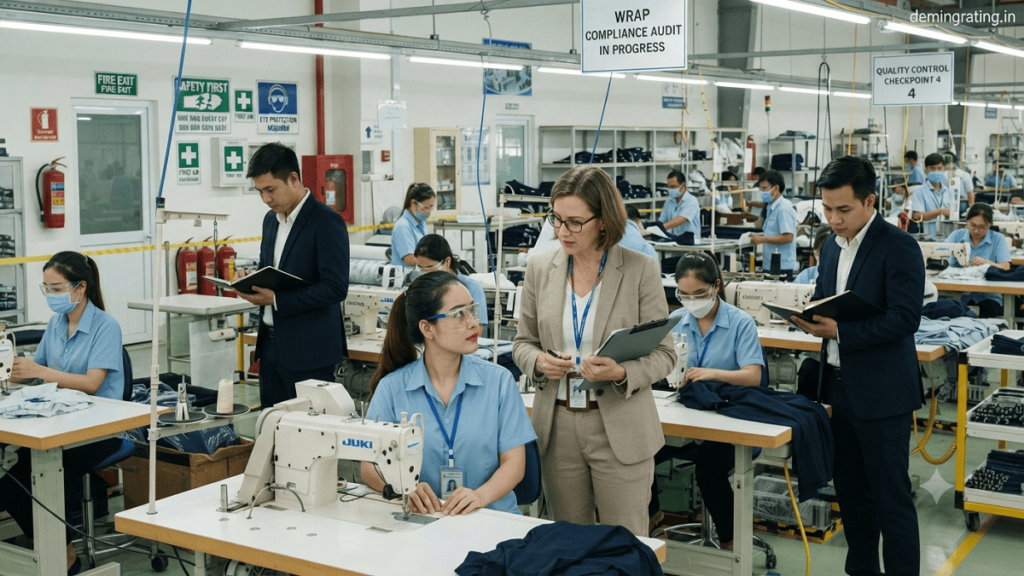
- Facility Inspection – Production areas, warehouses, emergency exits, safety equipment, and employee facilities are inspected.
- Worker Interviews – Confidential interviews are conducted to verify working conditions and labor practices.
- Audit Report – Findings are documented, including any non-conformities.
- Corrective Actions – The facility addresses identified issues before certification is granted, if required.
- Certification Decision – WRAP reviews the audit results and determines whether certification should be awarded.
Benefits of WRAP Certification
Organizations that successfully complete a WRAP audit benefit from:
- Enhanced credibility with global brands and retailers.
- Improved compliance with labor and ethical standards.
- Reduced operational and reputational risks.
- Better workplace safety and employee welfare.
- Increased customer confidence and market competitiveness.
- Demonstrated commitment to responsible and sustainable manufacturing.
Importance of WRAP Audits
Many international retailers and brand owners require suppliers to obtain WRAP certification as part of their responsible sourcing programs. A successful WRAP audit provides independent verification that a manufacturing facility follows internationally recognized ethical standards, helping organizations strengthen supply chain transparency and maintain long-term business relationships.
References
- Worldwide Responsible Accredited Production (WRAP) Official Website
- WRAP Principles
- WRAP Certification Process
- International Labour Organization (ILO) – International Labour Standards
- OECD Due Diligence Guidance for Responsible Business Conduct
What are WRAP Compliance Requirements?
WRAP (Worldwide Responsible Accredited Production) compliance requirements are a set of internationally recognized standards that manufacturing facilities must meet to achieve and maintain WRAP certification. These requirements are based on ethical labor practices, workplace safety, environmental responsibility, legal compliance, and secure manufacturing operations.
To become WRAP certified, a facility must demonstrate compliance with the 12 WRAP Principles, maintain supporting documentation, and successfully complete an independent third-party audit conducted by a WRAP-accredited monitoring organization.
The 12 WRAP Compliance Requirements
1. Compliance with Laws and Workplace Regulations
Facilities must comply with all applicable local, national, and international laws governing employment, workplace safety, environmental protection, and business operations.
2. Prohibition of Forced or Compulsory Labor
Employees must work voluntarily without coercion, debt bondage, human trafficking, or involuntary prison labor. Workers must be free to terminate employment according to applicable laws and contractual agreements.
3. Prohibition of Child Labor
Facilities must not employ workers below the legal minimum working age established by national law or international labor standards. Effective age verification procedures must be implemented during recruitment.
4. Prohibition of Harassment or Abuse
Organizations must provide a workplace free from physical, psychological, verbal, or sexual harassment, abuse, intimidation, or discrimination. Employees must be treated with dignity and respect.
5. Compensation and Benefits
Workers must receive wages, overtime compensation, and benefits that meet or exceed legal minimum requirements. Compensation practices should be transparent and accurately documented.
6. Hours of Work
Working hours, overtime, and rest periods must comply with applicable labor laws. Overtime should be voluntary whenever required by law, and employees must receive appropriate breaks and leave.
7. Prohibition of Discrimination
Employment decisions—including hiring, promotion, compensation, training, and termination—must be based on qualifications and performance without discrimination based on race, gender, religion, age, disability, nationality, or other legally protected characteristics.
8. Health and Safety
Facilities must maintain a safe and healthy work environment by implementing:
- Occupational health and safety policies
- Emergency preparedness and response plans
- Fire prevention and protection systems
- Personal protective equipment (PPE)
- Machine safety controls
- First aid facilities
- Regular safety training
9. Freedom of Association and Collective Bargaining
Workers must have the right to associate freely, join worker organizations, and participate in collective bargaining where permitted by law, without fear of retaliation or discrimination.
10. Environment
Organizations must comply with environmental regulations by implementing responsible practices for:
- Waste management
- Pollution prevention
- Hazardous material handling
- Resource conservation
- Environmental monitoring and reporting
11. Customs Compliance
Facilities involved in international trade must maintain accurate import and export documentation and comply with customs regulations to prevent illegal trade practices and supply chain violations.
12. Security
Organizations must establish security measures to protect facilities, employees, products, and supply chains against theft, tampering, unauthorized access, and other security threats.
Supporting Documentation Required
To demonstrate compliance during a WRAP audit, facilities are typically expected to maintain documentation such as:
- Employee personnel records
- Payroll and wage records
- Attendance and working hour logs
- Employment contracts
- Health and safety policies
- Emergency evacuation plans
- Training records
- Environmental permits and monitoring records
- Equipment maintenance logs
- Risk assessments
- Corrective action reports
- Internal audit reports
Continuous Compliance
WRAP compliance is an ongoing process rather than a one-time certification. Organizations are expected to:
- Conduct regular internal compliance assessments.
- Maintain accurate and up-to-date records.
- Address non-conformities through corrective actions.
- Provide continuous employee training.
- Monitor workplace conditions and legal requirements.
- Prepare for periodic third-party surveillance or recertification audits.
Benefits of Meeting WRAP Compliance Requirements
Organizations that meet WRAP compliance requirements can achieve several business and operational advantages, including:
- Demonstrated commitment to ethical manufacturing practices.
- Improved worker health, safety, and welfare.
- Enhanced supply chain transparency and accountability.
- Reduced legal, operational, and reputational risks.
- Increased confidence among customers, brands, and business partners.
- Improved eligibility to work with global retailers and sourcing organizations that require recognized social compliance certifications.
Conclusion
WRAP compliance requirements provide a comprehensive framework for responsible manufacturing by promoting legal compliance, ethical labor practices, workplace safety, environmental stewardship, and secure business operations. By adhering to the 12 WRAP Principles and maintaining effective management systems, organizations can strengthen governance, improve operational performance, and demonstrate their commitment to responsible and sustainable manufacturing.
References
- Worldwide Responsible Accredited Production (WRAP) – 12 Principles
- WRAP Certification Program
- International Labour Organization (ILO) – International Labour Standards
- ISO 45001 – Occupational Health and Safety Management Systems
- ISO 14001 – Environmental Management Systems
How to Prepare for a WRAP Audit
Preparing for a Worldwide Responsible Accredited Production (WRAP) audit requires organizations to establish robust management systems, ensure compliance with the 12 WRAP Principles, and maintain accurate documentation that demonstrates adherence to ethical, legal, environmental, and workplace safety standards. Effective preparation not only improves the likelihood of achieving WRAP certification but also strengthens overall operational performance and supply chain transparency.
1. Understand the WRAP Principles
Begin by thoroughly reviewing the 12 WRAP Principles and understanding how they apply to your organization’s operations. Ensure that management and employees are familiar with the requirements related to:
- Legal compliance
- Forced and child labor prevention
- Workplace safety
- Fair wages and working hours
- Environmental responsibility
- Freedom of association
- Security and customs compliance
2. Conduct a Gap Assessment
Perform an internal assessment to identify areas where current practices may not fully comply with WRAP requirements. Evaluate:
- Company policies and procedures
- Labor practices
- Health and safety measures
- Environmental management
- Security controls
- Documentation and recordkeeping
Document all findings and prioritize corrective actions before the official audit.
3. Review Company Policies
Ensure that all workplace policies are current, documented, and communicated to employees. Policies should cover:
- Code of conduct
- Anti-harassment and anti-discrimination
- Child labor prevention
- Forced labor prohibition
- Health and safety
- Environmental protection
- Working hours and overtime
- Employee grievance procedures
Policies should comply with applicable labor laws and WRAP requirements.
4. Verify Employee Records
Auditors typically review personnel documentation. Ensure the following records are complete and accurate:
- Employment contracts
- Employee identification records
- Age verification documents
- Payroll records
- Attendance records
- Working hour logs
- Overtime documentation
- Benefits records
- Leave records
Any inconsistencies should be corrected before the audit.
5. Evaluate Health and Safety Compliance
Inspect the facility to ensure compliance with occupational health and safety requirements. Verify that:
- Emergency exits are clearly marked and unobstructed.
- Fire extinguishers are properly maintained.
- Fire alarms and emergency lighting are functional.
- Emergency evacuation plans are displayed.
- First aid kits are fully stocked.
- Personal protective equipment (PPE) is available and used appropriately.
- Machinery has required safety guards.
- Employees receive regular safety training.
Conduct emergency drills and maintain records of training and inspections.
6. Review Environmental Compliance
Ensure compliance with applicable environmental regulations by reviewing:
- Waste disposal procedures
- Hazardous material storage
- Chemical handling practices
- Environmental permits
- Pollution prevention measures
- Water and energy conservation initiatives
- Environmental monitoring records
Maintain documentation demonstrating compliance with environmental requirements.
7. Assess Working Hours and Compensation
Verify that employee compensation and working hours comply with legal requirements by confirming:
- Wages meet or exceed minimum legal standards.
- Overtime is properly recorded and compensated.
- Working hours comply with applicable labor laws.
- Employees receive legally required rest periods and leave.
- Payroll calculations are accurate and transparent.
8. Train Employees
Employees should understand workplace policies and be prepared to answer auditor questions honestly. Training should cover:
- Company policies
- Worker rights
- Health and safety procedures
- Emergency response
- Grievance mechanisms
- Ethical workplace practices
Conduct refresher training before the audit and document attendance.
9. Organize Documentation
Prepare all documentation in advance to facilitate the audit process. Common documents include:
- Employee records
- Payroll reports
- Attendance logs
- Safety inspection reports
- Training records
- Environmental permits
- Risk assessments
- Internal audit reports
- Corrective action records
- Equipment maintenance logs
- Incident reports
- Organizational policies
Well-organized documentation helps auditors efficiently verify compliance.
10. Conduct an Internal Mock Audit
Perform a mock audit using the WRAP requirements as a checklist. Review:
- Facility conditions
- Documentation
- Worker interviews
- Compliance with company policies
- Health and safety measures
- Environmental practices
Address any identified non-conformities before the official audit.
11. Prepare for Employee Interviews
WRAP auditors commonly conduct confidential employee interviews. Ensure employees understand:
- Their job responsibilities
- Working hours and compensation practices
- Safety procedures
- Complaint reporting mechanisms
- Company policies
Employees should answer questions truthfully without coaching or pressure.
12. Address Corrective Actions
If previous audits identified deficiencies, verify that:
- Corrective actions have been fully implemented.
- Evidence supporting improvements is available.
- Management regularly monitors ongoing compliance.
- Preventive measures have been established to avoid recurrence.
WRAP Audit Preparation Checklist
Use the following checklist before the audit:
- Review the 12 WRAP Principles.
- Conduct a comprehensive internal compliance assessment.
- Update company policies and procedures.
- Verify employee documentation and payroll records.
- Inspect workplace health and safety conditions.
- Confirm environmental compliance.
- Review working hours and wage practices.
- Organize all supporting documentation.
- Train employees on WRAP requirements.
- Perform a mock audit and resolve identified issues.
- Verify implementation of corrective actions.
- Ensure senior management is prepared to support the audit process.
Best Practices
To maintain ongoing WRAP compliance:
- Conduct regular internal compliance reviews.
- Keep documentation accurate and up to date.
- Monitor changes in labor and environmental regulations.
- Provide continuous employee training.
- Maintain transparent communication with workers.
- Implement continuous improvement programs.
- Periodically review health, safety, and environmental performance.
Conclusion
Successful WRAP audit preparation requires proactive planning, strong management commitment, comprehensive documentation, and continuous monitoring of workplace practices. By conducting internal assessments, maintaining compliance with the 12 WRAP Principles, and ensuring employees understand organizational policies, manufacturers can improve audit readiness, minimize non-conformities, and demonstrate their commitment to responsible and ethical manufacturing.
References
- Worldwide Responsible Accredited Production (WRAP) – Certification Process
- WRAP – 12 Principles
- International Labour Organization (ILO) – International Labour Standards
- ISO 45001 – Occupational Health and Safety Management Systems
- ISO 14001 – Environmental Management Systems
- OECD Due Diligence Guidance for Responsible Business Conduct

What Are the Benefits of WRAP Certification?
Worldwide Responsible Accredited Production (WRAP) certification is an internationally recognized certification that verifies a manufacturing facility operates in accordance with ethical labor practices, workplace safety standards, environmental responsibility, and legal compliance. Widely adopted in the apparel, footwear, textiles, and sewn products industries, WRAP certification demonstrates a company’s commitment to responsible manufacturing and sustainable business practices.
Obtaining WRAP certification provides organizations with numerous operational, commercial, and reputational benefits.
1. Demonstrates Commitment to Ethical Manufacturing
WRAP certification confirms that a facility adheres to internationally recognized standards for responsible manufacturing. It assures customers, business partners, and stakeholders that the organization maintains ethical labor practices, respects workers’ rights, and complies with applicable laws.
2. Enhances Brand Reputation
Consumers and global brands increasingly prioritize responsible sourcing. WRAP certification strengthens an organization’s reputation by demonstrating a commitment to transparency, social responsibility, and ethical business conduct, which can improve customer confidence and long-term brand value.
3. Increases Market Access
Many international retailers, brands, and sourcing organizations require suppliers to hold recognized social compliance certifications. WRAP certification can help manufacturers qualify for new business opportunities and expand into global markets where ethical sourcing requirements are mandatory.
4. Improves Workplace Conditions
Compliance with WRAP standards encourages organizations to maintain safe, healthy, and respectful working environments by promoting:
- Occupational health and safety
- Fair wages and benefits
- Reasonable working hours
- Protection from harassment and discrimination
- Proper emergency preparedness
These improvements contribute to higher employee satisfaction and overall workplace well-being.
5. Strengthens Regulatory Compliance
WRAP certification requires facilities to comply with applicable labor, environmental, and business regulations. This helps organizations reduce the risk of legal violations, regulatory penalties, and operational disruptions while supporting ongoing compliance management.
6. Enhances Supply Chain Transparency
WRAP-certified facilities demonstrate accountability throughout their operations by maintaining documented policies, procedures, and records. This improves supply chain visibility and provides customers with greater confidence in sourcing practices.
7. Reduces Business Risk
By implementing structured compliance programs, organizations can reduce risks associated with:
- Labor law violations
- Unsafe working conditions
- Environmental non-compliance
- Reputational damage
- Supply chain disruptions
- Customer audits and corrective actions
A proactive compliance framework supports long-term business resilience.
8. Improves Operational Efficiency
Preparing for and maintaining WRAP certification often leads organizations to standardize processes, improve documentation, strengthen internal controls, and implement continuous improvement initiatives. These practices can increase operational efficiency and reduce process inconsistencies.
9. Supports Environmental Responsibility
WRAP certification promotes responsible environmental management by encouraging facilities to:
- Comply with environmental regulations.
- Reduce waste and pollution.
- Manage hazardous materials safely.
- Improve resource efficiency.
- Implement sustainable operational practices.
These efforts contribute to more sustainable manufacturing operations.
10. Builds Customer and Investor Confidence
Certification from an independent third-party organization demonstrates that a facility has undergone a rigorous evaluation process. This independent verification can strengthen relationships with customers, investors, regulators, and other stakeholders by providing credible evidence of responsible business practices.
11. Encourages Continuous Improvement
WRAP certification is not a one-time achievement. Facilities are expected to maintain compliance through ongoing monitoring, corrective actions, employee training, and periodic reassessments. This continuous improvement approach helps organizations adapt to changing regulatory requirements and evolving industry expectations.
12. Provides a Competitive Advantage
Organizations with WRAP certification can differentiate themselves from competitors by demonstrating compliance with globally recognized ethical manufacturing standards. This distinction can be valuable during supplier evaluations, procurement processes, and contract negotiations.
Summary of Key Benefits
| Benefit | Description |
|---|---|
| Ethical Manufacturing | Demonstrates compliance with responsible labor practices. |
| Brand Reputation | Enhances credibility with customers and stakeholders. |
| Market Access | Meets supplier requirements for global brands and retailers. |
| Workplace Safety | Promotes safer and healthier working environments. |
| Regulatory Compliance | Supports adherence to labor and environmental laws. |
| Supply Chain Transparency | Improves accountability and traceability. |
| Risk Reduction | Minimizes legal, operational, and reputational risks. |
| Operational Efficiency | Strengthens processes, controls, and documentation. |
| Environmental Responsibility | Encourages sustainable manufacturing practices. |
| Competitive Advantage | Differentiates the organization in global markets. |
Conclusion
WRAP certification provides significant value by promoting ethical manufacturing, legal compliance, workplace safety, environmental stewardship, and responsible supply chain management. Beyond meeting customer and regulatory expectations, certification helps organizations improve operational performance, strengthen stakeholder trust, and enhance their competitiveness in the global marketplace. By maintaining compliance with WRAP standards, manufacturers demonstrate a long-term commitment to responsible and sustainable business practices.
References
- Worldwide Responsible Accredited Production (WRAP) – Official Website
- WRAP Certification Program
- WRAP – 12 Principles
- International Labour Organization (ILO) – International Labour Standards
- OECD Due Diligence Guidance for Responsible Business Conduct
- ISO 45001 – Occupational Health and Safety Management Systems
- ISO 14001 – Environmental Management Systems
How Does WRAP Improve Ethical Manufacturing?
Worldwide Responsible Accredited Production (WRAP) improves ethical manufacturing by establishing a globally recognized framework that promotes responsible labor practices, safe working conditions, environmental stewardship, and legal compliance. Through independent third-party audits and continuous compliance monitoring, WRAP helps manufacturers create transparent, accountable, and sustainable operations while protecting the rights and well-being of workers.
By adhering to the 12 WRAP Principles, organizations demonstrate their commitment to ethical manufacturing practices that align with international labor standards and responsible business conduct.
1. Promotes Fair Labor Practices
WRAP requires manufacturers to comply with applicable labor laws and international standards, ensuring that employees are treated fairly throughout their employment.
Key requirements include:
- Payment of lawful wages and benefits
- Compliance with working hour regulations
- Equal employment opportunities
- Protection against discrimination
- Respect for employee rights
These measures help create a fair and equitable workplace.
2. Eliminates Forced and Child Labor
One of WRAP’s primary objectives is to prevent exploitative labor practices. Certified facilities must ensure that:
- Employment is voluntary.
- Workers are free to leave employment in accordance with applicable laws.
- No forced, bonded, or trafficked labor is used.
- Child labor is strictly prohibited.
- Employees meet the legal minimum working age requirements.
These requirements support internationally recognized human rights principles.
3. Improves Workplace Health and Safety
WRAP emphasizes the importance of providing a safe and healthy working environment. Manufacturers are expected to implement comprehensive occupational health and safety programs that include:
- Fire prevention and emergency preparedness
- Safe machinery operation
- Personal protective equipment (PPE)
- First aid facilities
- Workplace hazard assessments
- Employee safety training
These practices reduce workplace accidents and improve employee well-being.
4. Protects Worker Dignity and Rights
Ethical manufacturing extends beyond legal compliance by ensuring workers are treated with dignity and respect. WRAP prohibits:
- Physical abuse
- Verbal harassment
- Psychological intimidation
- Sexual harassment
- Corporal punishment
- Workplace bullying
Organizations must establish grievance mechanisms that allow employees to report concerns without fear of retaliation.
5. Encourages Freedom of Association
WRAP supports employees’ rights to:
- Form or join worker organizations
- Participate in collective bargaining where permitted by law
- Communicate workplace concerns openly
- Engage with management through lawful representation
Respecting these rights contributes to constructive labor-management relationships.
6. Strengthens Environmental Responsibility
Responsible manufacturing includes minimizing environmental impact. WRAP encourages facilities to:
- Comply with environmental regulations.
- Reduce pollution and waste.
- Safely manage hazardous materials.
- Improve energy and resource efficiency.
- Implement sustainable environmental practices.
These efforts help manufacturers operate more responsibly while supporting long-term sustainability goals.
7. Enhances Supply Chain Transparency
WRAP certification requires organizations to maintain accurate records and documented management systems, improving visibility across manufacturing operations. This transparency enables customers, business partners, and regulators to verify that ethical standards are consistently maintained throughout the production process.
8. Promotes Continuous Improvement
Ethical manufacturing is an ongoing commitment rather than a one-time achievement. WRAP encourages organizations to:
- Conduct regular internal compliance assessments.
- Monitor workplace performance.
- Address non-conformities through corrective actions.
- Update policies to reflect changing regulations.
- Provide ongoing employee training.
This continuous improvement approach helps organizations maintain high ethical standards over time.
9. Builds Trust with Customers and Stakeholders
Independent third-party verification through WRAP certification provides assurance that manufacturing facilities comply with recognized ethical standards. This enhances confidence among:
- Global brands
- Retailers
- Investors
- Regulatory authorities
- Employees
- Consumers
As a result, organizations strengthen their reputation and demonstrate accountability.
10. Supports Responsible Global Supply Chains
Many multinational companies require suppliers to meet recognized social compliance standards. WRAP certification helps manufacturers align with responsible sourcing expectations, promoting ethical practices across global supply chains and reducing the risk of labor violations or reputational damage.
Key Contributions of WRAP to Ethical Manufacturing
| Area | How WRAP Contributes |
|---|---|
| Labor Practices | Ensures fair wages, legal working hours, and equal treatment. |
| Human Rights | Prohibits forced labor, child labor, and workplace abuse. |
| Workplace Safety | Promotes safe working environments through health and safety management. |
| Employee Rights | Supports freedom of association and grievance mechanisms. |
| Environmental Responsibility | Encourages compliance with environmental regulations and sustainable practices. |
| Supply Chain Transparency | Improves documentation, traceability, and accountability. |
| Regulatory Compliance | Helps organizations comply with labor, environmental, and business laws. |
| Continuous Improvement | Encourages ongoing monitoring, training, and corrective actions. |
Conclusion
WRAP improves ethical manufacturing by providing a structured framework that integrates responsible labor practices, workplace safety, environmental management, and regulatory compliance into everyday business operations. Through independent audits, comprehensive management systems, and continuous improvement initiatives, WRAP enables manufacturers to protect workers’ rights, strengthen operational integrity, and build transparent, sustainable supply chains. Organizations that adopt WRAP standards are better positioned to meet customer expectations, comply with international regulations, and demonstrate a long-term commitment to ethical and responsible manufacturing.
References
- Worldwide Responsible Accredited Production (WRAP) – Official Website
- WRAP – 12 Principles
- WRAP Certification Process
- International Labour Organization (ILO) – International Labour Standards
- OECD Due Diligence Guidance for Responsible Business Conduct
- United Nations Global Compact – Ten Principles
- ISO 45001 – Occupational Health and Safety Management Systems
- ISO 14001 – Environmental Management Systems
Case Study of WRAP Audit & Compliance
Background
ABC Apparel Manufacturing Ltd. (fictional organization) is a medium-sized garment manufacturer supplying clothing products to international retailers across North America and Europe. As part of its expansion strategy, several global buyers required the company to obtain Worldwide Responsible Accredited Production (WRAP) certification to demonstrate compliance with internationally recognized ethical manufacturing standards.
The organization employed approximately 1,200 workers and operated multiple production lines manufacturing woven garments, knitwear, and uniforms. Prior to the WRAP audit, the company maintained basic labor and safety policies but lacked a structured compliance management system.
Challenges Identified
During the initial internal assessment, the organization identified several compliance gaps:
- Incomplete employee documentation and personnel records.
- Inconsistent recording of employee working hours.
- Limited occupational health and safety training.
- Emergency exit routes partially obstructed by inventory.
- Outdated fire safety equipment inspection records.
- Inadequate documentation for environmental waste disposal.
- No formal grievance mechanism for employees.
- Insufficient internal audit and compliance monitoring procedures.
These issues increased the risk of non-compliance with WRAP’s ethical manufacturing requirements.
WRAP Compliance Strategy
To prepare for certification, senior management established a cross-functional compliance team consisting of representatives from:
- Human Resources
- Production
- Health and Safety
- Quality Assurance
- Environmental Management
- Facility Management
- Senior Leadership
The team developed a six-month compliance improvement program.
Step 1: Policy Development
The organization reviewed and updated its policies to align with the WRAP 12 Principles, including:
- Code of Conduct
- Anti-Harassment Policy
- Child Labor Prevention Policy
- Forced Labor Prevention Policy
- Occupational Health and Safety Policy
- Environmental Management Policy
- Working Hours and Overtime Policy
- Employee Grievance Policy
All policies were translated into local languages and displayed throughout the facility.
Step 2: Employee Training
Comprehensive training sessions were conducted for all employees covering:
- Workplace ethics
- Employee rights and responsibilities
- Fire safety procedures
- Emergency evacuation
- Proper use of Personal Protective Equipment (PPE)
- Reporting workplace concerns
- Environmental awareness
Supervisors received additional training on labor law compliance and documentation requirements.
Step 3: Workplace Safety Improvements
The company implemented several workplace safety enhancements:
- Cleared all emergency exits and evacuation routes.
- Installed updated fire extinguishers and emergency lighting.
- Conducted quarterly fire drills.
- Improved machine guarding.
- Established first aid stations.
- Introduced routine workplace safety inspections.
These improvements significantly reduced workplace hazards.
Step 4: Documentation and Record Management
The compliance team centralized documentation and established standardized procedures for maintaining:
- Employee records
- Payroll documentation
- Attendance logs
- Working hour records
- Safety inspection reports
- Training records
- Environmental monitoring reports
- Equipment maintenance logs
- Internal audit reports
Electronic recordkeeping improved document accuracy and accessibility during audits.
Step 5: Internal Compliance Audit
Before the official WRAP assessment, the organization conducted an internal mock audit that included:
- Facility inspections
- Document reviews
- Employee interviews
- Policy verification
- Health and safety assessments
- Environmental compliance checks
Several minor non-conformities were identified and corrected before the external audit.
WRAP Audit Process
A WRAP-accredited monitoring organization performed an independent third-party audit consisting of:
Document Review
Auditors examined:
- Employment contracts
- Payroll records
- Attendance records
- Safety policies
- Environmental permits
- Training documentation
- Internal audit reports
Facility Inspection
The audit included inspection of:
- Production areas
- Warehouses
- Emergency exits
- Fire protection systems
- Chemical storage areas
- Employee welfare facilities
Employee Interviews
Auditors conducted confidential interviews with employees from multiple departments to verify:
- Working conditions
- Wage payments
- Overtime practices
- Workplace safety
- Awareness of grievance procedures
- Treatment by supervisors
The interviews confirmed that employees understood company policies and reported positive workplace conditions.
Audit Findings
The audit identified only a few minor observations:
- Additional safety signage was recommended in storage areas.
- Periodic refresher training should be scheduled more frequently.
- Environmental monitoring reports required standardized formatting.
No major violations of WRAP principles were identified.
The organization successfully implemented corrective actions within the required timeframe.
Results
Following completion of the audit and corrective action process, the facility achieved WRAP certification.
The certification delivered several measurable benefits:
| Area | Outcome |
|---|---|
| Ethical Compliance | Full alignment with the WRAP 12 Principles. |
| Workplace Safety | Improved emergency preparedness and reduced workplace hazards. |
| Employee Satisfaction | Increased confidence in workplace safety and grievance mechanisms. |
| Operational Efficiency | Standardized documentation and streamlined compliance processes. |
| Customer Confidence | Enhanced credibility with international buyers and sourcing partners. |
| Business Growth | Qualified to participate in supplier programs requiring recognized social compliance certifications. |
| Risk Management | Reduced legal, operational, and reputational risks through improved governance. |
Key Lessons Learned
The implementation of WRAP compliance demonstrated several important lessons:
- Strong leadership commitment is essential for successful certification.
- Regular internal audits help identify compliance issues before external assessments.
- Comprehensive documentation simplifies the audit process.
- Continuous employee training improves awareness of ethical and safety requirements.
- Proactive corrective actions reduce the likelihood of major audit findings.
- Compliance should be integrated into daily operations rather than treated as a one-time certification effort.
Best Practices for Organizations Seeking WRAP Certification
Organizations preparing for WRAP certification should consider the following practices:
- Conduct a comprehensive gap assessment before applying.
- Develop policies aligned with the WRAP 12 Principles.
- Maintain complete and accurate employee records.
- Implement robust occupational health and safety programs.
- Provide ongoing compliance and ethics training.
- Perform periodic internal audits and management reviews.
- Establish clear employee grievance procedures.
- Monitor environmental performance and regulatory compliance.
- Document corrective actions and continuously improve compliance processes.
Conclusion
This case study demonstrates how a structured approach to WRAP Audit & Compliance can help organizations strengthen ethical manufacturing practices, improve workplace safety, and achieve internationally recognized certification. By implementing comprehensive policies, enhancing employee awareness, maintaining accurate documentation, and conducting regular internal audits, organizations can successfully meet WRAP requirements while improving operational efficiency and building trust with customers, employees, and business partners.
References
- Worldwide Responsible Accredited Production (WRAP) – Official Website
- WRAP – 12 Principles
- WRAP Certification Process
- International Labour Organization (ILO) – International Labour Standards
- OECD Due Diligence Guidance for Responsible Business Conduct
- ISO 45001 – Occupational Health and Safety Management Systems
- ISO 14001 – Environmental Management Systems
White Paper on WRAP Audit & Compliance
Executive Summary
As global supply chains become increasingly complex, organizations face growing pressure from regulators, customers, investors, and business partners to demonstrate responsible manufacturing practices. Worldwide Responsible Accredited Production (WRAP) is an internationally recognized certification program that helps manufacturing facilities establish and maintain ethical labor practices, workplace safety, environmental responsibility, and legal compliance through independent third-party audits.
This white paper explores the objectives, principles, audit process, business benefits, implementation strategies, and future outlook of WRAP Audit & Compliance. It also highlights how organizations can strengthen governance, reduce operational risk, improve supply chain transparency, and build stakeholder trust by aligning with WRAP standards.
Introduction
Ethical sourcing and responsible manufacturing have become strategic priorities for organizations operating in global supply chains. Consumers, regulators, and multinational brands increasingly expect manufacturers to uphold human rights, maintain safe working conditions, and minimize environmental impacts.
WRAP Audit & Compliance provides a structured framework for evaluating whether production facilities operate in accordance with internationally recognized workplace standards and applicable legal requirements. Facilities achieving WRAP certification demonstrate their commitment to lawful, humane, safe, and ethical manufacturing practices. WRAP’s certification process is based on independent third-party audits, corrective action verification, and ongoing compliance monitoring.
Understanding WRAP Audit & Compliance
WRAP Audit & Compliance is a comprehensive assessment process that evaluates manufacturing facilities against WRAP’s 12 Principles, which address:
- Legal compliance
- Ethical labor practices
- Worker health and safety
- Environmental responsibility
- Human rights protection
- Security and customs compliance
- Effective management systems
Unlike traditional quality inspections, WRAP audits focus on operational governance, employee welfare, sustainability, and long-term compliance rather than product quality alone. Certification is granted only after identified non-conformities are corrected and verified. Facilities are also subject to ongoing oversight, including possible unannounced post-certification assessments.
The 12 WRAP Principles
The WRAP program evaluates organizations using twelve core principles:
- Compliance with Laws and Workplace Regulations
- Prohibition of Forced Labor
- Prohibition of Child Labor
- Prohibition of Harassment or Abuse
- Compensation and Benefits
- Hours of Work
- Prohibition of Discrimination
- Health and Safety
- Freedom of Association and Collective Bargaining
- Environment
- Customs Compliance
- Security
These principles are informed by international workplace standards and frameworks, including conventions of the International Labour Organization (ILO), the United Nations Guiding Principles on Business and Human Rights, and OECD guidance for responsible business conduct.
WRAP Audit Process
A typical WRAP audit consists of several structured phases:
1. Application
The facility submits an application, selects a WRAP-accredited monitoring firm, and registers for certification.
2. Pre-Audit Self-Assessment
Organizations perform an internal review to evaluate their readiness and identify compliance gaps before the external audit.
3. Independent Facility Audit
A third-party auditor evaluates:
- Employee records
- Payroll documentation
- Working hours
- Health and safety conditions
- Environmental management
- Security controls
- Management systems
Confidential employee interviews are conducted to validate actual workplace practices.
4. Corrective Action
If non-conformities are identified, the organization implements corrective actions and provides supporting evidence.
5. Certification
Certification is granted only after WRAP confirms that all required corrective actions have been satisfactorily completed. Facilities must continue to comply throughout the certification period and may undergo unannounced assessments.
Business Benefits of WRAP Compliance
Organizations implementing WRAP standards gain significant operational and strategic advantages.
Ethical Manufacturing
WRAP helps ensure fair labor practices, worker protection, and respect for internationally recognized human rights.
Improved Supply Chain Transparency
Standardized documentation and independent verification improve visibility throughout manufacturing operations.
Enhanced Brand Reputation
Certification demonstrates corporate responsibility and increases confidence among customers, investors, and regulators.
Risk Reduction
WRAP reduces exposure to:
- Labor law violations
- Human rights issues
- Regulatory penalties
- Reputational damage
- Supply chain disruptions
Greater Market Access
Many international brands and retailers recognize WRAP certification as evidence of responsible sourcing, which can simplify supplier qualification and reduce duplicate customer audits.
Key Compliance Requirements
To maintain WRAP compliance, organizations should establish effective management systems that include:
- Ethical employment policies
- Accurate payroll and attendance records
- Occupational health and safety programs
- Environmental management procedures
- Employee grievance mechanisms
- Internal audit programs
- Corrective action tracking
- Continuous employee training
These systems should be periodically reviewed and updated to reflect regulatory and operational changes.
Challenges in WRAP Compliance
Organizations may encounter several implementation challenges, including:
- Maintaining complete and accurate documentation
- Managing compliance across multiple facilities
- Adapting to evolving labor and environmental regulations
- Providing ongoing employee training
- Sustaining compliance after certification
- Addressing corrective actions promptly
- Integrating compliance into daily operations
Strong leadership commitment and continuous monitoring are essential to overcoming these challenges.
Best Practices
Organizations preparing for or maintaining WRAP certification should:
- Conduct regular internal compliance audits.
- Perform gap assessments against the WRAP Principles.
- Maintain comprehensive documentation.
- Train employees on workplace rights and responsibilities.
- Strengthen health and safety programs.
- Monitor environmental compliance.
- Review payroll and working hour records regularly.
- Implement preventive and corrective action programs.
- Promote a culture of ethics and continuous improvement.
Future Trends in WRAP Compliance
Global expectations for responsible sourcing continue to evolve. Key trends include:
- Increased emphasis on supply chain transparency.
- Integration of environmental, social, and governance (ESG) objectives with compliance programs.
- Greater use of digital compliance management systems and analytics.
- Stronger due diligence requirements driven by emerging regulations.
- Increased focus on human rights, sustainability, and traceability across global supply chains.
WRAP continues to update its certification program to align with evolving regulatory expectations and industry best practices.
Recommendations
Organizations seeking long-term WRAP compliance should:
- Establish executive-level commitment to ethical manufacturing.
- Integrate compliance into everyday business processes.
- Maintain accurate records and documentation.
- Conduct regular risk assessments and internal audits.
- Invest in employee awareness and compliance training.
- Monitor suppliers and subcontractors for responsible practices.
- Continuously evaluate and improve compliance performance.
Conclusion
WRAP Audit & Compliance provides a globally recognized framework for promoting ethical manufacturing, regulatory compliance, worker protection, and sustainable business operations. Through independent audits, structured management systems, and continuous improvement, organizations can strengthen governance, reduce operational and reputational risks, and improve supply chain integrity.
As expectations for responsible sourcing continue to grow, WRAP certification serves as a valuable benchmark for manufacturers seeking to demonstrate accountability, transparency, and long-term commitment to ethical production practices.
References
- Worldwide Responsible Accredited Production (WRAP) – Official Website
- WRAP – What We Do
- WRAP Certification Process
- WRAP Standard-Setting Process
- WRAP Certification FAQ
- International Labour Organization (ILO) – International Labour Standards
- United Nations Guiding Principles on Business and Human Rights
- OECD Due Diligence Guidance for Responsible Business Conduct
- ISO 45001 – Occupational Health and Safety Management Systems
- ISO 14001 – Environmental Management Systems
Industry Applications of WRAP Audit & Compliance
Introduction
Worldwide Responsible Accredited Production (WRAP) Audit & Compliance is a globally recognized certification program designed to promote ethical manufacturing, responsible labor practices, workplace safety, environmental stewardship, and legal compliance. Although WRAP was initially developed for the apparel and footwear industries, its principles are now applied across various manufacturing sectors that require responsible sourcing and socially compliant supply chains.
Organizations implementing WRAP standards benefit from improved operational transparency, enhanced stakeholder confidence, reduced compliance risks, and greater access to global markets. The certification is particularly valuable for companies supplying products to multinational brands and retailers that prioritize ethical sourcing.
1. Apparel and Garment Manufacturing
The apparel industry is the primary sector served by WRAP certification. Manufacturers producing clothing, uniforms, sportswear, and fashion products use WRAP to demonstrate compliance with ethical labor standards and responsible manufacturing practices.
Applications
- Ethical labor management
- Fair wages and lawful working hours
- Prevention of child and forced labor
- Workplace health and safety
- Supply chain transparency
- Compliance with international buyer requirements
Benefits
- Improved relationships with global fashion brands
- Increased export opportunities
- Reduced social compliance risks
- Enhanced brand reputation
2. Footwear Manufacturing
Footwear manufacturers supplying athletic shoes, casual footwear, safety boots, and fashion footwear implement WRAP standards to ensure ethical production throughout their manufacturing facilities.
Applications
- Safe manufacturing environments
- Employee welfare programs
- Chemical handling and workplace safety
- Environmental compliance
- Documentation and audit readiness
Benefits
- Stronger supplier credibility
- Improved operational efficiency
- Better compliance with international sourcing requirements
3. Textile Manufacturing
Textile manufacturers producing fabrics, yarns, and industrial textiles use WRAP to improve responsible production practices across spinning, weaving, dyeing, and finishing operations.
Applications
- Worker safety
- Environmental management
- Waste reduction
- Hazardous chemical management
- Regulatory compliance
Benefits
- Sustainable manufacturing practices
- Improved environmental performance
- Enhanced customer confidence
4. Home Furnishing and Soft Goods
Manufacturers of bedding, curtains, upholstery, towels, and home textiles use WRAP certification to demonstrate ethical manufacturing and responsible sourcing.
Applications
- Ethical labor compliance
- Workplace safety
- Environmental responsibility
- Supply chain documentation
Benefits
- Increased retailer confidence
- Improved market competitiveness
- Compliance with global sourcing programs
5. Leather Goods Manufacturing
Manufacturers producing handbags, belts, wallets, luggage, and other leather products apply WRAP standards to improve workplace conditions and environmental management.
Applications
- Responsible labor practices
- Chemical safety management
- Waste disposal compliance
- Occupational health and safety
Benefits
- Enhanced product credibility
- Reduced environmental risks
- Improved buyer confidence
6. Accessories and Fashion Products
Manufacturers producing accessories such as hats, gloves, scarves, jewelry, and fashion accessories often pursue WRAP certification to meet the ethical sourcing expectations of international brands.
Applications
- Supplier compliance programs
- Employee rights protection
- Production documentation
- Facility safety
Benefits
- Stronger relationships with global retailers
- Improved supply chain transparency
- Greater market access
7. Promotional Products Manufacturing
Organizations manufacturing promotional merchandise, branded apparel, corporate gifts, and customized products frequently implement WRAP standards to satisfy corporate procurement requirements.
Applications
- Responsible manufacturing verification
- Labor compliance
- Documentation management
- Third-party audit preparation
Benefits
- Qualification for corporate contracts
- Increased trust among business customers
- Improved governance
8. Sporting Goods Manufacturing
Manufacturers of sportswear, athletic equipment, bags, and outdoor products use WRAP to ensure ethical manufacturing practices throughout production operations.
Applications
- Safe working conditions
- Responsible sourcing
- Labor law compliance
- Environmental management
Benefits
- Compliance with international sporting brands
- Enhanced supply chain accountability
- Improved operational resilience
9. Personal Protective Equipment (PPE) Manufacturing
Manufacturers of gloves, protective clothing, masks, and safety equipment adopt WRAP standards to strengthen labor practices and workplace safety while supplying regulated industries.
Applications
- Employee safety
- Production traceability
- Ethical sourcing
- Compliance documentation
Benefits
- Greater customer confidence
- Improved manufacturing controls
- Enhanced regulatory readiness
10. Contract Manufacturing
Contract manufacturers producing goods for multiple international brands often require WRAP certification to demonstrate consistent ethical manufacturing across diverse production lines.
Applications
- Multi-client compliance management
- Internal audits
- Workforce management
- Supply chain transparency
Benefits
- Expanded business opportunities
- Reduced customer audit duplication
- Improved operational consistency
Common Industry Benefits
Organizations across industries implementing WRAP Audit & Compliance typically experience:
| Benefit | Industry Impact |
|---|---|
| Ethical Manufacturing | Demonstrates commitment to responsible labor practices. |
| Regulatory Compliance | Supports compliance with labor, environmental, and workplace safety regulations. |
| Supply Chain Transparency | Improves visibility and accountability across manufacturing operations. |
| Workplace Safety | Enhances employee health, safety, and emergency preparedness. |
| Brand Reputation | Strengthens trust with customers, investors, and business partners. |
| Market Access | Meets supplier requirements for international brands and retailers. |
| Risk Management | Reduces legal, operational, and reputational risks. |
| Operational Efficiency | Standardizes documentation, policies, and compliance processes. |
| Sustainability | Encourages environmentally responsible manufacturing practices. |
| Continuous Improvement | Promotes regular audits, corrective actions, and ongoing compliance monitoring. |
Real-World Examples
Many leading global brands require or recognize WRAP-certified suppliers as part of their responsible sourcing and supply chain compliance programs. Industries that commonly utilize WRAP-certified manufacturing facilities include:
- Apparel and fashion brands
- Sportswear manufacturers
- Footwear companies
- Home textile retailers
- Corporate merchandise suppliers
- Outdoor equipment manufacturers
- Uniform and workwear providers
WRAP certification helps these organizations ensure that suppliers operate in accordance with internationally recognized ethical manufacturing standards and responsible business practices.
Best Practices for Industry Implementation
Organizations implementing WRAP Audit & Compliance should:
- Conduct regular internal compliance assessments.
- Align company policies with the WRAP 12 Principles.
- Maintain accurate employee and payroll records.
- Implement comprehensive occupational health and safety programs.
- Establish employee grievance mechanisms.
- Monitor environmental compliance and sustainability initiatives.
- Provide ongoing ethics and compliance training.
- Perform periodic management reviews and corrective action assessments.
- Continuously improve operational processes through audit findings and performance monitoring.
Conclusion
WRAP Audit & Compliance has become an essential framework for industries seeking to demonstrate ethical manufacturing, responsible labor practices, environmental stewardship, and regulatory compliance. While it is most widely adopted in the apparel, footwear, and textile sectors, its principles are increasingly applicable across a broad range of manufacturing industries that participate in global supply chains.
By implementing WRAP standards, organizations can strengthen governance, improve workplace conditions, reduce operational risks, enhance supply chain transparency, and build long-term trust with customers, regulators, and business partners. As global demand for responsible sourcing continues to grow, WRAP certification remains a valuable benchmark for organizations committed to sustainable and ethical manufacturing.
References
- Worldwide Responsible Accredited Production (WRAP) – Official Website
- WRAP Certification Program
- WRAP – 12 Principles
- International Labour Organization (ILO) – International Labour Standards
- OECD Due Diligence Guidance for Responsible Business Conduct
- United Nations Guiding Principles on Business and Human Rights
- ISO 45001 – Occupational Health and Safety Management Systems
- ISO 14001 – Environmental Management Systems
Ask FAQs
What is WRAP certification, and why is it important?
WRAP (Worldwide Responsible Accredited Production) certification is an internationally recognized certification that verifies a manufacturing facility complies with ethical labor practices, workplace safety standards, environmental responsibility, and legal requirements. It is important because it demonstrates a company’s commitment to responsible manufacturing, enhances brand reputation, and helps meet the supplier requirements of global retailers and brands.
Which industries can benefit from WRAP certification?
WRAP certification is primarily designed for the apparel, footwear, textiles, and sewn products industries, but it is also applicable to manufacturers of home furnishings, leather goods, promotional products, sporting goods, personal protective equipment (PPE), and other consumer products. Any manufacturing facility seeking to demonstrate ethical production and responsible supply chain practices can benefit from WRAP certification.
How long does the WRAP certification process take?
The certification timeline varies depending on the organization’s size, operational complexity, and level of compliance readiness. The process typically includes application, self-assessment, an independent third-party audit, corrective actions (if required), and final certification. Organizations with well-established compliance systems generally complete the process more quickly than those requiring significant improvements.
What documents are typically reviewed during a WRAP audit?
WRAP auditors typically review documentation such as:
Employee personnel records
Employment contracts
Payroll and wage records
Attendance and working hour logs
Health and safety policies
Training records
Environmental permits and compliance records
Internal audit reports
Corrective action documentation
Equipment maintenance and inspection records
How can organizations maintain WRAP compliance after certification?
Maintaining WRAP compliance requires continuous monitoring and improvement. Organizations should regularly conduct internal audits, update policies, provide employee training, maintain accurate records, address non-conformities promptly, and monitor changes in labor, environmental, and workplace safety regulations. Ongoing compliance helps organizations remain prepared for surveillance audits and certification renewals.
Table of Contents
Disclaimer
The information provided in this document is for general informational and educational purposes only. While every effort has been made to ensure accuracy, WRAP standards and certification requirements may change over time. Readers should refer to the official Worldwide Responsible Accredited Production (WRAP) website and applicable regulatory authorities for the most current guidelines and certification requirements.