SMETA Basic Internal Auditor Workshop (Chinese)
The SMETA Basic Internal Auditor Workshop (Chinese) is a professional training program designed for Chinese-speaking professionals who are responsible for implementing, maintaining, and improving SMETA (Sedex Members Ethical Trade Audit) compliance within their organizations. The workshop provides participants with the fundamental knowledge SMETA Basic Internal Audit and practical skills needed to perform effective internal audits in accordance with the SMETA audit methodology.
SMETA is one of the world’s most widely recognized ethical trade audit methodologies, developed by Sedex to help organizations assess labor standards, workplace health and safety, environmental performance, and business ethics throughout their supply chains. Internal auditors play a critical role in ensuring that these requirements are consistently implemented and maintained before external audits.
Official references:
Sedex – SMETA Audit Methodology
Sedex Official Website
Purpose of the Workshop
The workshop is designed to equip participants with the knowledge required to:
- Understand the SMETA audit methodology
- Interpret SMETA 2-Pillar and 4-Pillar requirements
- Conduct effective internal ethical trade audits
- Identify non-conformities and compliance risks
- Review labor, health and safety, environmental, and business ethics practices
- Prepare organizations for external SMETA audits
- Develop and monitor corrective action plans
- Support continuous improvement in responsible sourcing and supply chain compliance
Who Should Attend?
The SMETA Basic Internal Auditor Workshop (Chinese) is suitable for:
- Internal Auditors
- Compliance Officers
- Quality Assurance Professionals
- Human Resources Managers
- Health, Safety, and Environment (HSE) Personnel
- Sustainability and ESG Professionals
- Factory and Production Managers
- Supplier Compliance Teams
- Procurement and Supply Chain Professionals
- Organizations with Chinese-speaking audit teams
Key Learning Outcomes
Upon completing the workshop, participants will be able to:
- Explain the purpose and structure of SMETA audits
- Understand the ETI Base Code and SMETA audit criteria
- Plan and conduct internal SMETA audits
- Evaluate compliance with labor standards and workplace safety requirements
- Review environmental and business integrity controls for SMETA 4-Pillar audits
- Collect objective audit evidence through document reviews, site inspections, SMETA Basic Internal Audit and employee interviews
- Prepare internal audit reports
- Recommend corrective and preventive actions
- Support continuous compliance improvement across the organization
Core Topics Covered
The workshop typically includes:
- Introduction to SMETA and Sedex
- SMETA 2-Pillar and 4-Pillar audit requirements
- Labor standards and worker rights
- Workplace health and safety
- Environmental management principles
- Business ethics and integrity
- Internal audit planning and execution
- Audit interviewing techniques
- Documentation and record verification
- Non-conformity reporting
- Corrective action planning
- Audit reporting and follow-up activities
Benefits of the Workshop
Organizations that train internal auditors through this workshop can:
- Improve readiness for external SMETA audits
- Strengthen ethical and social compliance programs
- Identify compliance gaps before third-party assessments
- Enhance workplace safety and labor practices
- Promote responsible sourcing throughout the supply chain
- Reduce compliance risks and audit findings
- Build internal auditing capability in Chinese-speaking operations
Conclusion
The SMETA Basic Internal Auditor Workshop (Chinese) provides a strong foundation for professionals responsible for internal ethical trade auditing. By combining SMETA requirements with practical auditing techniques, the workshop enables participants to evaluate compliance effectively, support corrective actions, and contribute to the development of transparent, ethical, and sustainable supply chains. It is an essential training program for organizations seeking to strengthen internal audit capabilities and maintain compliance with internationally recognized responsible sourcing standards.
What Is the SMETA Basic Internal Auditor Workshop?
The SMETA Basic Internal Auditor Workshop is a professional training program that equips participants with the knowledge and practical skills needed to conduct internal SMETA (Sedex Members Ethical Trade Audit) assessments within their organizations. The workshop focuses on understanding SMETA requirements, planning and performing internal audits, identifying non-conformities, and supporting continuous improvement in ethical and responsible business practices.
Designed for organizations that implement SMETA standards, the workshop helps internal auditors evaluate compliance with labor standards, workplace health and safety, environmental management, and business ethics before external audits take place.
Official references:
Sedex – SMETA Audit Methodology
Sedex Official Website
Purpose of the SMETA Basic Internal Auditor Workshop
The primary purpose of the workshop is to prepare participants to perform effective internal audits that assess compliance with SMETA requirements and identify opportunities for improvement.
The workshop enables organizations to:
- Improve audit readiness
- Strengthen ethical compliance programs
- Identify compliance gaps before external audits
- Enhance responsible sourcing practices
- Support continuous improvement across the supply chain
What Participants Learn
During the workshop, participants gain practical knowledge in several key areas.
Understanding SMETA Requirements
Participants learn the principles of the SMETA audit methodology, including:
- SMETA 2-Pillar requirements
- SMETA 4-Pillar requirements
- Ethical trade principles
- Responsible sourcing expectations
Internal Audit Planning
The workshop explains how to:
- Define the audit scope
- Develop audit plans
- Prepare audit checklists
- Schedule audit activities
- Organize audit documentation
Conducting Internal Audits
Participants learn how to perform internal audits using recognized auditing techniques.
Topics include:
- Opening meetings
- Site inspections
- Document reviews
- Employee interviews
- Evidence collection
- Objective reporting
Identifying Non-Conformities
The workshop teaches participants how to recognize and document issues related to:
- Labor standards
- Workplace safety
- Environmental practices
- Business ethics
- Management systems
Participants also learn how to classify audit findings and recommend corrective actions.
Corrective Action Management
An important part of the training focuses on:
- Root cause analysis
- Corrective action planning
- Preventive actions
- Follow-up verification
- Continuous improvement
Key Topics Covered
The SMETA Basic Internal Auditor Workshop typically covers:
- Introduction to SMETA and Sedex
- SMETA audit methodology
- ETI Base Code principles
- Labor standards
- Health and safety requirements
- Environmental management (for SMETA 4-Pillar)
- Business integrity requirements (for SMETA 4-Pillar)
- Audit planning and preparation
- Audit interviewing techniques
- Documentation review
- Audit reporting
- Corrective action processes
Who Should Attend?
The workshop is suitable for professionals involved in compliance, auditing, and supply chain management, including:
- Internal Auditors
- Compliance Managers
- Quality Assurance Professionals
- Human Resources Managers
- Health, Safety, and Environment (HSE) Personnel
- Sustainability and ESG Professionals
- Factory Managers
- Production Supervisors
- Supplier Compliance Teams
- Procurement Professionals
For organizations with Chinese-speaking teams, the SMETA Basic Internal Auditor Workshop (Chinese) delivers the same technical content in Chinese to improve understanding and practical application.
Benefits of the Workshop
Organizations and participants benefit in several ways.
Improved Internal Audit Capability
Participants gain the skills to conduct structured internal audits using SMETA methodology.
Better Compliance Readiness
Internal audits help identify and resolve issues before third-party SMETA assessments.
Stronger Ethical Supply Chain Management
Organizations can improve:
- Worker welfare
- Workplace safety
- Supplier oversight
- Responsible sourcing practices
Reduced Compliance Risks
The workshop helps organizations detect and address risks related to:
- Labor practices
- Health and safety
- Environmental management
- Business ethics
Continuous Improvement
Participants learn how to use audit findings to strengthen management systems and promote ongoing compliance.
Typical Workshop Outcomes
After completing the workshop, participants are able to:
- Understand SMETA audit requirements
- Plan and conduct internal audits
- Collect objective audit evidence
- Interview employees effectively
- Identify non-conformities
- Prepare internal audit reports
- Recommend corrective and preventive actions
- Support continuous compliance improvement
Conclusion
The SMETA Basic Internal Auditor Workshop provides essential training for professionals responsible for evaluating and improving ethical trade compliance within their organizations. By developing practical auditing skills and a thorough understanding of SMETA requirements, participants can help their organizations strengthen responsible sourcing practices, improve audit readiness, and maintain high standards of labor, health and safety, environmental, and ethical performance across the supply chain.

Who should attend the SMETA Internal Auditor Workshop?
The SMETA Internal Auditor Workshop is designed for professionals responsible for implementing, monitoring, and improving SMETA (Sedex Members Ethical Trade Audit) compliance within their organizations. The workshop equips participants with the knowledge and practical auditing skills needed to conduct internal audits, identify compliance gaps, and support ethical and responsible business practices.
It is suitable for organizations that manufacture, source, or supply products to customers requiring SMETA compliance or responsible sourcing verification.
Official references:
Sedex – SMETA Audit Methodology
Sedex Official Website
1. Internal Auditors
Internal auditors are the primary audience for this workshop.
They learn how to:
- Plan and conduct SMETA internal audits
- Collect objective audit evidence
- Interview employees
- Identify non-conformities
- Prepare audit reports
- Verify corrective actions
The workshop helps auditors perform structured assessments before external SMETA audits.
2. Compliance Managers and Officers
Compliance professionals responsible for ethical trade programs can benefit by learning how to:
- Monitor SMETA requirements
- Maintain compliance documentation
- Evaluate supplier performance
- Support corrective action implementation
- Strengthen compliance management systems
3. Quality Assurance and Quality Control Professionals
Quality teams often support compliance activities alongside product quality management.
The workshop enables them to:
- Integrate SMETA requirements into management systems
- Conduct compliance reviews
- Improve audit readiness
- Support continuous improvement initiatives
4. Human Resources (HR) Managers
HR professionals play a key role in maintaining compliance with labor standards.
The workshop helps HR teams understand requirements related to:
- Employment contracts
- Working hours
- Wages and benefits
- Child labor prevention
- Forced labor prevention
- Non-discrimination
- Employee grievance mechanisms
5. Health, Safety, and Environment (HSE) Professionals
HSE personnel are responsible for workplace safety and environmental compliance.
The workshop provides guidance on auditing:
- Workplace safety controls
- Emergency preparedness
- Risk assessments
- Safety training
- Personal protective equipment (PPE)
- Environmental management practices (for SMETA 4-Pillar)
6. Sustainability and ESG Professionals
Organizations with Environmental, Social, and Governance (ESG) objectives can use the workshop to strengthen responsible sourcing programs.
Participants learn how to evaluate:
- Labor practices
- Environmental performance
- Ethical business conduct
- Supply chain sustainability
7. Factory and Production Managers
Managers responsible for daily operations benefit by understanding how operational practices affect SMETA compliance.
They learn to:
- Support audit activities
- Implement corrective actions
- Improve workplace conditions
- Maintain compliance records
- Promote ethical working environments
What topics are covered in the SMETA Basic Auditor Workshop?
The SMETA Basic Auditor Workshop provides participants with the essential knowledge and practical skills required to conduct internal SMETA (Sedex Members Ethical Trade Audit) assessments. The training covers the core principles of ethical trade auditing, audit planning, evidence collection, reporting, and corrective action management.
The workshop is designed to help organizations strengthen compliance with labor standards, health and safety, environmental management, and business ethics, while preparing internal auditors for effective audit execution.
Official references:
Sedex – SMETA Audit Methodology
Sedex Official Website
1. Introduction to SMETA
The workshop begins with an overview of the SMETA framework and its role in ethical trade and responsible sourcing.
Participants learn about:
- What SMETA is
- Objectives of SMETA audits
- Benefits of ethical trade audits
- Responsible sourcing principles
- The role of Sedex in supply chain transparency
This module establishes the foundation for understanding the audit process.
2. SMETA Audit Methodology
Participants learn how SMETA audits are structured and conducted.
Topics include:
- SMETA audit principles
- Audit scope and objectives
- SMETA 2-Pillar and 4-Pillar audits
- Audit process and workflow
- Auditor responsibilities
- Audit ethics and impartiality
3. Labor Standards
This module explains how to assess compliance with labor requirements based on the Ethical Trading Initiative (ETI) Base Code.
Topics include:
- Employment contracts
- Working hours
- Wages and benefits
- Child labor prevention
- Forced labor prevention
- Freedom of association
- Non-discrimination
- Worker grievance mechanisms
Participants learn how to evaluate records and identify labor-related non-conformities.
4. Health and Safety
The workshop covers the principles of occupational health and safety within the SMETA framework.
Topics include:
- Workplace hazard identification
- Risk assessments
- Emergency preparedness
- Fire safety
- Personal protective equipment (PPE)
- Incident reporting
- Employee safety training
Participants learn how to assess workplace safety during site inspections.
5. Environmental Management (SMETA 4-Pillar)
For organizations implementing the SMETA 4-Pillar audit, the workshop includes environmental management topics.
These include:
- Environmental policies
- Waste management
- Resource efficiency
- Energy and water conservation
- Pollution prevention
- Environmental compliance
Participants learn how environmental performance is evaluated during audits.
6. Business Integrity (SMETA 4-Pillar)
This module focuses on ethical business practices.
Topics include:
- Anti-bribery and anti-corruption measures
- Business ethics policies
- Fraud prevention
- Whistleblowing mechanisms
- Transparency and governance
Participants learn how to assess business integrity controls during internal audits.
Conclusion
The SMETA Basic Auditor Workshop provides comprehensive training on the principles and practices of ethical trade auditing. Covering topics from labor standards and workplace safety to environmental management, business integrity, audit techniques, and corrective actions, the workshop equips participants with the skills needed to conduct effective internal SMETA audits and help their organizations maintain responsible, transparent, and sustainable supply chain practices.
What Are the Benefits of SMETA Auditor Training?
SMETA Auditor Training equips professionals with the knowledge and practical skills required to conduct effective SMETA (Sedex Members Ethical Trade Audit) assessments. The training helps organizations strengthen ethical trade compliance, improve internal auditing capabilities, and promote responsible business practices across their supply chains.
By developing competent internal auditors, organizations can identify compliance gaps early, implement corrective actions, and maintain continuous improvement before external SMETA audits.
Official references:
Sedex – SMETA Audit Methodology
Sedex Official Website
1. Improves Internal Auditing Skills
SMETA auditor training provides participants with a structured understanding of the audit process.
Participants learn how to:
- Plan internal audits
- Conduct workplace inspections
- Review compliance documentation
- Interview employees
- Collect objective evidence
- Prepare professional audit reports
These skills enable auditors to perform consistent and effective internal assessments.
2. Enhances Understanding of SMETA Requirements
The training helps participants understand the key elements of the SMETA framework, including:
- Labor standards
- Workplace health and safety
- Environmental management (SMETA 4-Pillar)
- Business integrity (SMETA 4-Pillar)
This knowledge allows auditors to accurately evaluate compliance and identify areas requiring improvement.
3. Strengthens Ethical Trade Compliance
Organizations benefit from auditors who can assess whether operations align with ethical trade principles.
Training supports compliance with:
- Fair labor practices
- Worker rights
- Safe working conditions
- Responsible sourcing expectations
- Ethical business conduct
This contributes to stronger governance and supply chain integrity.
4. Improves Audit Readiness
Regular internal audits conducted by trained auditors help organizations prepare for external SMETA assessments.
Benefits include:
- Early identification of compliance gaps
- Better document organization
- Improved implementation of policies
- Reduced audit findings
Being audit-ready minimizes disruptions and supports smoother certification or customer assessments.
5. Supports Continuous Improvement
SMETA auditor training emphasizes that compliance is an ongoing process.
Trained auditors can:
- Monitor compliance performance
- Track corrective actions
- Verify implementation of improvements
- Recommend preventive measures
This promotes continuous enhancement of management systems and workplace practices.
6. Reduces Compliance Risks
Effective internal audits help organizations identify and address risks before they become significant issues.
Examples include:
- Labor law non-compliance
- Health and safety hazards
- Environmental management gaps
- Weak business ethics controls
Addressing these risks proactively helps reduce legal, operational, and reputational exposure.
7. Improves Documentation and Record Management
Auditors learn how to review and verify essential compliance records, including:
- Employment contracts
- Payroll records
- Attendance logs
- Training records
- Safety inspections
- Environmental documentation
Accurate and organized documentation supports audit success and regulatory compliance.
Conclusion
SMETA Auditor Training provides organizations with the expertise needed to conduct effective internal ethical trade audits and strengthen responsible sourcing practices. By improving audit skills, compliance knowledge, documentation management, and corrective action processes, trained auditors help organizations reduce risks, improve operational performance, and maintain compliance with internationally recognized ethical trade standards.
Is the SMETA Basic Internal Auditor Workshop available in Chinese?
Yes. Many SMETA Basic Internal Auditor Workshops are offered in Chinese (Mandarin) to support organizations with Chinese-speaking employees, suppliers, and manufacturing facilities. These workshops deliver the same core SMETA audit principles and internal auditing techniques as the English version, but the training materials, presentations, discussions, and practical exercises are conducted in Chinese to improve comprehension and participation.
Availability depends on the training provider, location, and course schedule. Organizations with operations in China or Chinese-speaking audit teams often choose Chinese-language workshops to ensure participants fully understand SMETA requirements and can apply them effectively in the workplace.
For official information about SMETA and authorized training providers, refer to:
Why Choose the Chinese Version of the Workshop?
Delivering the workshop in Chinese offers several advantages for organizations operating in Chinese-speaking environments.
Improved Understanding
Participants can learn complex SMETA concepts in their native language, making it easier to understand audit requirements, compliance expectations, and ethical trade principles.
Better Communication During Training
Chinese-language instruction encourages participants to:
- Ask questions confidently
- Participate in group discussions
- Share workplace experiences
- Understand practical audit scenarios
More Effective Internal Audits
Training in Chinese helps internal auditors accurately interpret requirements and conduct audits more consistently across manufacturing sites and supplier facilities.
Stronger Employee Engagement
Employees are more likely to understand and apply the training when it is delivered in their preferred language, supporting better implementation of SMETA requirements.
Topics Covered in the Chinese Workshop
The Chinese-language workshop generally covers the same content as the standard SMETA Basic Internal Auditor Workshop, including:
- Introduction to SMETA and Sedex
- SMETA 2-Pillar and 4-Pillar requirements
- Labor standards and worker rights
- Workplace health and safety
- Environmental management
- Business integrity
- Internal audit planning
- Audit techniques and evidence collection
- Employee interview methods
- Documentation review
- Non-conformity reporting
- Corrective and preventive actions
- Internal audit reporting
- Continuous improvement
Who Should Attend the Chinese Workshop?
The Chinese-language workshop is suitable for:
- Internal Auditors
- Compliance Managers
- Human Resources Professionals
- Health, Safety, and Environment (HSE) Personnel
- Quality Assurance Teams
- Sustainability and ESG Professionals
- Factory Managers
- Production Supervisors
- Procurement and Supply Chain Professionals
- Supplier Compliance Teams
It is particularly beneficial for organizations with manufacturing facilities or supplier networks in Chinese-speaking regions.
Benefits of Attending the Chinese Workshop
Organizations that choose Chinese-language training can benefit from:
- Improved understanding of SMETA requirements
- More effective internal audit execution
- Better compliance documentation
- Enhanced communication between auditors and employees
- Increased audit readiness
- Stronger ethical trade and responsible sourcing practices
- Greater consistency across Chinese-speaking operations
Conclusion
The SMETA Basic Internal Auditor Workshop is commonly available in Chinese through many professional training providers, making it easier for Chinese-speaking professionals to understand and implement SMETA requirements. While the language of instruction changes, the workshop covers the same internationally recognized audit methodology and practical skills needed to conduct effective internal SMETA audits.
Before enrolling, organizations should confirm with the selected training provider that the course is offered in Chinese and review the course agenda, learning outcomes, and instructor qualifications to ensure it meets their training objectives.
Case Study on SMETA Basic Internal Auditor Workshop (Chinese)
1. Background
Organization Profile:
A multinational consumer goods manufacturer operates multiple production facilities in China and supplies products to international retailers across Europe, North America, and Asia. As several customers required compliance with SMETA (Sedex Members Ethical Trade Audit) standards, the company recognized the need to strengthen its internal audit capabilities.
Most operational managers, supervisors, and compliance personnel were native Chinese speakers. To improve understanding of SMETA requirements and ensure consistent audit practices, the company enrolled its internal audit team in a SMETA Basic Internal Auditor Workshop conducted in Chinese.
Official references:
2. Business Challenges
Before the training, the organization faced several operational and compliance challenges:
- Limited knowledge of SMETA audit methodology among internal auditors
- Inconsistent internal audit practices across manufacturing sites
- Language barriers when interpreting English-language audit guidance
- Incomplete documentation of labor and safety records
- Delayed implementation of corrective actions
- Increasing customer requests for evidence of ethical trade compliance
These challenges affected audit readiness and created inconsistencies in supplier and factory evaluations.
3. Training Objectives
The organization established the following objectives for the Chinese-language workshop:
- Develop a team of competent internal SMETA auditors
- Improve understanding of SMETA 2-Pillar and 4-Pillar requirements
- Standardize internal audit procedures across all facilities
- Enhance communication between auditors and factory personnel
- Strengthen documentation and reporting practices
- Improve readiness for customer and third-party SMETA audits
4. Workshop Implementation
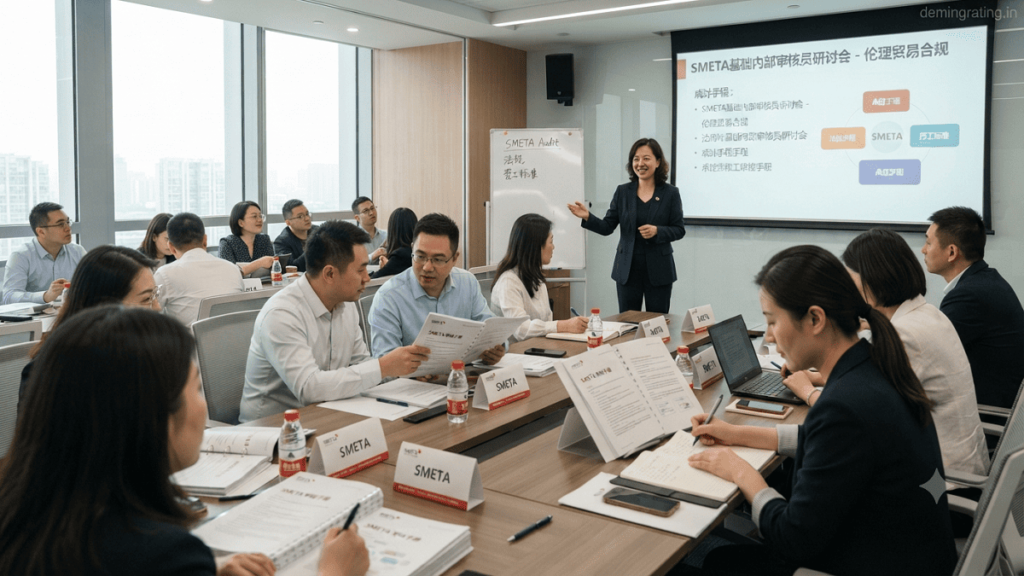
The SMETA Basic Internal Auditor Workshop was delivered in Chinese over several days using classroom instruction, practical exercises, and case-based discussions.
The training covered:
- Introduction to SMETA and Sedex
- Labor standards and worker rights
- Workplace health and safety
- Environmental management principles
- Business integrity requirements
- Internal audit planning
- Site inspection techniques
- Employee interview methods
- Documentation review
- Audit reporting
- Corrective and preventive action management
Participants also completed simulated audit exercises to apply their knowledge in realistic workplace scenarios.
5. Knowledge Applied After Training
Following the workshop, trained auditors conducted internal SMETA assessments at each manufacturing facility.
Internal Audit Improvements
The organization introduced:
- Standardized audit checklists
- Uniform audit reporting templates
- Scheduled internal audit programs
- Centralized documentation management
- Regular follow-up on corrective actions
This created a more consistent and structured audit process across all sites.
Labor Standards Improvements
Internal audits identified opportunities to improve:
- Working hour monitoring
- Payroll verification
- Employment record management
- Employee grievance procedures
Corrective actions were implemented before external customer audits.
Health and Safety Improvements
The audit team strengthened:
- Workplace risk assessments
- Emergency evacuation procedures
- Safety training programs
- PPE compliance monitoring
- Incident reporting processes
As a result, safety awareness increased across production facilities.
Documentation Management
The company established standardized procedures for maintaining:
- Employment contracts
- Attendance records
- Payroll documentation
- Safety inspection reports
- Training records
- Environmental monitoring records
This improved the availability and accuracy of audit evidence.
6. Results Achieved
Within several months of implementing the training program, the organization reported measurable improvements.
| Area | Before Training | After Training |
|---|---|---|
| Internal Audit Consistency | Different methods across sites | Standardized audit approach |
| Auditor Competence | Limited SMETA knowledge | Improved understanding of SMETA requirements |
| Documentation | Inconsistent records | Organized and standardized documentation |
| Corrective Actions | Delayed implementation | Timely follow-up and verification |
| Employee Awareness | Limited understanding | Increased awareness through auditor engagement |
| Audit Readiness | Reactive preparation | Continuous audit readiness |
7. Business Benefits
The Chinese-language workshop provided several organizational benefits.
Improved Communication
Training in Chinese enabled participants to understand technical audit concepts more clearly and communicate effectively with employees during audits.
Stronger Compliance Culture
Managers and employees became more familiar with:
- Ethical trade requirements
- Workplace responsibilities
- Continuous improvement practices
Conclusion
This case study demonstrates how a SMETA Basic Internal Auditor Workshop (Chinese) can strengthen an organization’s internal audit capability and improve ethical trade compliance. By providing training in participants’ native language, the company enhanced understanding of SMETA requirements, standardized audit practices, and improved communication across its manufacturing operations.
White Paper on SMETA Basic Internal Auditor Workshop (Chinese)
Executive Summary
As global supply chains become more complex, organizations are expected to demonstrate responsible business practices that protect workers, promote workplace safety, support environmental sustainability, and maintain ethical business conduct. International customers and retailers increasingly require suppliers to comply with recognized ethical trade standards.
The SMETA Basic Internal Auditor Workshop (Chinese) is a professional training program designed to help Chinese-speaking professionals develop the knowledge and practical auditing skills required to conduct effective internal SMETA (Sedex Members Ethical Trade Audit) assessments. By delivering training in Chinese, organizations can improve understanding of audit requirements, strengthen internal compliance programs, and build consistent audit capabilities across manufacturing facilities and supplier networks.
Official references:
1. Introduction
The SMETA Basic Internal Auditor Workshop provides participants with a structured understanding of the SMETA audit methodology and equips them with practical skills for planning, conducting, and reporting internal audits.
The workshop focuses on helping organizations evaluate compliance with:
- Labor standards
- Workplace health and safety
- Environmental management (SMETA 4-Pillar)
- Business integrity (SMETA 4-Pillar)
When delivered in Chinese, the workshop enables native Chinese-speaking participants to fully understand technical concepts and apply them consistently within their organizations.
2. Importance of Internal Auditor Training
Internal auditors play a critical role in maintaining ethical trade compliance. They help organizations identify risks, verify the implementation of policies, and recommend corrective actions before external assessments.
Effective internal auditors support organizations by:
- Identifying compliance gaps
- Monitoring management systems
- Evaluating workplace practices
- Reviewing documentation
- Supporting continuous improvement
- Preparing organizations for third-party audits
Without trained internal auditors, organizations may struggle to maintain consistent compliance across multiple facilities and suppliers.
3. Objectives of the Workshop
The SMETA Basic Internal Auditor Workshop (Chinese) aims to:
- Build internal auditing competence
- Improve understanding of SMETA requirements
- Standardize audit practices
- Enhance documentation review skills
- Strengthen audit reporting capabilities
- Improve corrective action management
- Support ethical sourcing and responsible supply chain management
4. Core Topics Covered
The workshop covers a comprehensive range of topics that prepare participants to perform effective internal SMETA audits.
Introduction to SMETA
Participants learn:
- Overview of Sedex
- Purpose of SMETA
- Ethical trade principles
- Responsible sourcing expectations
SMETA Audit Methodology
Topics include:
- Audit planning
- Audit scope
- Audit stages
- Evidence collection
- Audit ethics
- Auditor responsibilities
Labor Standards
Training covers:
- Employment conditions
- Working hours
- Wages and benefits
- Child labor prevention
- Forced labor prevention
- Freedom of association
- Non-discrimination
Health and Safety
Participants learn to assess:
- Workplace hazards
- Emergency preparedness
- Fire safety
- Risk assessments
- PPE usage
- Incident reporting
Environmental Management
For organizations implementing the SMETA 4-Pillar framework, the workshop includes:
- Waste management
- Resource conservation
- Pollution prevention
- Environmental compliance
Business Integrity
Participants learn about:
- Anti-bribery measures
- Ethical business conduct
- Whistleblowing mechanisms
- Governance and transparency
Audit Techniques
The workshop provides practical guidance on:
- Site inspections
- Employee interviews
- Observation techniques
- Document verification
- Objective evidence collection
Corrective Action Management
Participants learn how to:
- Identify non-conformities
- Perform root cause analysis
- Develop corrective actions
- Verify implementation
- Monitor continuous improvement
5. Benefits of Chinese-Language Training
Delivering the workshop in Chinese offers several advantages.
Improved Understanding
Participants can understand technical terminology and audit concepts more effectively in their native language.
Better Communication
Chinese-language instruction improves communication between trainers, auditors, supervisors, and employees during practical exercises and workplace audits.
Consistent Audit Practices
Training in a common language helps organizations standardize internal audit procedures across multiple facilities.
Greater Employee Engagement
Participants are more likely to ask questions, participate in discussions, and apply their learning when training is delivered in their preferred language.
Conclusion
The SMETA Basic Internal Auditor Workshop (Chinese) provides organizations with an effective way to develop competent internal auditors while overcoming language barriers. By combining internationally recognized SMETA audit methodology with localized instruction, the workshop improves understanding, strengthens compliance programs, and supports consistent ethical trade practices.
Organizations that invest in Chinese-language SMETA auditor training are better positioned to identify compliance risks, improve audit readiness, strengthen supplier oversight, and foster a culture of continuous improvement. As responsible sourcing becomes an increasingly important business requirement, well-trained internal auditors will remain essential to maintaining ethical, transparent, and sustainable supply chains.
References
- Sedex – SMETA Audit Methodology
Sedex SMETA Audit Methodology - Sedex Official Website
Sedex Official Website - Ethical Trading Initiative – ETI Base Code
Ethical Trading Initiative Base Code
Industry Application of SMETA Basic Internal Auditor Workshop (Chinese)
Executive Summary
The SMETA Basic Internal Auditor Workshop (Chinese) is designed to help Chinese-speaking professionals develop the knowledge and practical skills required to conduct internal SMETA (Sedex Members Ethical Trade Audit) assessments. The workshop enables organizations to strengthen ethical trade compliance, improve internal auditing capabilities, and support responsible sourcing across global supply chains.
Industries that operate manufacturing facilities or supplier networks in China frequently use Chinese-language SMETA auditor training to ensure consistent understanding of audit requirements, improve communication, and maintain compliance with customer expectations.
Official references:
1. Apparel and Textile Industry
Industry Overview
The apparel and textile sector relies on extensive supplier networks and labor-intensive manufacturing processes. Global brands often require suppliers to demonstrate compliance with ethical trade standards.
Application of the Workshop
Chinese-language SMETA auditor training helps organizations:
- Conduct internal labor compliance audits
- Verify working hours and wage records
- Assess workplace health and safety
- Review supplier ethical practices
- Prepare for customer and third-party SMETA audits
Business Benefits
- Improved factory audit readiness
- Enhanced worker welfare
- Stronger customer confidence
- Better compliance with responsible sourcing requirements
2. Consumer Goods Manufacturing
Industry Overview
Manufacturers of consumer products often supply international retailers that require ethical sourcing and social compliance.
Application of the Workshop
Participants learn to:
- Perform standardized internal audits
- Review compliance documentation
- Monitor corrective actions
- Improve factory management systems
Business Benefits
- Consistent audit processes
- Reduced compliance risks
- Improved operational efficiency
- Enhanced supplier transparency
3. Electronics Industry
Industry Overview
Electronics manufacturers operate complex supply chains involving numerous component suppliers and production facilities.
Application of the Workshop
Internal auditors use the training to evaluate:
- Labor standards
- Workplace safety
- Environmental management
- Supplier compliance
- Documentation accuracy
Business Benefits
- Better supplier oversight
- Improved ethical sourcing
- Stronger audit preparedness
- Increased customer trust
4. Food and Beverage Industry
Industry Overview
Food producers must balance product quality with ethical employment and safe working conditions.
Application of the Workshop
Chinese-speaking auditors assess:
- Worker welfare
- Health and safety practices
- Environmental management
- Internal documentation
- Corrective action implementation
Business Benefits
- Stronger compliance culture
- Improved workplace safety
- Better support for sustainable sourcing programs
5. Automotive Industry
Industry Overview
Automotive manufacturers depend on large supplier networks that must meet customer compliance expectations.
Application of the Workshop
The training supports:
- Supplier audits
- Internal factory assessments
- Workplace inspections
- Documentation reviews
- Continuous improvement programs
Business Benefits
- Reduced supply chain risks
- Improved supplier performance
- Enhanced compliance consistency
6. Pharmaceutical and Healthcare Industry
Industry Overview
Pharmaceutical manufacturers must maintain strict operational controls while ensuring ethical employment practices.
Application of the Workshop
Auditors evaluate:
- Employee working conditions
- Safety procedures
- Environmental controls
- Business ethics practices
- Internal audit documentation
Business Benefits
- Improved governance
- Better workplace compliance
- Enhanced stakeholder confidence
7. Packaging Industry
Industry Overview
Packaging companies support industries such as food, retail, pharmaceuticals, and consumer goods.
Application of the Workshop
Internal auditors review:
- Labor compliance
- Factory safety
- Environmental practices
- Ethical business procedures
Business Benefits
- Improved customer compliance
- Better audit performance
- Increased operational transparency
Conclusion
The SMETA Basic Internal Auditor Workshop (Chinese) provides significant value across industries by equipping Chinese-speaking professionals with the skills required to conduct effective internal SMETA audits. Whether applied in apparel, manufacturing, electronics, food production, automotive, pharmaceuticals, packaging, retail, or logistics, the workshop helps organizations strengthen ethical trade compliance, improve audit consistency, and support responsible sourcing initiatives.
By investing in localized SMETA auditor training, organizations can build stronger internal audit teams, enhance supplier oversight, improve operational transparency, and maintain compliance with internationally recognized ethical trade standards. This contributes to more resilient, sustainable, and responsible supply chains in an increasingly global business environment.
Ask FAQs
What is the SMETA Basic Internal Auditor Workshop (Chinese)?
The SMETA Basic Internal Auditor Workshop (Chinese) is a professional training program designed for Chinese-speaking professionals who want to develop the skills to conduct internal SMETA (Sedex Members Ethical Trade Audit) assessments. The workshop covers SMETA audit methodology, audit planning, labor standards, health and safety, environmental management, business ethics, evidence collection, audit reporting, and corrective action management.
Who should attend the SMETA Basic Internal Auditor Workshop (Chinese)?
The workshop is suitable for professionals responsible for compliance and internal auditing, including:
Internal Auditors
Compliance Managers
Human Resources Professionals
Quality Assurance Personnel
Health, Safety, and Environment (HSE) Teams
Sustainability and ESG Professionals
Factory Managers
Procurement and Supply Chain Professionals
Supplier Compliance Teams
It is particularly beneficial for organizations with Chinese-speaking employees or manufacturing facilities.
Is prior auditing experience required to attend the workshop?
No. The SMETA Basic Internal Auditor Workshop (Chinese) is intended for both beginners and professionals who want to strengthen their understanding of SMETA requirements. While prior knowledge of compliance or auditing can be helpful, the workshop starts with the fundamentals and gradually introduces practical internal auditing techniques.
What topics are covered in the workshop?
The workshop typically includes:
Introduction to SMETA and Sedex
SMETA 2-Pillar and 4-Pillar requirements
Labor standards
Workplace health and safety
Environmental management
Business integrity
Internal audit planning
Audit interviewing techniques
Documentation review
Non-conformity reporting
Corrective and preventive actions
Internal audit reporting
These topics help participants conduct effective internal SMETA audits.
What are the benefits of attending the SMETA Basic Internal Auditor Workshop (Chinese)?
Participants and organizations can benefit by:
Developing practical internal auditing skills
Improving understanding of SMETA requirements
Strengthening ethical trade compliance
Enhancing audit readiness for external assessments
Improving documentation and corrective action management
Supporting responsible sourcing and sustainable supply chain practices
Building stronger internal compliance and continuous improvement programs
Table of Contents
Disclaimer:
This content is provided for general informational and educational purposes only. It does not constitute official SMETA, Sedex, legal, or professional training advice. Course content, language availability, and certification may vary by training provider. Always refer to the official Sedex guidance or consult an authorized training provider for the most current information.